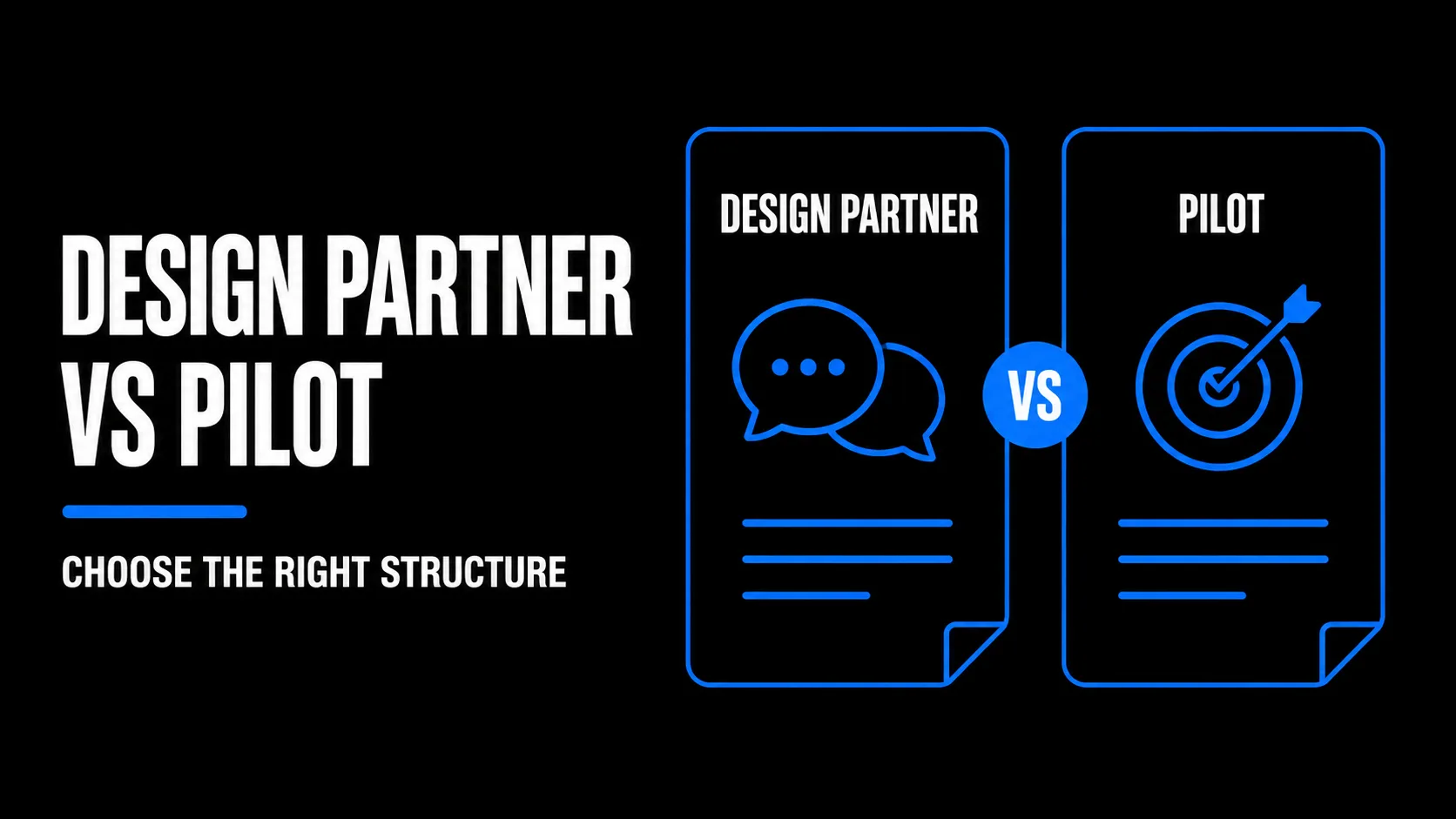
Design Partner Agreement vs Pilot Agreement: Which One Fits?
last updated: May 15, 2026
A design partner agreement and a pilot agreement both help an early-stage founder work with real customers before a full commercial rollout. They are not interchangeable. A design partner structure usually fits when you still need deep product learning; a pilot structure usually fits when the customer is testing whether the product can create a business outcome worth paying for.
TL;DR: Use the structure that matches the commitment
Choose a design partner agreement when learning quality matters more than immediate revenue. Choose a pilot agreement when the buyer expects a defined scope, success criteria, timeline, and commercial decision.
Note: Read this as a decision guide, not legal advice.
- Use a design partner agreement when the product is still being shaped and the customer is contributing feedback, workflow access, and domain expertise.
- Use a pilot agreement when the product is usable enough to test against a specific business case, often with paid access or a clear path to purchase.
- Avoid calling something a pilot if there is no success metric, buyer owner, timeline, or next-step commercial decision.
Note: Read this as a decision guide, not legal advice.
Core Definitions
- Design partner agreement. An early-customer agreement that sets expectations for product access, feedback, confidentiality, ownership, and collaboration while the product is still being shaped. For a deeper single-agreement breakdown, see the design partner agreement guide.
- Design partner program. The operating system around multiple design partners, including who you recruit, what feedback you collect, and how you translate learning into product decisions. See the design partner program guide before you scale this motion.
- Pilot agreement. A time-bound customer agreement that gives a prospect access to the product so both sides can test whether it solves a defined business problem well enough to justify purchase.
- Beta customer. A user or account trying an early product, often with less commercial structure than a pilot or design partner relationship. If that is closer to your situation, compare this with the beta customers guide.
- Success criteria. The measurable or observable conditions that determine whether the pilot or partnership worked. These should be agreed before the engagement starts.
Decision table: design partner agreement vs pilot agreement
Use this decision table before you send an agreement, proposal, or kickoff email.
Use this four-step decision sequence
- Name the primary objective in one sentence. If the sentence starts with "We need to learn whether...", lean design partner. If it starts with "We need to prove this can...", lean pilot.
- Identify the customer contribution. A design partner contributes context, feedback, workflow access, and judgment. A pilot customer contributes usage, evaluation, internal stakeholder feedback, and a buy/no-buy decision.
- Define the end state before kickoff. For a design partner, the end state might be a validated workflow, clear must-have requirements, or a narrowed ICP. For a pilot, the end state should be a commercial decision, expansion path, or explicit reason not to proceed.
- Check whether the agreement name matches the buyer's expectation. A confusing label creates avoidable tension. A customer who thinks they are co-designing may resent being pushed for a purchase too early. A customer who thinks they are running a pilot may lose confidence if the product still needs discovery-level handholding.
A practical mini-rubric
Source-backed caution
Usability and discovery methods can generate useful signal with small samples, but they do not prove market demand by themselves. Nielsen Norman Group's usability testing heuristic argues that testing with five users can reveal many usability issues, but that is a product usability heuristic, not a replacement for buyer validation (Nielsen Norman Group).
Steve Blank's customer development archive is useful background for the customer-development idea that founders should test assumptions with customers, but the archive should not be treated as a direct source for purchase commitment or conversion claims (Steve Blank). For AI or data-heavy pilots, NIST's AI Risk Management Framework is a useful reminder that risk, measurement, governance, and context should be explicit rather than assumed (NIST AI RMF).
Hypothetical example: if a founder has six early accounts, four need roadmap-level workflow discovery and two are asking for a defined business outcome, the clean split is not "six pilots." It is four design partners and two pilots, with different kickoff docs, feedback expectations, and success criteria.
Steve Blank's customer development archive is useful background for the customer-development idea that founders should test assumptions with customers, but the archive should not be treated as a direct source for purchase commitment or conversion claims (Steve Blank). For AI or data-heavy pilots, NIST's AI Risk Management Framework is a useful reminder that risk, measurement, governance, and context should be explicit rather than assumed (NIST AI RMF).
Hypothetical example: if a founder has six early accounts, four need roadmap-level workflow discovery and two are asking for a defined business outcome, the clean split is not "six pilots." It is four design partners and two pilots, with different kickoff docs, feedback expectations, and success criteria.
Will design partner agreement vs pilot agreement actually get you to first customers?
The right agreement can help you get closer to first customers, but it cannot replace the actual customer development work. A design partner agreement helps you learn faster from serious early users. A pilot agreement helps you test whether a buyer will attach value, budget, and urgency to the product.
The founder trap is treating early customer learning and early revenue as the same thing. They are related, but they answer different questions. Learning asks, "Are we building the right thing for the right workflow?" Revenue asks, "Will this buyer commit resources because the problem is painful enough?"
Use the agreement type to prevent confused expectations. If you need collaboration, call it a design partner relationship and ask for real feedback. If you need a commercial test, call it a pilot and define the success criteria, timeline, owner, and next decision before anyone starts.
This is why I built Traction OS. Fix your foundation before you launch.
The founder trap is treating early customer learning and early revenue as the same thing. They are related, but they answer different questions. Learning asks, "Are we building the right thing for the right workflow?" Revenue asks, "Will this buyer commit resources because the problem is painful enough?"
Use the agreement type to prevent confused expectations. If you need collaboration, call it a design partner relationship and ask for real feedback. If you need a commercial test, call it a pilot and define the success criteria, timeline, owner, and next decision before anyone starts.
This is why I built Traction OS. Fix your foundation before you launch.
FAQ
- You:Can a design partner agreement be paid?Guide:Yes, but payment should not confuse the relationship. If the customer is paying mainly for early access while helping shape the product, it can still be a design partner relationship. If they are paying to evaluate a defined outcome with a purchase decision at the end, it is closer to a pilot.
- You:Is a free pilot just a design partner agreement?Guide:Not necessarily. Free versus paid is only one dimension. A free pilot can still have a clear scope, success criteria, timeline, and conversion decision. A design partner relationship is defined more by collaboration and product learning than by price.
- You:When should I switch from design partners to pilots?Guide:Switch when the main risk moves from "what should we build and for whom?" to "can this product create enough value for a buyer to adopt and pay?" At that point, success criteria and commercial next steps matter more than open-ended feedback.
- You:Should I use the same document for both?Guide:Usually no. You can reuse some clauses, such as confidentiality, access limits, data handling, and ownership language, but the operating terms should differ. A design partner agreement should emphasize collaboration and feedback; a pilot agreement should emphasize scope, success criteria, timeline, and commercial decision process.
Find where your first 100 customers are in 2 mins. — or browse all the free founder guides.
No-BS guides