Design Partner Recruitment Email Founders Can Send
last updated: May 16, 2026
A design partner recruitment email is not a sales pitch pretending the product is finished. It is a clear ask for a qualified operator to spend time with you, react to the problem, test early workflows, and help you learn whether there may be a real commercial path. Use this when your broader design partner recruitment motion is ready, but your first message still sounds vague, needy, or too much like a generic beta invite.
TL;DR: Ask for learning commitment, not applause
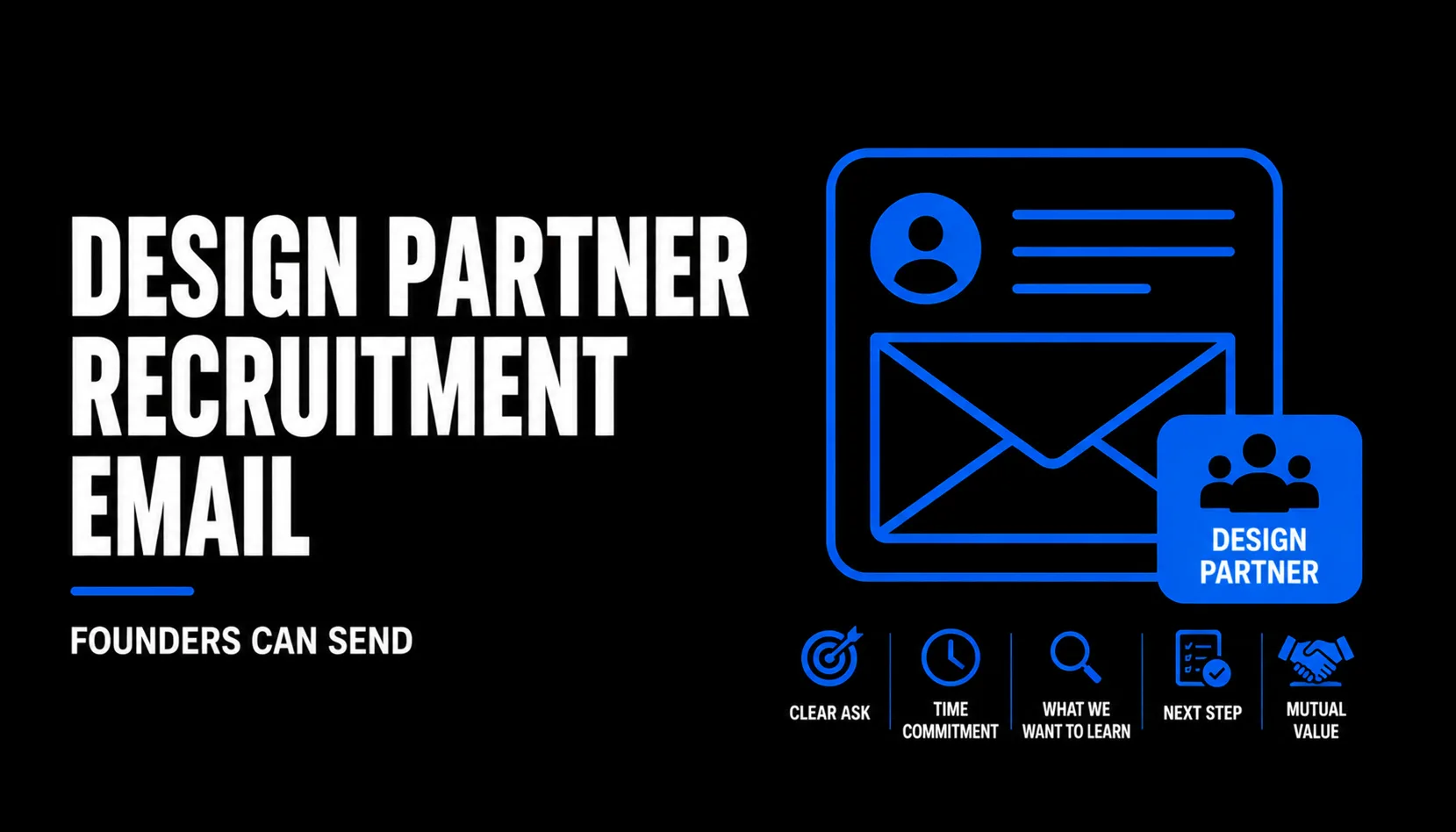
A strong design partner outreach email names the pain, explains why you are reaching out now, defines the expected time commitment, states what you want to learn, and asks for one concrete next step.
Use this as a swipe file for first-touch emails and follow-up logic, then adapt the details to your market, product maturity, and qualification criteria.
- Make the ask specific enough that a busy buyer can say yes, no, or not now.
- Separate discovery from proof: you are recruiting insight and usage, not claiming a proven outcome.
- Avoid sending a full pitch deck when a short, relevant email would start a better founder-led conversation.
Use this as a swipe file for first-touch emails and follow-up logic, then adapt the details to your market, product maturity, and qualification criteria.
Core Definitions
- Design partner. A target customer or domain expert who gives structured feedback, tests early workflows, and may become an early commercial customer if the product solves a real problem.
- Design partner recruitment email. The first outreach message used to invite a qualified person into a design partner conversation.
- Learning commitment. A specific agreement to spend time helping you understand the workflow, pain, buying context, and product fit.
- Commercial commitment. A stronger agreement that may include payment, pilot scope, procurement steps, or contract terms. Handle that separately from the first email, especially when you later need a design partner agreement.
- Follow-up logic. The sequence of short reminders and pivots you send after the first message so you do not confuse persistence with pressure.
The email structure
Start with one modular email structure, then choose the variant that matches your relationship to the prospect.
Base structure
Subject: Quick question about [pain / workflow]
Hi [first name],
I am building around [specific pain / workflow], especially for [role / company type] dealing with [concrete situation].
The reason I am reaching out now: we are looking for a small number of design partners who can help us pressure-test whether the workflow is painful enough, frequent enough, and specific enough to solve well.
This is not a polished sales pitch. The ask would be [expected time commitment], focused on [learning goal]. In return, you would get early access to what we are building and a direct line into the product decisions.
Would you be open to a [next step], such as [15-30 minute conversation / async workflow review / short product walkthrough] next week?
Best,
[your name]
Why this works: it says what you are studying, why the recipient is relevant, how much time you are asking for, and what happens next. That matters because customer development is usually stronger when founders test assumptions directly with the market, a core idea behind the lean startup approach described in Harvard Business Review's overview of validated learning and rapid experimentation.
The broader research habit matters too. The U.S. Small Business Administration's market research guide frames customer and competitive research as part of understanding demand, economic indicators, location, market saturation, and pricing before making business decisions.
Hi [first name],
I am building around [specific pain / workflow], especially for [role / company type] dealing with [concrete situation].
The reason I am reaching out now: we are looking for a small number of design partners who can help us pressure-test whether the workflow is painful enough, frequent enough, and specific enough to solve well.
This is not a polished sales pitch. The ask would be [expected time commitment], focused on [learning goal]. In return, you would get early access to what we are building and a direct line into the product decisions.
Would you be open to a [next step], such as [15-30 minute conversation / async workflow review / short product walkthrough] next week?
Best,
[your name]
Why this works: it says what you are studying, why the recipient is relevant, how much time you are asking for, and what happens next. That matters because customer development is usually stronger when founders test assumptions directly with the market, a core idea behind the lean startup approach described in Harvard Business Review's overview of validated learning and rapid experimentation.
The broader research habit matters too. The U.S. Small Business Administration's market research guide frames customer and competitive research as part of understanding demand, economic indicators, location, market saturation, and pricing before making business decisions.
Variant 1: Warm intro
Subject: Re: intro from [mutual connection]
Hi [first name],
[Mutual connection] suggested I speak with you because you have seen [specific pain / workflow] up close at [company / team type].
I am working on [one-line product area], and we are recruiting a few design partners to help us understand where this workflow breaks, what teams already do manually, and what would make a first version useful enough to keep using.
The commitment would be [expected time commitment], likely [cadence], centered on [learning goal]. We are early, so I am not asking you to validate a finished product. I am asking whether you would be willing to help us test the problem and shape the first useful version.
Open to a [next step] on [two specific windows]?
Best,
[your name]
Hi [first name],
[Mutual connection] suggested I speak with you because you have seen [specific pain / workflow] up close at [company / team type].
I am working on [one-line product area], and we are recruiting a few design partners to help us understand where this workflow breaks, what teams already do manually, and what would make a first version useful enough to keep using.
The commitment would be [expected time commitment], likely [cadence], centered on [learning goal]. We are early, so I am not asking you to validate a finished product. I am asking whether you would be willing to help us test the problem and shape the first useful version.
Open to a [next step] on [two specific windows]?
Best,
[your name]
Variant 2: Cold outbound
Subject: Question about [specific workflow] at [company]
Hi [first name],
I noticed [relevant trigger / role-based observation], and I had a question about how your team handles [specific workflow].
We are building for [role / team type] that struggle with [pain], and we are looking for design partners who can help us understand the workflow before we overbuild the product.
The ask is small: [expected time commitment]. The learning goal is to understand [specific assumption], then show you an early workflow if the problem is real on your side.
Would it be unreasonable to ask for [next step] next week?
Best,
[your name]
Cold email note: if your message is commercial, keep it honest, relevant, and easy to decline. Confirm current legal and platform requirements before sending at scale. For more tactical sequencing, pair this message with a focused cold email approach for B2B startups rather than blasting a generic list.
Hi [first name],
I noticed [relevant trigger / role-based observation], and I had a question about how your team handles [specific workflow].
We are building for [role / team type] that struggle with [pain], and we are looking for design partners who can help us understand the workflow before we overbuild the product.
The ask is small: [expected time commitment]. The learning goal is to understand [specific assumption], then show you an early workflow if the problem is real on your side.
Would it be unreasonable to ask for [next step] next week?
Best,
[your name]
Cold email note: if your message is commercial, keep it honest, relevant, and easy to decline. Confirm current legal and platform requirements before sending at scale. For more tactical sequencing, pair this message with a focused cold email approach for B2B startups rather than blasting a generic list.
Variant 3: Existing beta user
Subject: Help shape the next version of [product / workflow]
Hi [first name],
You have been using [product / beta / prototype], and I wanted to ask whether you would be open to a more structured design partner conversation.
We are trying to learn [learning goal], especially around [pain / workflow / adoption moment]. The commitment would be [expected time commitment], and the goal would be to understand what would make this useful enough for your real operating rhythm, not just interesting as a beta.
If it is worth exploring, could we do [next step] on [two specific windows]?
Best,
[your name]
Hi [first name],
You have been using [product / beta / prototype], and I wanted to ask whether you would be open to a more structured design partner conversation.
We are trying to learn [learning goal], especially around [pain / workflow / adoption moment]. The commitment would be [expected time commitment], and the goal would be to understand what would make this useful enough for your real operating rhythm, not just interesting as a beta.
If it is worth exploring, could we do [next step] on [two specific windows]?
Best,
[your name]
Follow-up logic
Follow-up 1: Restate the specific pain and make the next step easier
Subject: Re: [pain / workflow]
Hi [first name],
Wanted to bump this once. The specific thing I am trying to learn is whether [pain / workflow] is a real priority for [role / team type], or just something that sounds annoying from the outside.
If a call is too much, would you be open to replying with how your team handles [workflow] today?
Best,
[your name]
Follow-up 2: Add context, not pressure
Subject: Re: [pain / workflow]
Hi [first name],
One extra bit of context: we are not looking for broad product feedback. We are trying to understand [specific assumption], because that decision affects what we build first.
Worth a short conversation, or is this not a priority for your team right now?
Best,
[your name]
Breakup: Leave the door open and ask for routing
Subject: Should I ask someone else?
Hi [first name],
I will close the loop here. If [pain / workflow] is not something you own, is there someone closer to it who would be better to ask?
Either way, thanks for considering it.
Best,
[your name]
Subject: Re: [pain / workflow]
Hi [first name],
Wanted to bump this once. The specific thing I am trying to learn is whether [pain / workflow] is a real priority for [role / team type], or just something that sounds annoying from the outside.
If a call is too much, would you be open to replying with how your team handles [workflow] today?
Best,
[your name]
Follow-up 2: Add context, not pressure
Subject: Re: [pain / workflow]
Hi [first name],
One extra bit of context: we are not looking for broad product feedback. We are trying to understand [specific assumption], because that decision affects what we build first.
Worth a short conversation, or is this not a priority for your team right now?
Best,
[your name]
Breakup: Leave the door open and ask for routing
Subject: Should I ask someone else?
Hi [first name],
I will close the loop here. If [pain / workflow] is not something you own, is there someone closer to it who would be better to ask?
Either way, thanks for considering it.
Best,
[your name]
Decision rules
- Use the warm intro version when trust is borrowed from a mutual connection.
- Use the cold outbound version when relevance has to be proven in the first two lines.
- Use the beta user version when the recipient has already shown behavior, not just interest.
- Use customer discovery questions after someone replies yes; do not cram every discovery question into the first email.
- Use a founder sales email guide when the conversation shifts from learning to a real buying conversation.
- Build the surrounding design partner program before you imply ongoing access, influence, support, or commercial terms.
Common mistakes
- Saying "we would love your feedback" without naming the specific workflow you want to learn about.
- Asking for too much time before the prospect understands why the conversation is relevant.
- Pitching the product as proven when you are still recruiting evidence.
- Calling every interested person a design partner before you define fit, cadence, and expectations.
- Treating a positive reply as a sale instead of the start of structured qualification.
Illustrative math only: if you contact 40 tightly matched prospects, 8 reply, 5 take a first call, and 2 agree to a structured design partner cadence, your reply rate is 20%, your call rate is 12.5%, and your design partner conversion from outreach is 5%. Those numbers are not benchmarks. They are a simple way to track whether your message, targeting, or ask may need to change.
Will a design partner recruitment email get you to first customers?
A design partner recruitment email can get you into the right conversations, but it will not create urgency by itself. The email tends to work best when the pain is specific, the recipient is qualified, and the next step feels like a useful exchange instead of free consulting.
The founder trap is trying to sound more proven than you are. Early design partner outreach should be honest about the product's stage while still being precise about the business problem you are testing. That balance makes the ask credible: you are not begging for feedback, and you are not pretending the market has already validated the product.
This tactic breaks down when founders stop at interest. A good reply should lead into discovery, usage, qualification, and eventually a clear commercial path. Treat the email as the opening move, then use the conversation to learn whether this person can become a serious design partner, a future customer, or simply a useful data point.
This is why I built Traction OS. Fix your foundation before you launch.
The founder trap is trying to sound more proven than you are. Early design partner outreach should be honest about the product's stage while still being precise about the business problem you are testing. That balance makes the ask credible: you are not begging for feedback, and you are not pretending the market has already validated the product.
This tactic breaks down when founders stop at interest. A good reply should lead into discovery, usage, qualification, and eventually a clear commercial path. Treat the email as the opening move, then use the conversation to learn whether this person can become a serious design partner, a future customer, or simply a useful data point.
This is why I built Traction OS. Fix your foundation before you launch.
FAQ
- You:Should a design partner recruitment email mention pricing?Guide:Usually not in the first message unless payment is already part of the design partner ask. The first email should earn the conversation. Pricing, pilot scope, and commercial terms belong after you understand the problem, buyer, urgency, and fit.
- You:How long should the email be?Guide:Short enough to scan in under a minute. Aim for a few tight paragraphs: relevance, why now, time commitment, learning goal, and next step. If you need six paragraphs to explain the ask, the offer may not be clear enough yet.
- You:Is this different from a beta invite?Guide:Yes. A beta invite often asks someone to try a product. A design partner recruitment email asks someone to help shape the product around a real workflow, with a clearer expectation of time, feedback, and learning.
- You:How many follow-ups should I send?Guide:A practical sequence is the first email, one reminder that lowers the effort to respond, one context-based follow-up, and a short close-the-loop message. Treat that as workflow discipline, not a universal benchmark.
- You:What should I do when someone says yes?Guide:Confirm the next step, ask a small number of focused discovery questions, and define what happens after the conversation. If the person is a strong fit, move toward a structured design partner cadence instead of leaving the relationship as casual feedback.
Find where your first 100 customers are in 2 mins. — or browse all the free founder guides.
No-BS guides