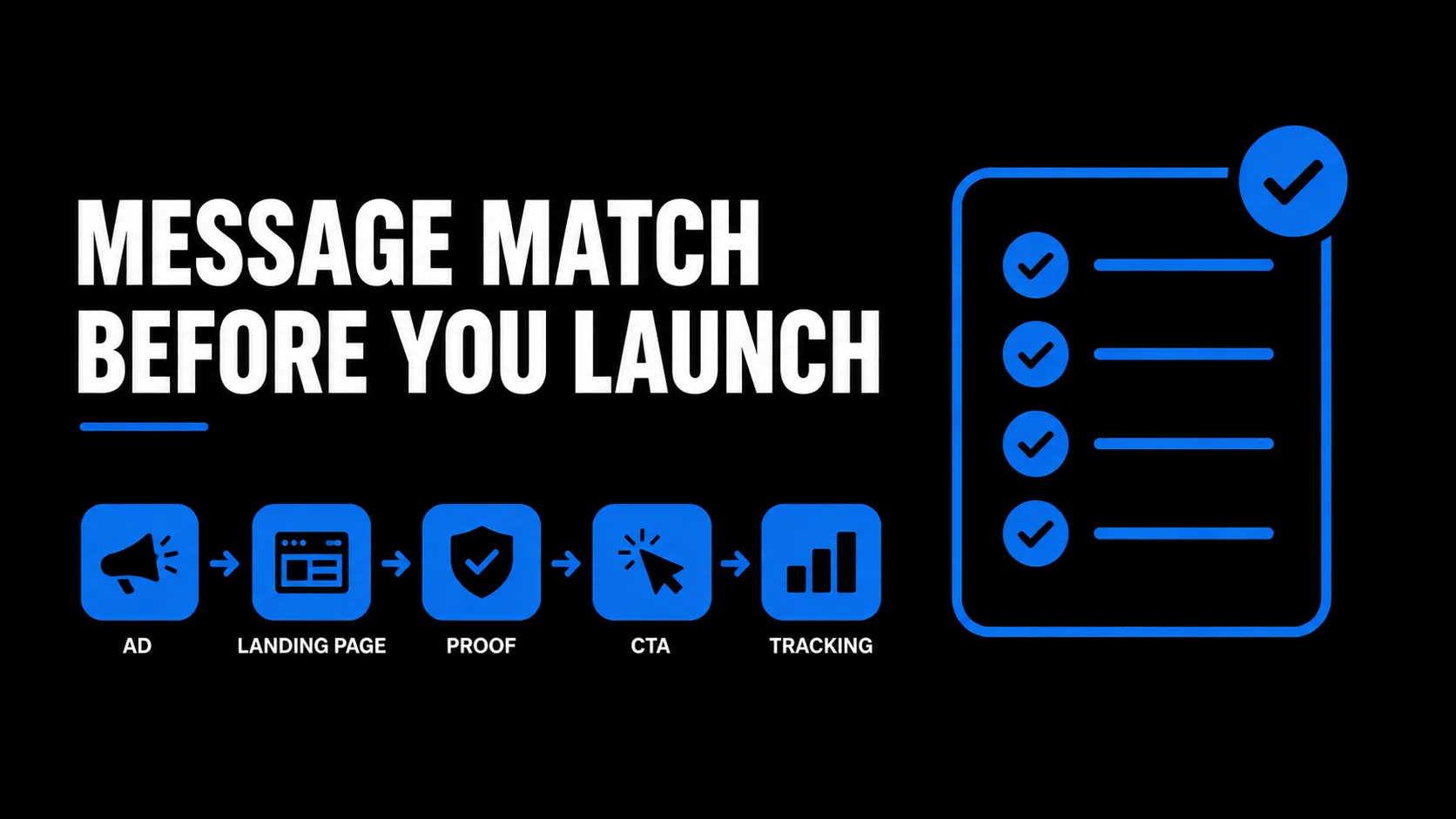
Ad to Landing Page Message Match Questions Before You Launch
last updated: May 7, 2026
Message match means the ad, landing page, proof, CTA, and tracking all describe the same customer problem in the same language. Before you spend on LinkedIn, Google Search, or another paid channel, use these ad to landing page message match questions to catch mismatches that can make qualified buyers bounce. This is not a copywriting polish pass; it is a launch-readiness check for founders who cannot afford avoidable paid learning.
TL;DR: Check the promise before the spend
Run this question set before a paid campaign goes live. The mistake to avoid is treating the ad and landing page as separate assets instead of one conversion path.
Use this as a pre-launch QA script, not a full campaign strategy.
- Your ad should name the same audience, pain, promise, and next step as the landing page.
- Your landing page should prove the ad promise quickly enough that a cold visitor does not need to infer the connection.
- Your tracking should tell you which promise, audience, and CTA produced meaningful conversions, not just clicks.
Use this as a pre-launch QA script, not a full campaign strategy.
Core Definitions
- Message match. The visible continuity between what the ad promises and what the landing page immediately confirms.
- Landing page experience. The relevance, usefulness, transparency, and ease of navigation a visitor gets after clicking an ad. Google describes Quality Score for Search campaigns as a diagnostic estimate that includes expected clickthrough rate, ad relevance, and landing page experience (Google Ads Help).
- Conversion expectation. The action a visitor reasonably expects to take after reading the ad, such as booking a demo, starting a trial, reading a guide, or requesting pricing.
- Proof. Evidence that makes the ad promise believable, such as specific product capabilities, customer quotes, screenshots, workflow examples, or quantified outcomes when properly sourced.
- Pre-spend decision check. A review done before budget goes live to decide whether the campaign is ready, needs revision, or should be paused.
The question bank
Use this question bank during the final review of your ad, landing page, and tracking setup. For a broader strategy pass, pair it with the ad to landing page message match framework. For a page-level review, use it alongside the ad landing page message match guide and the landing page teardown checklist.
1. Audience match questions
Founder decision rule: If you cannot name the audience in one sentence, hold the launch. Paid traffic can amplify ambiguity.
2. Promise match questions
For paid search, this is especially important because the visitor has already expressed intent. The Google Search ads for startups guide should connect the query, ad group, ad copy, and landing page around one job. Google recommends using Quality Score diagnostics to identify whether landing page experience or relevance may need improvement (Google Ads Quality Score guidance).
3. Proof match questions
Use proof to reduce inference. Nielsen Norman Group's usability heuristic on recognition over recall is useful here: interfaces should reduce the amount users must remember or infer (NN/g usability heuristics). In ad-to-page matching, the visitor should not have to remember the ad copy to understand why the page is relevant.
4. CTA expectation questions
A paid-ads landing page should usually be narrower than a homepage. The job is not to explain the whole company. The job is to continue the ad's argument and make the next step obvious.
5. Objection handling questions
For LinkedIn, many visitors are not actively searching at the moment they see the ad. The LinkedIn ads for founders guide should therefore connect audience targeting, problem framing, and landing page education more tightly than a high-intent search campaign.
6. Conversion tracking questions
Google's conversion measurement documentation describes conversions as actions valuable to your business after an ad interaction, such as purchases, signups, or calls (Google Ads conversion measurement help). For LinkedIn-specific setup, prepare conversion events and UTM rules before budget goes live.
7. Final launch decision rubric
Score each group: audience, promise, proof, CTA expectation, objection handling, and conversion tracking. Treat a campaign with any zero as not ready until that gap is resolved. A campaign with mostly ones is still a draft. A campaign with twos across the board is ready for a controlled test, not unlimited spend.
If I clicked this ad cold, would I immediately see the same audience, problem, promise, proof, and next step on the landing page? If not, what exactly changed between the click and the page?
Use that question before debating button color, layout polish, or audience expansion.
Illustrative math: If you plan to spend $1,500 on a first test and your average click costs $15, you are buying about 100 visits. If 40 of those visitors land on a page that answers a different promise than the ad, the example waste is not just $600 of spend; it is also the risk of concluding that the channel failed when the message path was never coherent.
If I clicked this ad cold, would I immediately see the same audience, problem, promise, proof, and next step on the landing page? If not, what exactly changed between the click and the page?
Use that question before debating button color, layout polish, or audience expansion.
Illustrative math: If you plan to spend $1,500 on a first test and your average click costs $15, you are buying about 100 visits. If 40 of those visitors land on a page that answers a different promise than the ad, the example waste is not just $600 of spend; it is also the risk of concluding that the channel failed when the message path was never coherent.
Will ad to landing page message match actually get you to first customers?
Message match can help you avoid wasting paid budget, but it does not create demand by itself. If the audience is wrong, the offer is weak, or the product has no urgent buyer pain, a cleaner ad-to-page path will only reveal the problem faster.
The point of this check is pre-spend discipline. Founders often learn from paid campaigns after the money is gone, then call the channel expensive. Sometimes the channel was wrong; often the ad promised one thing, the page argued another, and tracking could not explain the gap.
Use these questions before launch, then run a small controlled test. The founder mistake to avoid is scaling spend because the ad gets clicks while the landing page, CTA, proof, and conversion events are still telling different stories.
This is why I built Traction OS. Fix your foundation before you launch.
The point of this check is pre-spend discipline. Founders often learn from paid campaigns after the money is gone, then call the channel expensive. Sometimes the channel was wrong; often the ad promised one thing, the page argued another, and tracking could not explain the gap.
Use these questions before launch, then run a small controlled test. The founder mistake to avoid is scaling spend because the ad gets clicks while the landing page, CTA, proof, and conversion events are still telling different stories.
This is why I built Traction OS. Fix your foundation before you launch.
FAQ
- You:How many message match questions do I need to answer before launching?Guide:Answer at least one clear question in each category: audience, promise, proof, CTA expectation, objection handling, and conversion tracking. If any category is unanswered, treat the campaign as not ready until that gap is resolved.
- You:Should every ad get its own landing page?Guide:Not always. Ads with the same audience, promise, offer, and objection pattern can share a page. If the promise or buyer intent changes materially, build a separate landing page or variant.
- You:Is message match more important for Google Search or LinkedIn ads?Guide:It matters for both, but the failure mode differs. Search usually fails when the page does not satisfy the query's intent. LinkedIn often fails when the page assumes too much context from a colder visitor.
- You:What is the fastest way to find a mismatch?Guide:Put the ad headline, landing page hero, first proof point, primary CTA, and conversion event name in one row. If they do not describe the same buyer action and outcome, fix the path before launch.
Find where your first 100 customers are in 2 mins. — or browse all the free founder guides.
No-BS guides