TL;DR
An MVP is an evidence machine, not just a cheap first version of your product.
With AI making development fast, founders often skip validation and build features nobody needs.
The best minimum viable product examples, like concierge pilots, simulate the core value manually to extract willingness to pay before writing code.
Focus on fixing the single most painful problem for one specific audience.
What are the best minimum viable product examples?
The most effective MVPs validate demand without building a full product. Top types include the concierge MVP (delivering value manually), the smoke test (measuring intent via landing pages), manual service delivery, and paid pilots. They focus on securing a transaction or strong intent before engineering begins.
An AI-personalized workout app was struggling with zero traction. The founders wanted to remake the product, adding new features and tweaking the architecture. But instead of rebuilding, they tested demand first.
They sold a 14-day B2C pilot to 15 buyers. The "AI personalization" wasn't software at all — it was delivered manually through WhatsApp by a human. They only went on to develop the automation after the pilot ended, when some testers indicated they wanted to buy the £60 subscription.
The mistake many founders make is treating a startup MVP as a cheap first build — especially now with AI — instead of a tool to prove a painful use case with real buyers.
Why the "Build It Fast" Mindset Fails
Founders often overcomplicate their MVP by treating it as a tiny product to build rather than a test. The ease of modern coding and AI tools makes this worse. Teams add easy, nice-to-have features like dark mode or slick UI themes, skipping the hard work: testing one painful problem, one target audience, and one distribution path.
A stronger MVP can be ugly and manual. You don't need a polished app to learn if someone will pay you. When you study effective minimum viable product examples, you see that they prevent founders from overbuilding before they have confirmed true market demand.
As Steve Blank outlines in his customer development framework, the goal is to get out of the building and test your hypotheses with real customer reactions.
Minimum Viable Product Examples
Here are common ways to validate demand efficiently:
Concierge MVP: Simulate the software's job manually to confirm willingness to pay before writing code. For example, testing an AI workout personalization tool by running a paid £60 subscription after a 14-day WhatsApp pilot.
B2B Service Pilot: Deliver the result as a service first. For example, testing a B2B data reporting dashboard by securing upfront payment for a one-time PDF report. If businesses won't pay for the manual output, they won't pay for the software.
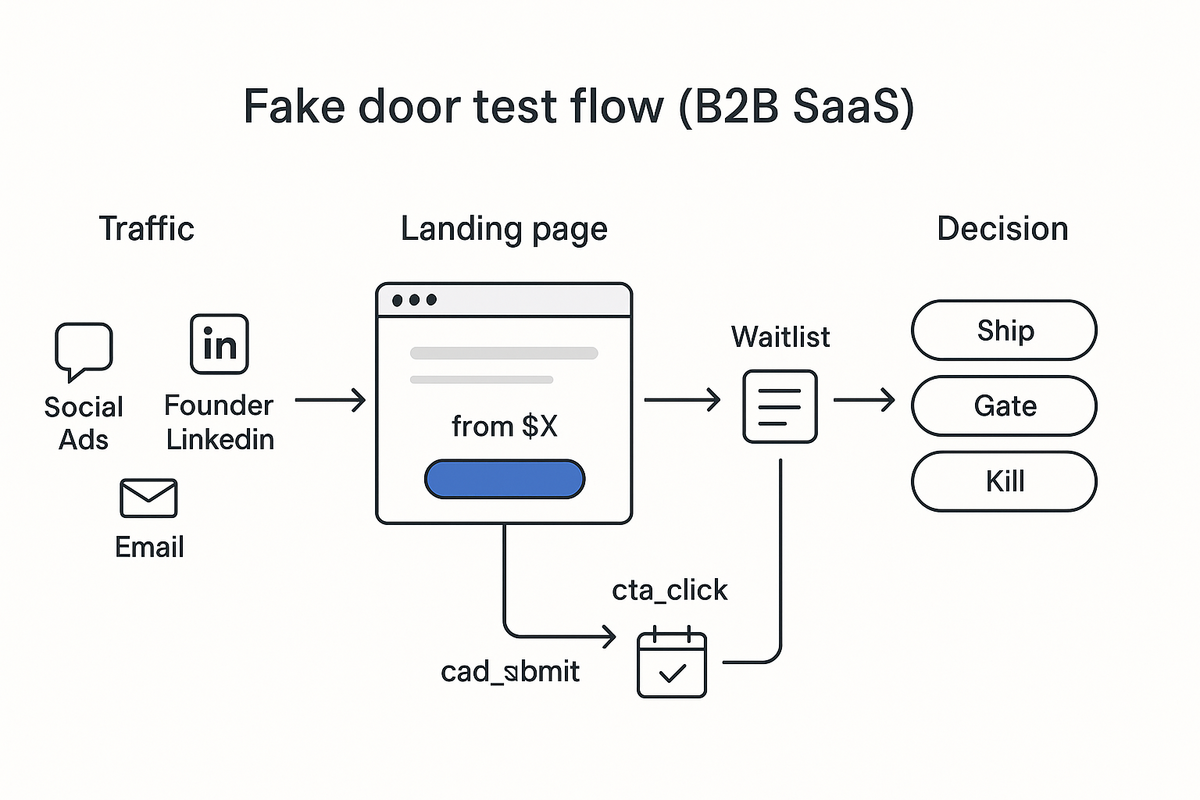
Smoke Test: Track real purchase intent, not just email signups. For example, testing interest in a new productivity tool by collecting credit card submissions on a pricing page for an unbuilt product.
Pre-Sale Landing Page: A simple landing page collecting payments validates the market faster than creating the entire curriculum first. For example, testing a niche specialized training course by collecting paid pre-orders.
MVP Type | Core Mechanism | Best For | Demand Signal |
|---|---|---|---|
Concierge MVP | Deliver value manually (e.g., via WhatsApp/Email). | Complex workflows or personalized services. | Subscription or contract conversion. |
Smoke Test | Landing page pitching a nonexistent product. | Testing broad market interest. | Credit card input or pricing clicks. |
Manual Service | Selling the outcome as a consulting/agency service. | B2B SaaS ideas. | Paid invoices for manual work. |
Pre-Sale | Selling a product before it's built at a discount. | Courses, books, or physical products. | Upfront payments. |
The Concierge MVP Framework
If you want to validate demand without wasting engineering hours, use this practical framework to set up your own concierge MVP. It relies on simulating the value rather than building the infrastructure. Setting up a customer discovery kit can help you track these steps properly.
Identify the Pain: Isolate the single most painful problem your audience faces. Stop guessing. You need a specific problem that people are actively trying to solve.
Simulate the Value: Deliver the core value manually. Use existing tools like WhatsApp, email, or spreadsheets. Avoid writing code. The goal is to see if the outcome matters to the buyer, not if the software works.
Test with Real Buyers: Sell the manual pilot to a small group (e.g., 10-15 people). Collect real objections. If they don't show any, it doesn't mean they don't have them — you have to extract them. For more on structuring customer interviews to get real answers, check out The Mom Test.
Check Willingness to Pay: Ask for a subscription or payment at the end of the pilot. Demand validation requires money changing hands. Only build automation after paid intent appears.
This is similar to running a smoke test for your startup, but instead of just collecting emails on a landing page, you are actively delivering the service manually to see if the retention and willingness to pay are there.
Common Mistakes When Validating Demand
Building before selling: Writing code is comfortable. Talking to customers is hard. Startups often hide behind development rather than facing rejection. In fact, running out of cash or building something no one needs are top reasons startups fail, according to CB Insights.
Accepting false positives: A sign-up or a waitlist is not validation. Real validation involves extracting hard objections or getting paid.
Ignoring the market: If you don't know your competitors, you don't know the market. If you don't know the market, you don't know the customer.
Getting distracted by features: With AI, it is faster to build things people don't need. Keep your focus on the core pain point instead of getting distracted by what is cheap and available to build.
FAQ
Why bother with MVP planning or examples now that AI can build the product fast?
Because AI also makes it faster to build what nobody needs. Use MVP examples as proof of a mechanism: isolate the single most painful problem, sell or pilot the smallest version with real buyers, and only automate after demand shows up. The mistake is treating cheap building as permission to add nice-to-have features before proving the pain and willingness to pay.
What is a good minimum viable product example for B2B?
A strong B2B MVP often looks like a manual service pilot. Instead of building a SaaS dashboard, you sell the outcome — like an analytics report or compliance document — and manually produce it. If B2B clients won't pay for the outcome delivered manually, they won't pay for your software.
What if people say they need to think about it?
A prospect disappearing after showing interest doesn't always indicate a lack of product-market fit. Ask prospects who need to think about it to identify what specifically concerns them. Aim to end the discussion with a concrete next step to clarify their interest.
Should I offer a free pilot to get users?
It is usually better to run paid pilots. Free users may gladly consume your manual effort without ever intending to pay, which gives you false signals about actual market demand.