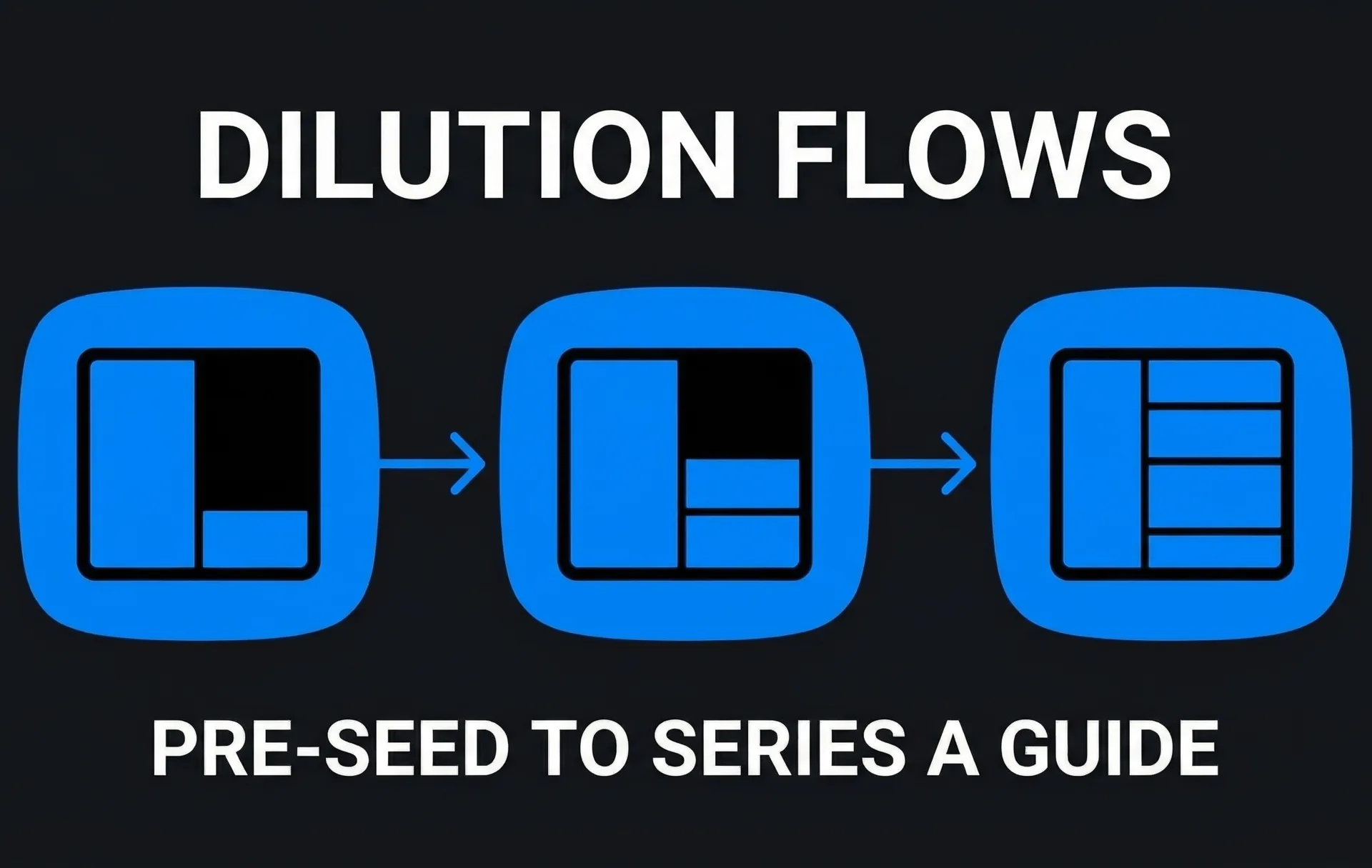
Cap Table 2026 Examples: Pre-Seed to Series A Dilution
last updated: Apr 22, 2026
Founders obsess over fractional equity points while their revenue sits at zero. Stop staring at spreadsheets and use these standard dilution benchmarks to map your raises so you can get back to building. Here is the reality check on how much of your company you actually keep.
TL;DR
- Benchmark: You typically give up 15-25% of your company per priced round of funding.
- Rule of thumb: Try to cap your pre-seed dilution at 20% — giving away more can break your cap table for future rounds.
- Warning: Forgetting to calculate the 10-15% employee option pool expansion will wreck your personal ownership math.
Glossary
- Dilution: The percentage decrease in your ownership stake when new shares are issued to investors or employees.
- Pre-money valuation: What your company is worth immediately before a new investor wires the funds.
- Post-money valuation: Your pre-money valuation plus the total amount of new capital raised.
- Option pool: A reserved chunk of equity, usually 10-15%, set aside for future employee grants. This pool is crucial for attracting and retaining talent.
How to model your cap table dilution
Follow these stages to understand how your ownership stake shrinks over time. Each step builds on the last, showing the compounding effect of dilution.
1. Incorporation and founder split
You split the pie among founders before anyone else writes a check. Keep it simple and use vesting schedules so no one walks away with free equity.
Sample math: Founders start with 100% (e.g., two founders at 50% each).
2. Pre-seed round
You raise initial capital via SAFEs or convertible notes to build the MVP. Standard Y Combinator SAFE terms dictate how these eventually convert into equity.
Sample math: Investors take 10-15% of the company. Founders drop to 85-90%.
3. Seed round
You price the round and officially convert those early SAFEs. You will also carve out an initial employee equity pool, which comes directly out of the pre-raise cap table. Data from industry reports, like those from Carta, shows median seed dilution hovering around 20%. You can model this using a standard cap table template.
Sample math: Seed investors purchase 15-25% equity. The option pool takes 10-15%. Founder ownership drops to 55-65%.
4. Series A round
You find product-market fit and raise institutional venture capital to scale. The lead investor will likely demand a refresh of the employee option pool to ensure enough equity is available for key hires.
Sample math: Series A investors require 20-25% equity. The option pool is refreshed by 5-10%. Founder ownership compresses to 35-45%.
1. Incorporation and founder split
You split the pie among founders before anyone else writes a check. Keep it simple and use vesting schedules so no one walks away with free equity.
Sample math: Founders start with 100% (e.g., two founders at 50% each).
2. Pre-seed round
You raise initial capital via SAFEs or convertible notes to build the MVP. Standard Y Combinator SAFE terms dictate how these eventually convert into equity.
Sample math: Investors take 10-15% of the company. Founders drop to 85-90%.
3. Seed round
You price the round and officially convert those early SAFEs. You will also carve out an initial employee equity pool, which comes directly out of the pre-raise cap table. Data from industry reports, like those from Carta, shows median seed dilution hovering around 20%. You can model this using a standard cap table template.
Sample math: Seed investors purchase 15-25% equity. The option pool takes 10-15%. Founder ownership drops to 55-65%.
4. Series A round
You find product-market fit and raise institutional venture capital to scale. The lead investor will likely demand a refresh of the employee option pool to ensure enough equity is available for key hires.
Sample math: Series A investors require 20-25% equity. The option pool is refreshed by 5-10%. Founder ownership compresses to 35-45%.
Benchmarks
- Pre-seed dilution (SAFE/note): 10-15%
- Seed round dilution (priced): 15-25%
- Series A round dilution (priced): 20-25%
- Initial employee option pool: 10-15%
- Series A option pool refresh: 5-10%
Sample math: If your company is valued at a $4M pre-money valuation and you raise a $1M seed round, your post-money valuation becomes $5M. The new investors own $1M of the $5M total, or 20% of the company. All existing shareholders (founders, previous investors) are diluted proportionally by this 20%.
Priced round vs. SAFE
Understanding the difference between these two fundraising instruments is critical for managing your cap table.
- Priced round (e.g., seed, Series A): An investor buys a specific number of shares at a fixed price. This immediately sets a company valuation (e.g., "$1M on a $5M pre-money valuation"). The dilution is clear and immediate. This requires more legal work but provides certainty.
- SAFE (Simple Agreement for Future Equity): An investor gives you capital in exchange for the right to equity in the future, typically at the next priced round. It does not set a valuation immediately, instead using a "valuation cap" to determine the conversion price later. It's faster and cheaper than a priced round but creates debt on the cap table that must be converted, sometimes with surprising dilution effects.
Risks
- Over-dilution: Giving away too much equity too early is the most common mistake. If founders own too little, they lose motivation and future investors may walk away, fearing there isn't enough equity left to incentivize the team.
- Signaling risk: Raising money at a lower valuation than your previous round (a "down round") signals to the market that the company is struggling. It severely dilutes existing shareholders and can damage morale.
- Complexity: A messy cap table with many unconverted SAFEs, different valuation caps, and non-standard terms is a major red flag for institutional investors. It can delay or even kill a Series A deal.
Will a flawless SaaS cap table get you to $10K MRR?
Knowing your cap table is essential, but obsessing over 1% equity while revenue sits at zero is a trap. A flawless SaaS cap table doesn't get you to sales on its own. Your singular focus should be validating your strategy to hit that first $10K MRR. Stop modeling scenarios and start figuring out how to close customers in the next 90 days. This is why I built Traction OS. Fix your foundation before you launch.
FAQ
- You:How much dilution is normal for a seed round?Guide:Founders should expect 15-25% dilution during a standard seed round. If you give up more than 25%, you risk losing significant control of your company too early and may have trouble raising future rounds.
- You:Do SAFEs dilute founders immediately?Guide:No, not technically. SAFEs convert into equity during the first priced round (like a seed or Series A). However, you must account for them as if they are already equity. Failing to do so leads to nasty surprises when the notes convert. Understanding a term sheet vs SAFE is critical to avoid this pitfall.
Find where your first 100 customers are in 2 mins. — or browse all the free founder guides.
No-BS guides