Crunchbase Lead List Building for Founder-Led Sales
last updated: May 9, 2026
A Crunchbase lead list is not just a spreadsheet of companies that match a broad market category. For founder-led sales, the list is the first operational version of your buyer hypothesis: who has the pain, who can buy, why now, and what evidence makes outreach worth doing. This guide gives you a repeatable process for turning ICP assumptions into filters, qualification rules, enrichment fields, and a simple account score before you export anything.
TL;DR: Build the list around fit, not volume
Use Crunchbase to encode your ICP before outreach starts: define the account profile, choose filters that represent likely pain or readiness, exclude obvious poor fits, then enrich only the accounts that pass a clear qualification screen.
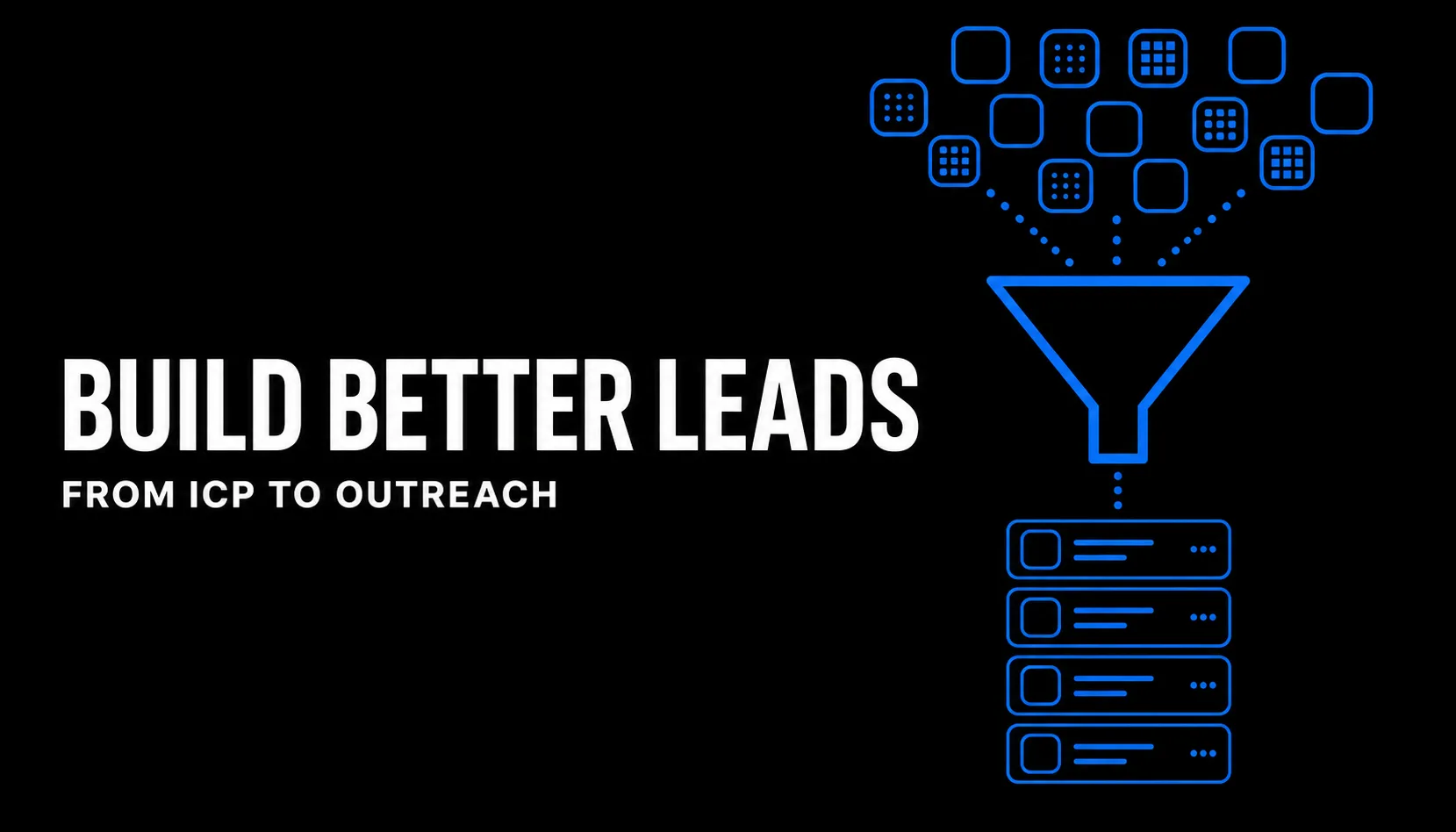
Build sequence: ICP inputs first, filters second, qualification third, export last.
- Start from positioning: if your target buyer and use case are vague, fix that before building a lead list with the startup positioning guide.
- Use Crunchbase filters as a hypothesis, not a shortcut. The B2B search framework can help you translate ICP logic into search criteria.
- Export only after scoring and exclusion rules are applied. Then use a defined export workflow before writing founder sales emails.
Build sequence: ICP inputs first, filters second, qualification third, export last.
Core Definitions
- ICP. The ideal customer profile: the type of company most likely to have the problem, urgency, budget, and operating context your product is built for.
- Buyer hypothesis. A testable belief about which accounts should care, which role should own the problem, and which trigger makes outreach timely.
- Account qualification. The process of deciding whether a company belongs on your outreach list based on fit, evidence, and exclusion rules.
- Enrichment. Adding missing account and contact fields after initial sourcing, such as buyer role, domain, LinkedIn URL, employee count, recent funding, tools used, or relevant trigger notes.
- Lead score. A lightweight prioritization score that ranks accounts by likely relevance before you spend founder time on outreach.
The working lead-list process
Use this Crunchbase lead list building process as a compact operating guide. It is not a full spreadsheet template; it is the sequence that helps the spreadsheet stay useful.
1. Write the ICP inputs before opening Crunchbase
Capture these inputs in plain language:
If these inputs are weak, pause and refine your positioning first. A lead list cannot rescue an unclear market thesis; it only makes the thesis visible faster. For a deeper positioning pass, use product positioning for startups.
2. Translate ICP inputs into Crunchbase filters
Build filters from the buyer hypothesis, not from what happens to return the biggest list. A practical Crunchbase search for founders usually combines firmographic filters, stage filters, category filters, and trigger filters.
For a structured search setup, use the Crunchbase B2B search framework.
3. Ask account qualification questions before export
Before adding an account to the working list, answer these questions quickly:
If you want a more complete qualification prompt set, use the Crunchbase lead list building questions.
- Problem fit: What evidence suggests this company has the problem?
- Buyer clarity: Which role likely owns the problem?
- Timing: Why might this matter now instead of someday?
- Budget plausibility: Is this account likely able to pay for a solution like yours?
- Workflow match: Would your product fit into how this company probably operates?
- Reachability: Can you identify a relevant person or team without guessing wildly?
- Message angle: Can you write a specific first sentence that would not fit every company in the market?
If you want a more complete qualification prompt set, use the Crunchbase lead list building questions.
4. Apply exclusion rules aggressively
Exclusion rules protect founder time. They also prevent broad exports from turning into fake pipeline.
A useful test: if the only reason an account is on the list is that it appeared in a search result, remove it.
- Exclude accounts outside the segment you can currently serve.
- Exclude companies where the likely buyer is unclear.
- Exclude accounts that are too small to pay or too large for your current sales motion.
- Exclude companies with no visible trigger or evidence of pain.
- Exclude accounts that require integrations, compliance, procurement, or support capacity you do not yet have.
- Exclude duplicates, subsidiaries, agencies, consultants, investors, schools, nonprofits, or service providers unless they are explicitly part of the ICP.
- Exclude accounts where personalization would require unsupported assumptions.
A useful test: if the only reason an account is on the list is that it appeared in a search result, remove it.
5. Score accounts before enrichment
Use a simple 0-2 score for each criterion. Keep it fast enough to use consistently.
Suggested interpretation:
This is a prioritization heuristic, not a universal benchmark. Adjust the criteria based on your sales motion and what you learn from replies.
- 10-12 points: Priority account. Enrich and prepare founder-led outreach.
- 7-9 points: Secondary account. Enrich if the list needs more volume.
- 4-6 points: Hold. Revisit after sharpening the ICP or adding better filters.
- 0-3 points: Exclude.
This is a prioritization heuristic, not a universal benchmark. Adjust the criteria based on your sales motion and what you learn from replies.
6. Enrich only the accounts that pass the score
After scoring, add fields that will help you send better outreach and learn faster:
7. Export in batches, not bulk dumps
Export a small, scored batch first. Then run outreach, review reply quality, and revise the filters. The U.S. Small Business Administration frames market research around understanding customer needs and market fit, not as a one-time data pull (SBA market research guidance). Treat your first list the same way: a research-backed sales experiment.
Start with a small scored batch you can manually inspect before scaling. The point is to keep the batch small enough that you can check quality and learn from responses before increasing export volume.
When you are ready to move from scored accounts to a working file, follow the Crunchbase export leads workflow. If you want to estimate list size and effort before you start, use the Crunchbase search for founders calculator.
Start with a small scored batch you can manually inspect before scaling. The point is to keep the batch small enough that you can check quality and learn from responses before increasing export volume.
When you are ready to move from scored accounts to a working file, follow the Crunchbase export leads workflow. If you want to estimate list size and effort before you start, use the Crunchbase search for founders calculator.
8. Turn the list into founder sales outreach
The list should make the first email easier to write. If it does not, the list is not qualified enough.
For each priority account, write the outreach premise in this format:
Illustrative outreach premise:
Then use the founder sales email guide to turn the premise into a concise message. Keep the first email tied to evidence, not generic claims.
For each priority account, write the outreach premise in this format:
- Account: [Company]
- Buyer role: [Role]
- Evidence: [Observable signal]
- Trigger: [Why now]
- Hypothesis: [Why this problem may matter]
- Ask: [Low-friction next step]
Illustrative outreach premise:
- Account: ExampleCo
- Buyer role: VP Operations
- Evidence: Hiring for implementation roles across three regions
- Trigger: Recently expanded into a new market
- Hypothesis: Onboarding work may be becoming harder to coordinate manually
- Ask: Ask whether improving implementation visibility is a current priority
Then use the founder sales email guide to turn the premise into a concise message. Keep the first email tied to evidence, not generic claims.
9. Review list quality after outreach
Do not judge the list only by reply volume. Review whether the replies teach you something about your ICP.
The strongest list gets sharper after outreach. The weakest list only gets bigger.
External reality check: Google Search Central advises creating helpful, reliable, people-first content, not content made mainly to attract clicks (Google helpful content guidance). Apply the same standard to sales lists: a useful list should help a founder make a better decision about who to contact, not merely produce a larger file.
Illustrative math: If you export 300 broad accounts and only 20 are true ICP fits after review, your usable list rate is 20/300 = 6.7%. If you instead build a 60-account scored batch and 35 pass qualification, your usable list rate is 35/60 = 58.3%. These numbers are hypothetical, not Crunchbase benchmarks; the lesson is that scoring before export can reduce wasted founder outreach time.
- Positive reply from the intended buyer role
- Referral to the right role
- Clear objection that improves your positioning
- No-response pattern by segment
- Bad-fit reason you should turn into a new exclusion rule
- Messaging angle that produces better replies
The strongest list gets sharper after outreach. The weakest list only gets bigger.
External reality check: Google Search Central advises creating helpful, reliable, people-first content, not content made mainly to attract clicks (Google helpful content guidance). Apply the same standard to sales lists: a useful list should help a founder make a better decision about who to contact, not merely produce a larger file.
Illustrative math: If you export 300 broad accounts and only 20 are true ICP fits after review, your usable list rate is 20/300 = 6.7%. If you instead build a 60-account scored batch and 35 pass qualification, your usable list rate is 35/60 = 58.3%. These numbers are hypothetical, not Crunchbase benchmarks; the lesson is that scoring before export can reduce wasted founder outreach time.
Will Crunchbase lead list building actually get you to first customers?
Crunchbase lead list building can help you get to first customers when it is used as founder sales infrastructure. The list should encode your best current view of the market: who hurts, who owns the pain, what changed recently, and why your outreach is worth reading.
It breaks when founders treat Crunchbase as a volume engine. A broad export can create the feeling of pipeline while hiding the hard question: whether the account actually matches the buyer hypothesis. If the list cannot explain why each company belongs, the outreach will become generic and the learning loop will get noisy.
The founder mistake to avoid is separating list building from discovery. Build the first list, send targeted outreach, inspect the replies, then revise the ICP, filters, exclusions, and message angles. That is how a lead list becomes traction infrastructure instead of another spreadsheet.
This is why I built Traction OS. Fix your foundation before you launch.
It breaks when founders treat Crunchbase as a volume engine. A broad export can create the feeling of pipeline while hiding the hard question: whether the account actually matches the buyer hypothesis. If the list cannot explain why each company belongs, the outreach will become generic and the learning loop will get noisy.
The founder mistake to avoid is separating list building from discovery. Build the first list, send targeted outreach, inspect the replies, then revise the ICP, filters, exclusions, and message angles. That is how a lead list becomes traction infrastructure instead of another spreadsheet.
This is why I built Traction OS. Fix your foundation before you launch.
FAQ
- You:How many Crunchbase leads should a founder export first?Guide:Start with a small scored batch rather than a large export. Choose a batch size you can manually inspect before scaling so list quality does not fall as volume increases.
- You:What should I do if Crunchbase returns too many companies?Guide:Add stronger exclusion rules and timing filters. Narrow by segment, stage, geography, buyer relevance, recent trigger, or pain evidence. If the account still cannot support a specific outreach premise, it should not be in the first batch.
- You:What should I do if Crunchbase returns too few companies?Guide:Check whether your ICP is too narrow, your filters are too strict, or your category language does not match how companies are classified. Expand one dimension at a time so you can see which assumption changes the list quality.
- You:Should I enrich every account before outreach?Guide:No. Score first, then enrich the accounts most likely to matter. Enriching low-fit accounts wastes the same founder time you were trying to save.
- You:What fields matter most in a Crunchbase lead list?Guide:The most useful fields are the ones that improve qualification and outreach: segment, buyer role, pain signal, trigger note, score, exclusion reason, and outreach angle. Basic company data is necessary, but it is not enough to make the list useful.
- You:How does this connect to founder-led sales emails?Guide:A good list gives each email a reason to exist. If the list captures account evidence and a buyer hypothesis, the email can lead with a relevant observation instead of a generic pitch.
Find where your first 100 customers are in 2 mins. — or browse all the free founder guides.
No-BS guides