Crunchbase vs PitchBook for B2B Prospecting
last updated: May 9, 2026
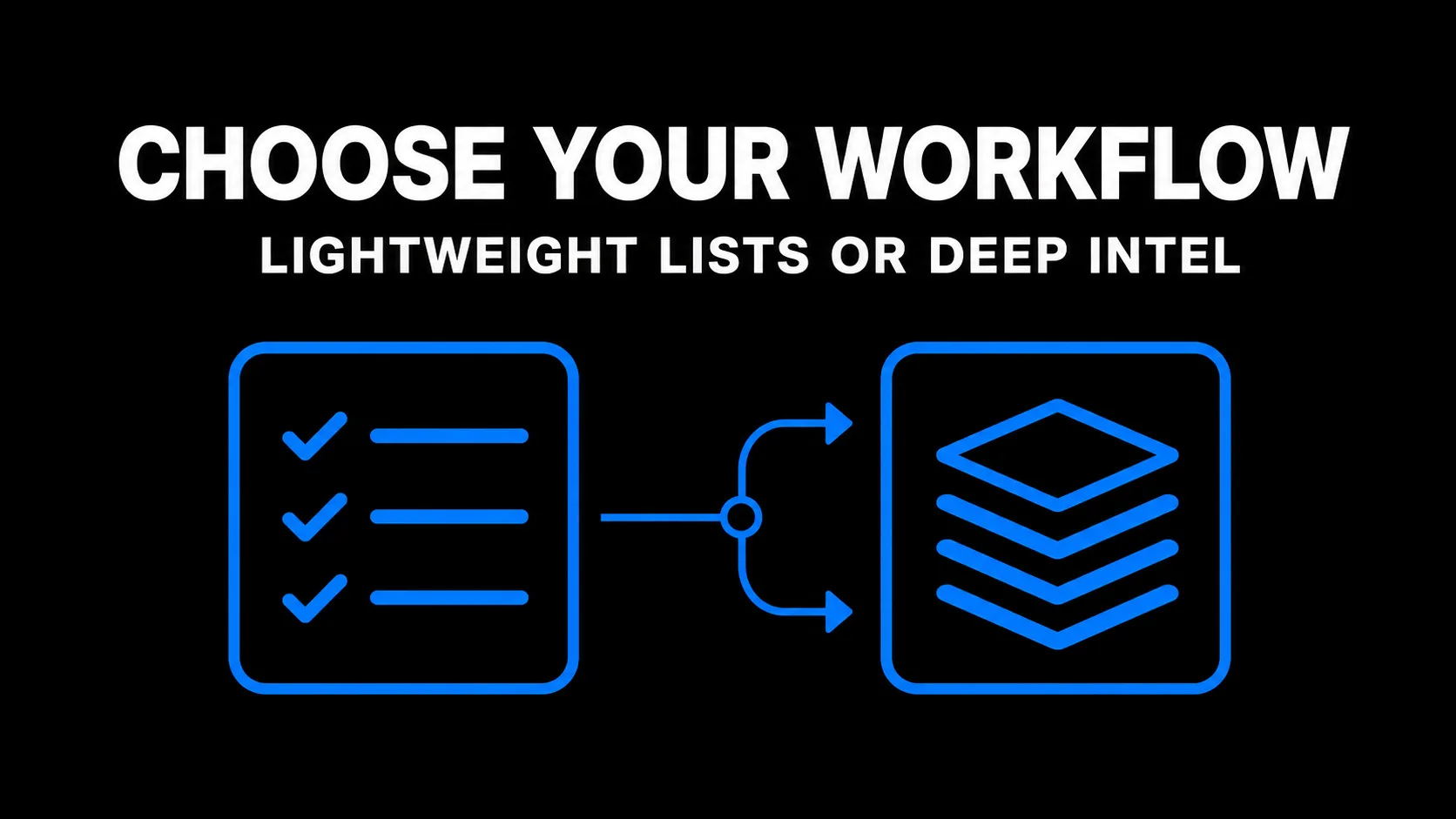
Crunchbase vs PitchBook for B2B prospecting is not really a question of which database is better. It is a question of whether your founder-led sales motion needs a lightweight lead-list workflow or a deeper market intelligence workflow. If you are still proving a segment, start with the process you can actually run every week, then add data depth only when the sales motion demands it.
TL;DR: Pick by workflow depth
Use this as a founder decision heuristic: Crunchbase tends to fit a lighter account-discovery and list-building motion, while PitchBook tends to fit a research-heavy private-market workflow. The practical choice depends on the fields you need, the export path you will use, and whether deeper company, investor, financing, or transaction context will change which accounts you pursue.
Read this as a founder decision guide, not procurement advice.
- Choose the lighter workflow when your main job is B2B prospect discovery, list building, and quick account research. Start with a focused process like the Crunchbase B2B search framework before buying more complexity.
- Choose the deeper research workflow when account selection depends on private-company context, financing history, investor relationships, transaction signals, or market mapping.
- Avoid treating either platform as a customer-validation shortcut. A list helps you find accounts; it does not prove they feel pain, have urgency, or will buy.
Read this as a founder decision guide, not procurement advice.
Core Definitions
- B2B prospecting platform. A tool used to identify, filter, research, and organize companies or contacts that may become sales opportunities.
- Lightweight prospecting workflow. A repeatable process for finding target accounts, applying filters, saving or exporting a list, researching each account briefly, and running outreach.
- Market intelligence workflow. A broader research process used to understand companies, investors, deals, funding activity, sectors, markets, and competitive landscapes before choosing accounts.
- Firmographic filters. Company-level filters such as industry, location, size, growth signals, funding stage, technology category, or business model.
- Export need. The practical requirement to move selected accounts into a spreadsheet, CRM, enrichment workflow, outbound tool, or research memo.
- Overkill. A platform is overkill when its research depth, cost, setup time, or workflow complexity exceeds the founder's current selling motion.
The comparison table
Use this comparison to decide whether your current B2B prospecting job needs a lightweight prospecting workflow or a deeper market intelligence workflow.
Founder decision script
- Write the next 30 days of work in one sentence: "We need to find ___ companies that likely have ___ pain so we can run ___ conversations or outreach tests."
- List the five fields that must be present for an account to be useful. Examples include category, geography, employee range, funding signal, buyer function, technology indicator, or trigger event.
- Decide whether those fields are enough to start selling. If yes, use the lighter workflow first.
- Decide whether deeper investor, financing, deal, or market context would materially change account selection. If yes, evaluate PitchBook seriously.
- Run a small manual sample before scaling. For example, build 25 accounts, research 10, contact 5, and inspect whether the list creates real conversations. Treat these as illustrative sample sizes for a fast founder test, not a universal benchmark.
Winner-when summary
- Crunchbase wins when the job is founder-led B2B prospecting, category search, list building, and repeatable outbound.
- PitchBook wins when the job is private-market intelligence, investor-backed account strategy, financing context, transaction research, or market mapping.
- Neither wins if you have not defined the buyer, pain, timing signal, or outreach motion.
Common misfit cases
- You buy PitchBook because it feels more comprehensive, but your only workflow is exporting a basic SaaS account list.
- You buy Crunchbase because it is simpler, but your target accounts require deep private-market research before outreach.
- You compare platforms before defining the account fields your outbound workflow actually needs.
- You assume database coverage equals demand. Coverage helps you find accounts; discovery and sales calls test whether the accounts care.
How to judge signal quality
Do not judge a prospecting platform by surface coverage alone. In search analytics, Google separates exposure from action with metrics such as impressions and clicks in its Search Console definitions. Apply the same discipline to prospecting: a database can create exposure to possible accounts, but replies, meetings, and learning are the actions that matter.
Google's guidance on helpful, reliable, people-first content is also a useful operating principle for outbound research: usefulness beats volume. A smaller list with clearer pain, timing, and buyer logic is usually more useful than a larger list that only looks complete.
Hypothetical sample math: if a database helps you build 200 candidate accounts, and your manual review removes 60% as weak fit, you have 80 accounts left. If you contact 40 of those accounts in a tightly defined test and 6 agree to discovery calls, your useful signal is not "the database converts at 15%." It is "this segment and message produced 6 conversations from 40 targeted attempts." Use that learning to refine the ICP before expanding the list.
Google's guidance on helpful, reliable, people-first content is also a useful operating principle for outbound research: usefulness beats volume. A smaller list with clearer pain, timing, and buyer logic is usually more useful than a larger list that only looks complete.
Hypothetical sample math: if a database helps you build 200 candidate accounts, and your manual review removes 60% as weak fit, you have 80 accounts left. If you contact 40 of those accounts in a tightly defined test and 6 agree to discovery calls, your useful signal is not "the database converts at 15%." It is "this segment and message produced 6 conversations from 40 targeted attempts." Use that learning to refine the ICP before expanding the list.
Will Crunchbase vs PitchBook B2B actually get you to first customers?
The platform decision can help you move faster, but it will not replace customer discovery. Crunchbase can make it easier to assemble a practical prospect list; PitchBook can make it easier to understand a market and choose accounts with more context. The mistake is expecting either database to tell you who urgently wants the product.
For most early B2B founders, the right first question is: "Do I need a lightweight prospecting workflow or a deeper market intelligence workflow?" If the answer is lightweight prospecting, start with simple filters, a tight list, and a repeatable outreach rhythm. If the answer is market intelligence, make sure the research will change which accounts you pursue, not just make the spreadsheet look smarter.
Use the Crunchbase vs PitchBook decision script before committing to a platform. The founder-level win is not buying the most complete database; it is choosing the smallest reliable workflow that gets you into real customer conversations.
This is why I built Traction OS. Fix your foundation before you launch.
For most early B2B founders, the right first question is: "Do I need a lightweight prospecting workflow or a deeper market intelligence workflow?" If the answer is lightweight prospecting, start with simple filters, a tight list, and a repeatable outreach rhythm. If the answer is market intelligence, make sure the research will change which accounts you pursue, not just make the spreadsheet look smarter.
Use the Crunchbase vs PitchBook decision script before committing to a platform. The founder-level win is not buying the most complete database; it is choosing the smallest reliable workflow that gets you into real customer conversations.
This is why I built Traction OS. Fix your foundation before you launch.
FAQ
- You:Is Crunchbase or PitchBook better for startup B2B prospecting?Guide:Crunchbase is usually the better fit when the job is simple B2B prospect discovery, filtering, lead-list building, and founder-led outbound. PitchBook is usually the better fit when the prospecting decision depends on private-market intelligence, financing history, investors, transactions, or deeper market mapping.
- You:When is PitchBook overkill for a founder?Guide:PitchBook is overkill when you only need a basic account list and will not use its deeper research layer. If your next step is contacting a clearly defined account sample, a lightweight workflow is usually easier to operate than a full market-intelligence process.
- You:When is Crunchbase not enough?Guide:Crunchbase may not be enough when account selection depends on detailed financing context, ownership, investor relationships, transaction history, or private-market research. In that case, the issue is not just finding companies; it is understanding why certain companies belong in the target market.
- You:Should I choose based on database size?Guide:No. Choose based on the fields and workflow that change your next sales actions. A larger or deeper database only matters if it helps you identify better accounts, prioritize outreach, or learn faster from customer conversations.
Find where your first 100 customers are in 2 mins. — or browse all the free founder guides.
No-BS guides