Crunchbase vs. Pitchbook: Decision Matrix & Budget Script
last updated: Apr 24, 2026
You are staring at a $24,000 price tag for Pitchbook and a $588 invoice for Crunchbase Pro. Both claim to give you "market intelligence," but one costs as much as a junior employee and the other costs less than your coffee budget. Here is exactly how to justify the spend — or kill it entirely.
TL;DR: The Cheat Code
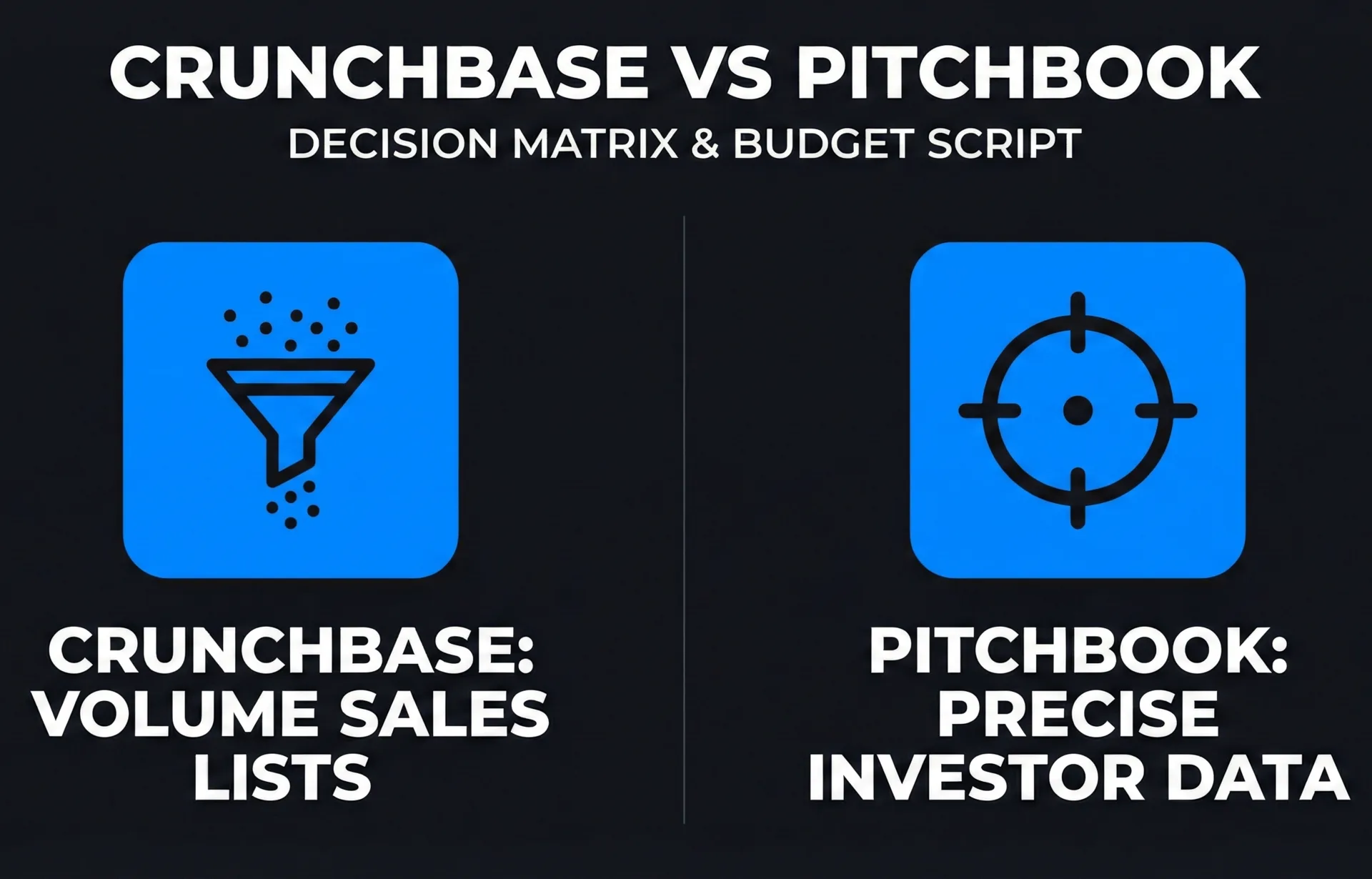
Crunchbase is a shotgun for sales teams building volume lists. Pitchbook is a sniper rifle for investors needing verified valuations and cap tables. If you aren't writing checks or doing M&A, Pitchbook is likely vanity spend.
- Benchmark: A typical B2B SaaS company spends ~13% of ARR on sales costs. For a $1M ARR startup, a $24k Pitchbook contract eats nearly 18.5% of that entire budget. Crunchbase consumes just 0.45%.
- Rule: If your average deal size is under $10k, Crunchbase is sufficient. If you need private pre-money valuations to price a term sheet, Pitchbook is mandatory.
- Warning: Crunchbase Pro has hidden export limits (often 1,000 rows/search) and charges extra for contact data (emails/phones).
Glossary
- Private Market Data: Financials (revenue, cap tables) for companies that don't report to the SEC. This is Pitchbook’s primary moat.
- Firmographic Data: Basic "business card" info (Industry, HQ, Headcount). This is Crunchbase’s commodity data.
- The "Seat" Tax: Pricing models based on user licenses. Pitchbook often forces a 3-seat minimum; Crunchbase allows single-seat "Pro" accounts.
The Asset: Decision Matrix
Use this "Feature vs. Cost" table to make the logical choice.
The Asset: Budget Script
Use this email when you need to justify the $20k+ Pitchbook expense to a skeptical CFO or Partner. If you are raising pre-seed capital, this logic signals you are serious about due diligence.
Subject: Approval Request: Market Data Intelligence (ROI Justification)
To: [CFO Name / Partner]
From: [Founder Name]
I’ve evaluated our data stack options for Q2. We are deciding between Crunchbase ($588/yr) and Pitchbook (~$24k/yr).
While Crunchbase is cheaper, it lacks the private valuation data and cap table details we need to [insert specific goal: e.g., "accurately price our Series A" or "vet acquisition targets"].
The Math for Pitchbook:
We sign the Pitchbook contract for 1 year. If we haven't sourced $50k in pipeline directly attributed to their data by Month 6, we downgrade to Crunchbase next renewal.
Can you approve the budget allocation by Friday?
Subject: Approval Request: Market Data Intelligence (ROI Justification)
To: [CFO Name / Partner]
From: [Founder Name]
I’ve evaluated our data stack options for Q2. We are deciding between Crunchbase ($588/yr) and Pitchbook (~$24k/yr).
While Crunchbase is cheaper, it lacks the private valuation data and cap table details we need to [insert specific goal: e.g., "accurately price our Series A" or "vet acquisition targets"].
The Math for Pitchbook:
- Risk Avoidance: If we misprice one deal by even 5% due to bad comps, we lose ~$50k in equity value immediately. Pitchbook prevents this.
- Labor Savings: It currently takes [Analyst Name] ~10 hours/week to manually scrape incomplete data. At their hourly rate, that's $26k/year in wasted time. Pitchbook automates this.
- Revenue Impact: We only need to source one additional deal or partner using their "Request an Analyst" feature to cover the entire annual contract.
We sign the Pitchbook contract for 1 year. If we haven't sourced $50k in pipeline directly attributed to their data by Month 6, we downgrade to Crunchbase next renewal.
Can you approve the budget allocation by Friday?
Benchmarks & ROI Math
Before you buy, run these numbers against your current traction. You can verify this with our export ROI calculator.
Scenario A: The Sales Volume Play (Crunchbase)
If you need volume, Crunchbase is the clear ROI winner. Using SaaS search templates, you can quickly build lists of funded companies.
Scenario B: The Investor Play (Pitchbook)
Pitchbook is an insurance policy against bad investments. Pricing is opaque, but reliable sources estimate it between $20,000 and $25,000 per year for a small team.
Scenario A: The Sales Volume Play (Crunchbase)
If you need volume, Crunchbase is the clear ROI winner. Using SaaS search templates, you can quickly build lists of funded companies.
- Cost: $588/year (Pro)
- Math: 500 prospects exported → 50 meetings (10% conversion) → 5 deals ($10k LTV) = $50k Revenue.
- ROI: $50k Revenue / $588 Cost = 85x ROI.
Scenario B: The Investor Play (Pitchbook)
Pitchbook is an insurance policy against bad investments. Pricing is opaque, but reliable sources estimate it between $20,000 and $25,000 per year for a small team.
- Cost: ~$24,000/year (3 seats)
- Math: Avoids 1 bad investment/partnership (-$100k loss avoided) = Immediate Payback.
- Budget Context: For a startup with $1M ARR, the median sales budget is ~13% (SaaS Capital, 2025). Pitchbook would represent 18% of your entire sales spend. If you aren't an investor, that is indefensible.
Risks: The "Gotchas"
- The Renewal Trap. Pitchbook contracts are notorious for auto-renewals with price uplifts. They often require 60-day notice to cancel. If you miss the window, you are on the hook for another $25k. Set a calendar reminder for 90 days before expiry.
- The Seat Minimum. Pitchbook salespeople are trained to sell 3-seat minimums. Single "solopreneur" seats exist but are hard to negotiate. Crunchbase is cleaner: buy one seat, add more as needed.
Conclusion
Mastering market intelligence is a necessary step, but it is not the whole picture. You can have the most expensive data subscription in the world, knowing exactly who has money and when they raised it. But if your Offer is weak or your Outreach is generic, your probability of hitting $10k MRR remains near 0%.
Pitchbook gives you the "Who," not the "How." Data is fuel; your sales process is the engine. Don't buy premium fuel for a broken engine. Fix your foundation before you launch.
Pitchbook gives you the "Who," not the "How." Data is fuel; your sales process is the engine. Don't buy premium fuel for a broken engine. Fix your foundation before you launch.
FAQ
- You:Is there a "Startup Tier" for Pitchbook in 2025?Guide:Officially, no. However, if you are part of a major accelerator (YC, Techstars), you often get perks or shared access. Otherwise, they aggressively protect their $20k floor to maintain premium positioning.
- You:Can I share my Crunchbase Pro login?Guide:You can, but they monitor concurrent logins and IP addresses. If you trigger their fraud detection, they will lock your account. It's roughly $49/mo — just buy a second seat if you need it.
- You:What is the best free alternative?Guide:OpenVC is excellent for investor lists. LinkedIn Sales Navigator (while not free) often has better "people" data than either Pitchbook or Crunchbase for pure sales contexts.
Find where your first 100 customers are in 2 mins. — or browse all the free founder guides.
No-BS guides