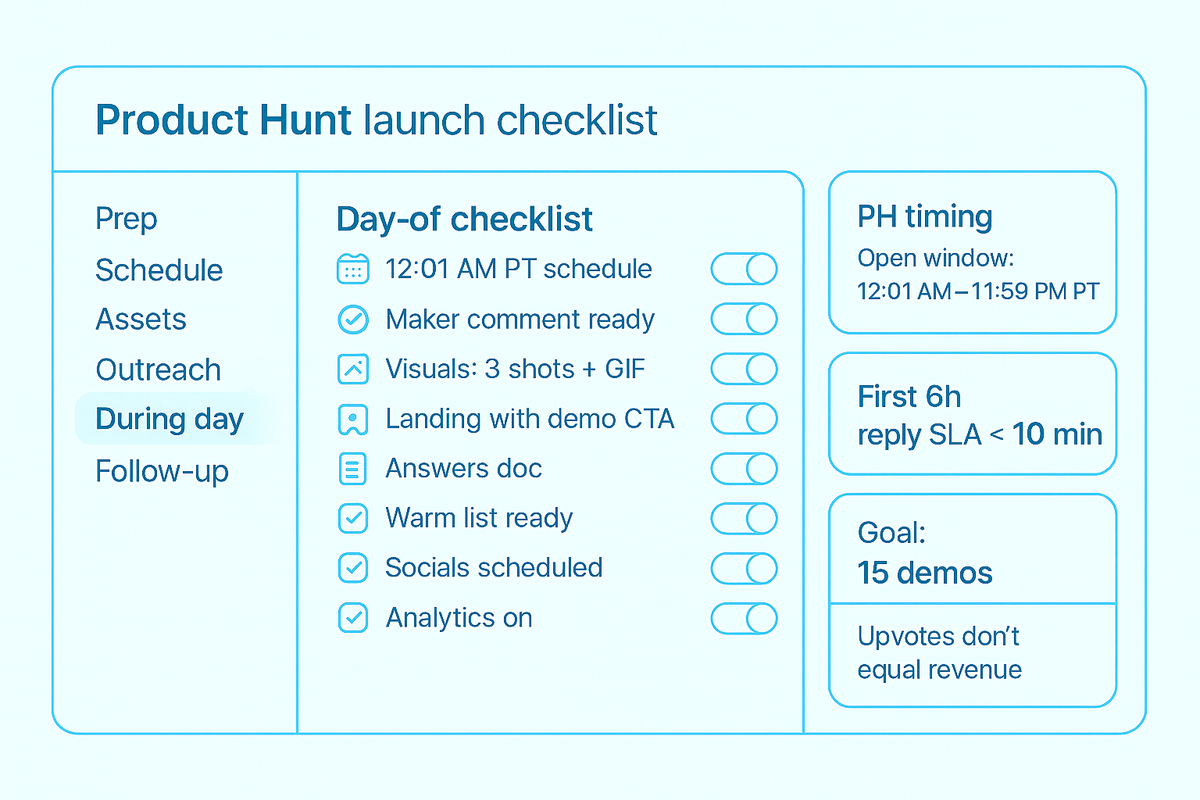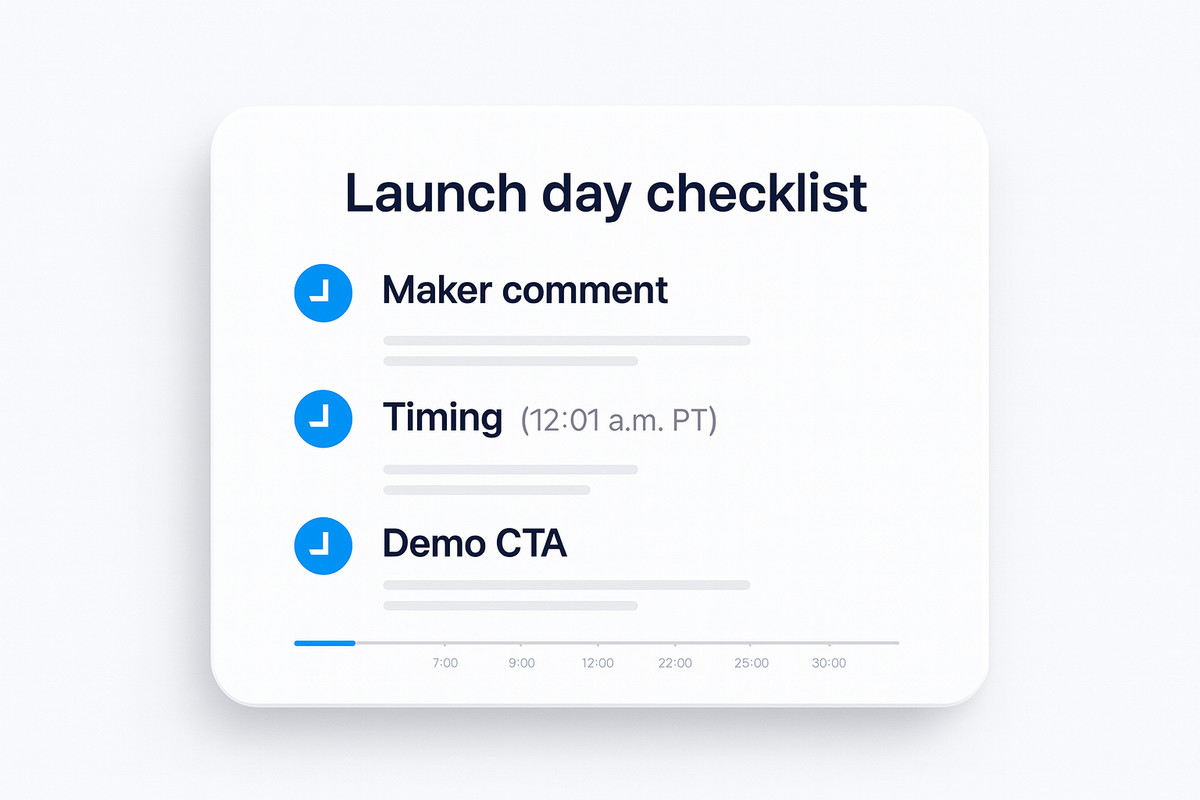
You do not need another launch checklist. You need launch copy you can adapt before launch day, then paste when the page is live. Use these Product Hunt templates for your maker comment, outreach, social posts, tagline, and first comments.
The scripts help your launch look prepared. They do not fix weak positioning. If the product story is still fuzzy, start with the Product Hunt launch strategy guide before you copy these blocks.
TL;DR: Product Hunt launch templates are pre-written text assets for the moments when speed matters: the maker comment, warm DMs, social posts, tagline options, and early comment prompts.
Use templates to reduce friction. They help you avoid writing important launch copy under pressure.
Avoid mass upvote requests. Ask people who know the problem for feedback, comments, or support instead.
Keep the copy specific. A clear pain point beats a polished but vague launch story.
Separate attention from demand. A strong launch day can bring traffic, but buyers still need a sharp offer.
Core Definitions
Maker comment: The first comment from the maker. It explains why the product exists, who it helps, and what kind of feedback you want.
Hunter: The person who submits the product. Some founders self-hunt when they want more control over timing and messaging.
Launch window: The part of launch day when your team is actively answering comments, sharing the page, and watching for unclear messaging.
Conservative outreach: Ask people to inspect the product, leave feedback, or join the discussion. Do not pressure people to take a specific platform action.
The Swipe File
Copy these blocks into your launch doc. Replace every bracketed placeholder with real details. Remove any line that sounds exaggerated for your product.
1. Maker Comment Structure
This is the most important copy on the launch page. It should sound like a founder explaining the product to a thoughtful early user.
Hey Product Hunt, I am [Name], maker of [Product Name].
The problem:
For the past [time period], I have struggled with [specific pain point]. I tried [alternative A] and [alternative B], but they felt too [complex / expensive / manual / broad] for [target user].
The solution:
So I built [Product Name]. It is a [category] for [target audience] who want to [benefit] without [negative constraint].
What it does:
[Feature 1]: [plain benefit]
[Feature 2]: [plain benefit]
[Feature 3]: [plain benefit]
What I would love feedback on:
Does [specific feature or workflow] make sense for how you currently handle [problem]?
Thanks for taking a look.
[Your Name]
2. Tagline Formulas
Your tagline should tell people who the product helps and what it helps them do. Use one of these formulas if your current line is too clever or broad.
[Product Name] helps [target audience] [specific outcome] without [common frustration].
The [category] for [target audience] who need to [job to be done].
Turn [painful workflow] into [clear result] for [target audience].
[Product Name] replaces [messy old process] with [simpler new process].
3. Warm Outreach DM Scripts
Use these for people who know you, used the product, or already care about the topic. Do not use them as a cold spam blast.
Warm investor or advisor
Subject: Launching today on Product Hunt
Hey [Name],
We just launched [Product Name] on Product Hunt today.
You saw the early version when we were working through [specific problem]. The page now explains the sharper version: [one-line positioning].
If you have a minute, I would value a comment on whether the positioning feels clear to you.
Launch link: [Link]
No pressure if today is packed.
Best,
[Your Name]
Beta user
Subject: The beta is live today
Hey [Name],
Thanks again for trying [Product Name] during the beta.
We launched on Product Hunt today, and your experience would be useful for people who are still deciding whether it fits their workflow.
If you are open to it, could you leave a short comment about what you used it for and what changed?
Launch link: [Link]
Appreciate it either way.
Best,
[Your Name]
Niche community member
Subject: Built something for [Community/Role]
Hey [Name],
I know you care about [specific topic], so I wanted to share this directly.
We launched [Product Name] today. It helps [audience] handle [problem] without [old painful workflow].
If it looks useful, I would love your feedback in the Product Hunt comments. A specific critique would help more than a generic cheer.
Launch link: [Link]
Best,
[Your Name]
4. Social Media Announcement Posts
Post these after the launch page is live. If you are still choosing a channel, compare Product Hunt vs Hacker News first and treat the channel fit as a heuristic, not a rule.
Twitter/X thread opener
We are live on Product Hunt.
After [number] months of building, [Product Name] is out.
We built it because [short pain point].
It helps [audience] [specific outcome] without [old constraint].
Launch page: [Link]
I will share the build notes below.
LinkedIn post
[Product Name] is live on Product Hunt today.
I started working on it [time period] ago because [problem] kept showing up in my own work.
Now it is ready for [target audience].
The product helps them [benefit] without [pain point].
Launch page: [Link]
I will be in the comments today answering questions and collecting feedback.
5. First Comment Strategy
Do not leave the comments section empty if real users can help. Ask two or three users, teammates, or friends to post honest questions early. The goal is useful discussion, not fake praise.
Technical question: "Congrats on the launch. How does this handle [specific technical edge case]?" This lets you explain depth.
Beta user comment: "I have been using the beta for [time period]. [Feature] helped me [specific result]." Use this only if the person can say it truthfully.
Roadmap question: "Any plans to add [feature] for [use case]?" This lets you explain what comes next without overpromising.
Before You Paste Anything
Run each script through this quick check:
Can a stranger understand the product in one sentence?
Does the pain point name a real situation, not a broad market category?
Does the ask request feedback or discussion instead of demanding votes?
Does every result claim sound provable?
Would the same copy still work if you removed the Product Hunt logo?
If the answer is no, fix the positioning before launch day. The scripts help with execution. They do not decide who should care.
If you also turn this launch copy into a public launch page, keep the page clear and useful. Google's SEO starter guide, helpful content guidance, and Search Console Help are useful references when you check whether that page can be found and understood after launch day.
Inspect a Live Launch Before You Write
A useful way to study launch copy is to inspect a live Product Hunt page you can access before writing your own. Do not copy the product, tone, or claims. Study how the page helps a new visitor understand the offer.
Look for four things:
Maker comment: Does it explain what changed for the user, or only celebrate the launch?
Early activity: Do the comments create useful discussion, or are they mostly short praise?
Comment quality: Do people ask about use cases, tradeoffs, pricing, privacy, setup, or roadmap?
Positioning angle: Could you explain the user shift in one plain sentence before writing the launch copy?
Use the pattern, not the promise. Your launch still needs its own audience and reason to care.
Will These Templates Create Paying Customers?
They can help you look prepared. They can help more people understand what you built. They cannot turn weak demand into strong demand.
A Product Hunt launch can bring attention, comments, and early users. Revenue depends on the offer, pricing, onboarding, follow-up, and whether the audience has the problem badly enough to pay. If your goal is customers, use these scripts as the execution layer, not the strategy.
If you are still trying to understand what makes a launch get noticed, read the broader guide on getting featured on Product Hunt.
Use this page when your strategy is set and you need cleaner launch copy. If the strategy is not set, the next action is to fix the product story before you prepare the assets.
FAQ
Should I use a hunter or hunt it myself?
Some founders choose to self-hunt when they want more control over timing and copy. A hunter can still help if they know your category and will stay involved, but follower count alone is not enough reason to use one.
What is the best time to post these templates?
Prepare the copy before launch day. Post the maker comment when the page is live, then send warm outreach only when you can respond to comments. Specific timing should depend on where your audience is awake and reachable.
Can I ask people to upvote?
Use conservative outreach. Ask for feedback, comments, or support, and let people decide what action to take. Avoid pressure, repeated follow-ups, and messages to people who have no connection to the problem.