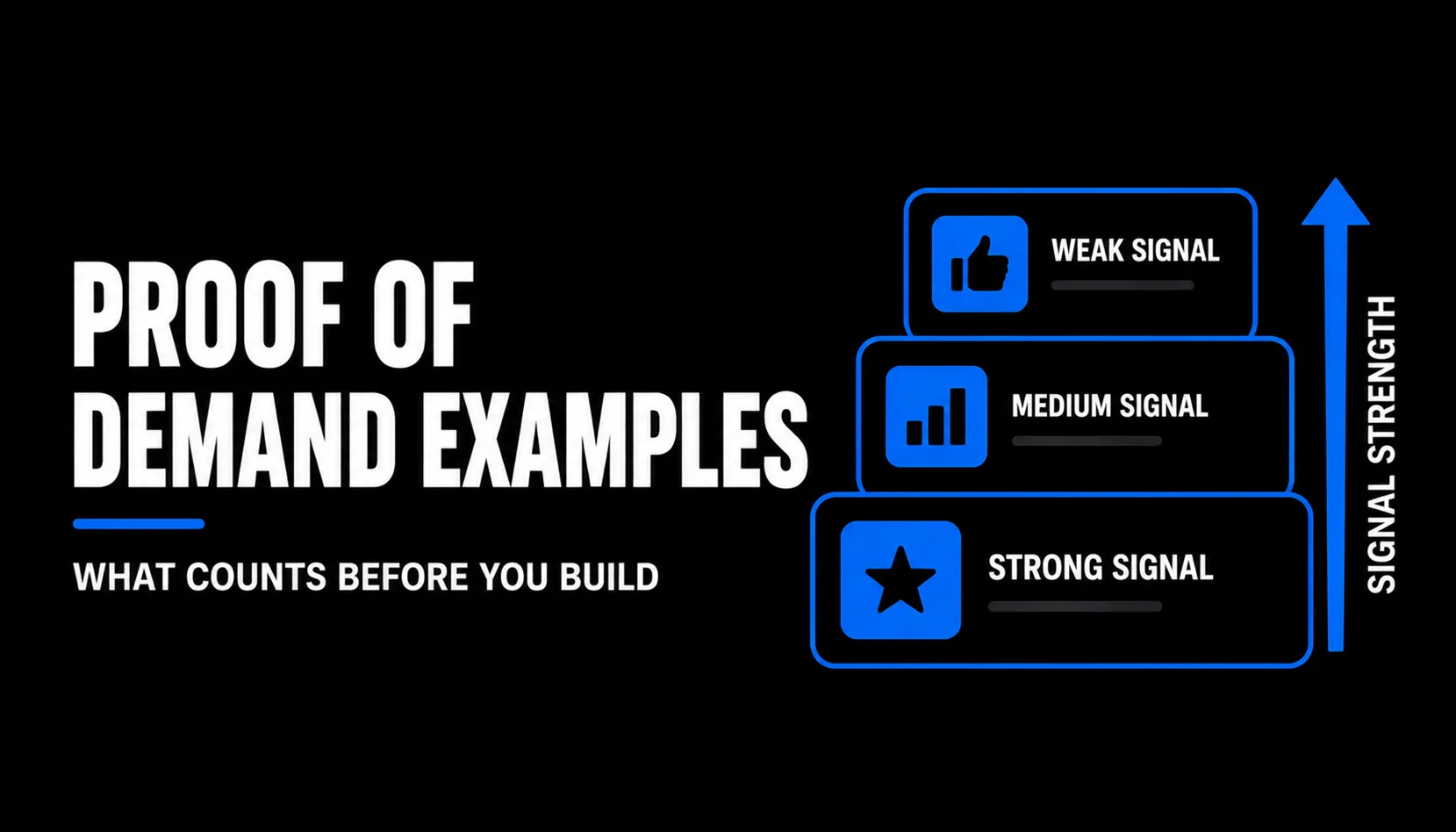
Proof of Demand Examples: What Counts Before You Build
last updated: May 14, 2026
Proof of demand is evidence that a specific customer segment has a painful problem and is willing to take action to solve it. The mistake is treating every positive signal as equal. A compliment, a waitlist signup, a deposit, a referral, and a paid pilot all reduce different kinds of risk, so this guide ranks proof of demand examples by signal quality before you commit serious build time.
TL;DR: Rank behavior over praise
Higher-quality demand validation examples involve customer effort: money, time, internal access, procurement movement, repeated usage, or introductions to other buyers. Use this guide alongside a broader proof of demand framework, then decide whether your next move is discovery, a fake-door test, beta access, or pilot sales.
Read the table by asking: What did the customer risk or spend?
- Weak proof sounds encouraging but costs the buyer almost nothing: compliments, survey interest, casual waitlist joins, and vague “keep me posted” replies.
- Medium proof shows some customer effort: detailed problem stories, repeated follow-up, manual workaround evidence, product usage, or a qualified fake-door click.
- Strong proof changes the customer’s behavior: paid deposits, signed pilots, procurement steps, referrals to budget owners, or repeated use tied to a real workflow.
Read the table by asking: What did the customer risk or spend?
Core Definitions
- Proof of demand. Evidence that a defined customer segment has enough urgency to spend money, time, reputation, or internal effort on a solution.
- Demand signal. A customer behavior that suggests real intent, such as booking a second call, sharing internal data, joining a pilot, paying a deposit, or referring you to a decision-maker.
- False positive. A signal that feels validating but may not predict buying behavior, such as praise from a non-buyer or signups from people outside the target segment.
- Discovery evidence. Qualitative evidence from interviews and observation that explains the problem, current workaround, decision process, and trigger event.
- Commercial evidence. Evidence that the customer may move toward a transaction, such as budget discussion, procurement review, deposit, paid pilot, or signed agreement.
Signal-quality table: proof of demand examples by strength
Use this signal-quality table to grade what you have before you build. The goal is not to collect every signal. The goal is to know whether the next step should be more discovery, a tighter test, a beta cohort, or a commercial pilot.
Decision rule
- If most signals are weak, avoid a broad build. Tighten the segment and run more interviews around recent behavior.
- If signals are medium, run a constrained test: fake door, concierge workflow, prototype walkthrough, or beta cohort.
- If signals are strong, move toward a commercial commitment: paid pilot, deposit, implementation plan, or procurement path.
- If signals conflict, weight behavior over opinion and recent customer action over future intent.
Signal grading checklist
- Segment fit: Is the signal from the exact customer type you plan to sell to?
- Recency: Did the customer experience the problem recently, or are they speaking hypothetically?
- Cost: Did they spend money, time, reputation, political capital, or internal effort?
- Specificity: Did they describe the current workaround, trigger event, budget owner, and success condition?
- Repeatability: Have you seen the same pattern across more than one target customer?
- Conversion path: Does the signal naturally lead to a next step, such as beta, pilot, procurement, or purchase?
External grounding and caveats
Use external research as guardrails, not as a substitute for buyer behavior. The U.S. Small Business Administration’s market research guidance is a useful starting point for thinking about market research and competitive analysis before committing resources.
Y Combinator’s Startup Library is a broad startup-advice library, so treat it as background reading rather than proof that any one demand signal is enough. For research methods, Nielsen Norman Group’s five-user usability testing article is about finding interface usability issues with a small sample. That is not the same as proving market demand, so use it as a reminder that small qualitative samples can reveal patterns, not as a sales forecast.
Hypothetical example: If 40 qualified operators join a waitlist, 12 reply to a follow-up question, 5 book discovery calls, 3 agree to a scoped pilot discussion, and 1 signs a paid pilot, the paid pilot is stronger commercial proof than the full waitlist by itself. The 40 signups are useful top-of-funnel evidence, but they carry less commercial weight without follow-through.
Y Combinator’s Startup Library is a broad startup-advice library, so treat it as background reading rather than proof that any one demand signal is enough. For research methods, Nielsen Norman Group’s five-user usability testing article is about finding interface usability issues with a small sample. That is not the same as proving market demand, so use it as a reminder that small qualitative samples can reveal patterns, not as a sales forecast.
Hypothetical example: If 40 qualified operators join a waitlist, 12 reply to a follow-up question, 5 book discovery calls, 3 agree to a scoped pilot discussion, and 1 signs a paid pilot, the paid pilot is stronger commercial proof than the full waitlist by itself. The 40 signups are useful top-of-funnel evidence, but they carry less commercial weight without follow-through.
Will proof of demand examples actually get you to first customers?
Proof of demand examples help because they stop you from treating encouragement as validation. A founder can collect dozens of positive comments and still have little evidence that buyers will switch tools, fight for budget, or use the product when work gets busy.
The right next move depends on signal strength. Weak signals call for better discovery. Medium signals call for a sharper test or beta. Strong signals justify commercial follow-up, especially when the customer is taking action inside a real workflow or buying process.
The founder mistake to avoid is building as soon as people sound excited. Demand is not proven by enthusiasm alone. It becomes more credible when the customer spends something scarce: time, money, access, attention, reputation, or internal effort.
This is why I built Traction OS. Fix your foundation before you launch.
The right next move depends on signal strength. Weak signals call for better discovery. Medium signals call for a sharper test or beta. Strong signals justify commercial follow-up, especially when the customer is taking action inside a real workflow or buying process.
The founder mistake to avoid is building as soon as people sound excited. Demand is not proven by enthusiasm alone. It becomes more credible when the customer spends something scarce: time, money, access, attention, reputation, or internal effort.
This is why I built Traction OS. Fix your foundation before you launch.
FAQ
- You:What counts as proof of demand before you build?Guide:Higher-quality pre-build proof is customer behavior that costs something. Examples include paid deposits, signed pilot agreements or scoped pilot commitments, repeated follow-up from target buyers, introductions to decision-makers, qualified fake-door conversions, or access to real workflow data. Compliments and survey interest can guide discovery, but they are weak proof by themselves.
- You:Are waitlists good proof of demand?Guide:A waitlist is useful when it is qualified. A small list of target buyers who describe the problem, respond to follow-up, and ask for access is stronger than a large list of curious subscribers who never engage.
- You:Is a free pilot proof of demand?Guide:Sometimes, but only if it has a real sponsor, defined success criteria, access to the workflow, and a credible path to payment. A free pilot with no owner, no deadline, and no conversion path is closer to product feedback than demand proof.
- You:How many proof points do I need before building?Guide:There is no universal number. Look for repeated behavior from the same customer segment and increasing customer commitment. If evidence is still mostly verbal, keep the build small and use discovery, concierge delivery, or fake-door testing before investing heavily.
Find where your first 100 customers are in 2 mins. — or browse all the free founder guides.
No-BS guides