TL;DR
When selling early B2B deals, prospects rarely give you clean objections like "it's too expensive." Instead, they stall or offer vague brush-offs. Effective sales objections scripts don't defensively rebut these stalls; they draw out the real, hidden concerns underneath. Here are five practical, fill-in-the-blank scripts to navigate early-stage pushback, along with a framework for uncovering the real blockers.
In early-stage founder-led sales, we often wait for the prospect to hand us a clean, logical objection so we can counter it. But buyers rarely say, "Your product lacks this specific feature so we are going with a competitor." Instead, they give you a polite stall or a vague brush-off.
The most common early-deal mistake is trying to defensively answer that polite brush-off as if it were the real objection. Instead of a naked rebuttal, your scripts should be designed to draw out the hidden blocker before handling it. Having proven founder-led sales process playbooks ready allows you to navigate these conversations confidently and uncover what's actually stopping the deal.
The "I Need to Think About It" Framework
When a prospect says, "Let me think about it," do not let the call end on a vague stall. You need a concrete next step or, in some cases, a commitment to move forward.
Use this practical objection handling script to identify what specifically concerns them:
You: "Totally fair. So I don't guess, what exactly do you need to think through: budget, timing, implementation, or internal buy-in?"
(Wait for them to select an option, e.g., "Well, we aren't sure how we'd implement it.")
You: "If it is about the implementation, here is how a similar team handled it: [insert brief social proof]. Should we book a 15-minute sync next Tuesday to outline the rollout, or is this not worth continuing?"
This approach pulls the real objection into the open without being combative.
Objection Handling Script Examples for Early B2B Deals
Before diving into the swipe file, here is the core script pattern that makes these work:
Acknowledge → Clarify → Isolate → Proof → Next Step.
Use this table as a quick reference for the five most common early-stage stalls:
Objection | Real Concern | Best Response Pattern | Script Number |
|---|---|---|---|
"It's too early for us" | Don't see immediate ROI | Clarify priorities | 1 |
"We don't have budget" | Value doesn't outweigh cost | Isolate the budget issue | 2 |
"We're using a competitor" | Switching costs seem high | Acknowledge and ask for limits | 3 |
"I need to show my boss" | Lack of purchasing power | Offer to help translate | 4 |
"Missing X feature" | Feature gap or lack of trust | Focus on underlying goal | 5 |
Below are five explicit, fill-in-the-blank script excerpts for handling common early-stage B2B pushback without sounding overly aggressive. For more on the underlying strategy, check out our sales objection handling framework.
1. The "It's Too Early for Us" Brush-Off
The hidden concern: They don't see the immediate ROI to justify changing their current workflow.
When to use: Early in the discovery process when the prospect tries to defer.
The script:
"I completely understand. Just so I'm aligned with your priorities—when you say it's too early, is that because [Current Process] is working well enough for now, or is there another initiative taking up your bandwidth this quarter? Often when I hear that from [Target Persona], they are focused on [Alternative Priority]. Is that the case here?"
Next-step target: Uncover their actual current priority and determine if your solution aligns with it.
2. The "We Don't Have Budget" Stall
The hidden concern: They aren't convinced the value outweighs the cost, or they don't have the authority to find the funds.
When to use: When discussing pricing or ROI.
The script:
"That makes sense—budget is tight everywhere right now. If budget wasn't an issue, is this the exact solution you'd want to use to solve [Specific Pain Point]? ... (If yes) ... Got it. If we could structure a [Pilot/Trial] that proves the ROI to your team before full commitment, would that be worth exploring?"
Next-step target: Transition to a pilot discussion. (Note: Make sure your pilot customer success criteria are rock-solid if you go this route.)
3. The "We're Using a Competitor" Block
The hidden concern: Switching costs seem higher than the potential benefits.
When to use: When they mention an existing incumbent vendor.
The script:
"You're in good company—[Competitor] is a solid tool. Most of our best customers actually started on [Competitor]. They typically came to us when they hit a wall with [Specific Limitation of Competitor]. Have you run into that yet, or is it handling everything you need?"
Next-step target: Identify a specific frustration with their current setup.
4. The "I Need to Show This to My Boss" Deflection
The hidden concern: They don't want to make a decision, or they genuinely lack purchasing power.
When to use: Near the end of a demo when asking for next steps.
The script:
"Makes sense, this is definitely a team decision. In my experience, when I'm not in the room to answer technical questions, these deals usually stall out. What if we schedule a quick 10-minute intro with [Boss's Title]? I can walk through the technical side so you don't have to translate it all."
Next-step target: Book a meeting with the actual decision-maker.
5. The "Your Product is Missing X Feature" Pushback
The hidden concern: They don't trust an early-stage product, or they are using feature gaps as an excuse to avoid saying no.
When to use: When they hyper-fixate on a single missing capability.
The script:
"You're right, we don't have [Feature] built out yet—it's on the roadmap for [Timeframe]. But usually, teams need [Feature] because they are trying to achieve [Underlying Goal]. If we can help you achieve [Underlying Goal] using [Your Current Feature/Workaround], would that solve the core problem for now?"
Next-step target: Shift the conversation from features back to business outcomes.
A Warning on Stated vs. Real Objections
Founders often overcomplicate their sales scripts by writing elaborate rebuttals for exactly what prospects literally say.
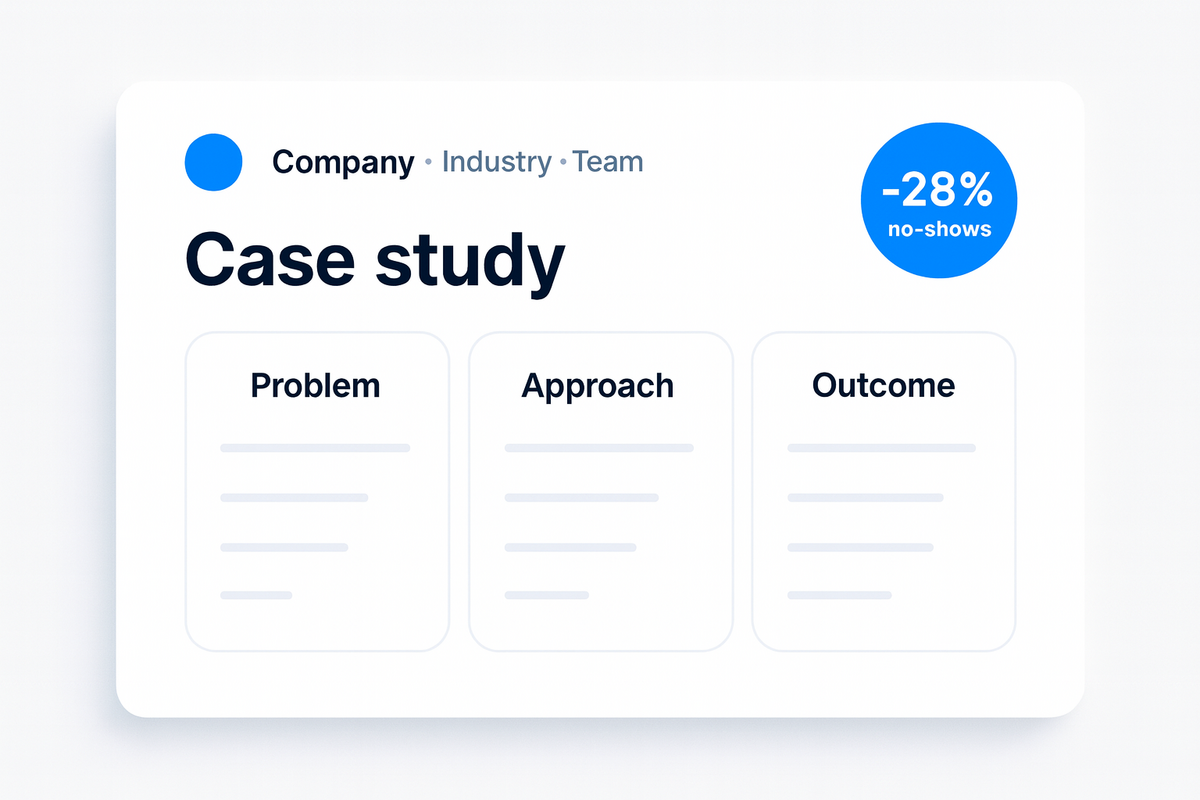
The stated objection is often not the real one. Your script must first draw the hidden objection out. Once you know the real blocker, handle it without sounding like you are correcting the buyer. Being told you are wrong is a hard pill to swallow, and nobody wants to pay for a tool that makes them feel stupid. In your follow-ups, favor objection handling paired with social proof — like sharing a case study highlighting similar problems from First Round Review or SaaStr — over defensive, point-by-point arguments. Keep your scripts focused on the 80% use case, and avoid scripting rare edge cases into the MVP version of your sales talk track.
FAQ
If the prospect's objection is factually wrong, should my objection handling script correct them directly?
No. Do not make the script a debate or a lesson where the buyer feels told they are wrong. First, pull the real objection into the open, because prospects often use factually incorrect statements as a smokescreen. Acknowledge the concern, ask what is underneath it, and then pair your handler with concrete social proof instead of arguing from your own authority.What should a sales objections and responses template include?
A strong template should include the stated objection, the likely hidden concern, a script pattern to isolate the real issue, and a specific next-step target to keep the deal moving forward. Avoid templates that just list aggressive rebuttals.Should I send objection handling responses over email?
You can, but avoid naked rebuttals. If a prospect raises an objection over email, the best response pairs a brief, empathetic acknowledgment with strong social proof (e.g., "I get the concern on implementation speed — here's how Acme Corp handled it in two weeks").Do I need a script for every possible objection?
No. Focus on the core 4 or 5 objections that come up in 80% of your calls. Rare edge cases don't need a formal script; they just require you to stay curious and ask clarifying questions.