TL;DR
A pitch deck is a standard container for your business evidence, not a fundraising shortcut. Before you worry about your 10-slide outline, check if you have MRR, pilots, or customer proof. Investors prefer a standardized deck structure because it removes friction, allowing them to skip decoding your format and focus entirely on your traction, market understanding, and customer validation.
A pitch deck template is a standardized sequence of slides that founders use to present their business model, market opportunity, and traction to potential investors. Rather than acting as a storytelling gimmick, it provides a predictable framework that allows backers to quickly evaluate the core metrics and viability of a startup.
I mentor dozens of founders every month, and many of them ask how to position their pitch deck for a raise before they have MRR, first traction, or clear proof anyone wants the product. The mistake is treating the deck template as the thing that makes the raise possible.
Because building is cheaper and faster now, a polished 10-slide deck without traction reads like optimism from a bygone era, not an investable B2B startup. As the startup funding environment evolves, investor scrutiny shifts heavily toward customer evidence.
Pause the deck. Check the proof.
Practical Framework: The Deck Readiness Check
Founders often mistake procedural diligence (worrying about slide design, narrative arcs, and storytelling aesthetics) for real due diligence. If you lack evidence, a template is unlikely to save you.
Before you start filling out your pitch deck, run through this reality check:
Do we have MRR or early revenue?
Do we have first traction or active usage?
Do we have design partners, LOIs, or credible customer interviews?
Do we know our exact Ideal Customer Profile (ICP) and their alternatives?
Do we have Go-to-Market (GTM) evidence beyond just guesses?
If the answer is no, your first fundraising problem is not slide design. Stop tweaking your deck and go collect evidence.
Why Investors Want a Standard 10-Slide Deck
A pitch deck template is not a magical storytelling device. It is a predictable, frictionless container.
Investors review hundreds of decks, and startup news on TechCrunch is full of hyped startups that failed to deliver on flashy slides. When you use a standardized sequence for your investor pitch, you remove the cognitive load of deciphering your format. They don't have to figure out where your revenue model is hidden. Instead, they can immediately evaluate your business traction. The deck is not where you make the business convincing. It is where you show the evidence that already exists.
Practical Asset: The Copy-Paste 10-Slide Outline
Here is a practical sequence for an early-stage B2B deck, heavily aligned with what Y Combinator recommends.
1. Title
Investor Question: Who are you and what do you do?
What to Write: Company name, logo, and a one-sentence clear value proposition.
Evidence to Include: One standout proof point, only if material.
2. Problem
Investor Question: Is this a real, painful problem?
What to Write: The specific workflow or business pain your ICP experiences.
Evidence to Include: Quotes from credible customer interviews or industry data.
3. Customer / ICP
Investor Question: Who exactly is bleeding from this?
What to Write: Firmographic and demographic details of the target buyer.
Evidence to Include: Pilot demographics, waitlist quality, or customer titles.
4. Solution
Investor Question: How does your product fix it?
What to Write: Clean visuals of the product resolving the specific pain.
Evidence to Include: Usage metrics on core features or "aha" moment data.
5. Market
Investor Question: Is this big enough to matter?
What to Write: TAM/SAM/SOM grounded in bottom-up math, not top-down guesses.
Evidence to Include: Competitor revenue pools or specific sector growth rates.
6. Traction
Investor Question: Do people actually want this?
What to Write: Hard numbers showing momentum for a strong market validation pitch deck.
Evidence to Include: MRR, active pilots, user retention, or signed LOIs.
7. Business Model
Investor Question: How do you make money?
What to Write: Pricing tiers, unit economics, and expected ACV.
Evidence to Include: Early willingness-to-pay validation or signed contracts.
8. GTM
Investor Question: How will you acquire customers?
What to Write: Your ICP-led distribution plan and early acquisition channels.
Evidence to Include: Customer acquisition cost (CAC) signals or organic growth rates.
9. Competition
Investor Question: Why you instead of the alternatives?
What to Write: A matrix separating you from incumbents on specific axes.
Evidence to Include: Customer switch reasons or win/loss data against rivals.
10. Ask
Investor Question: How much do you need and why?
What to Write: The capital target and the next milestone it funds.
Evidence to Include: Burn rate, runway extension, and hiring plan to hit the goal.
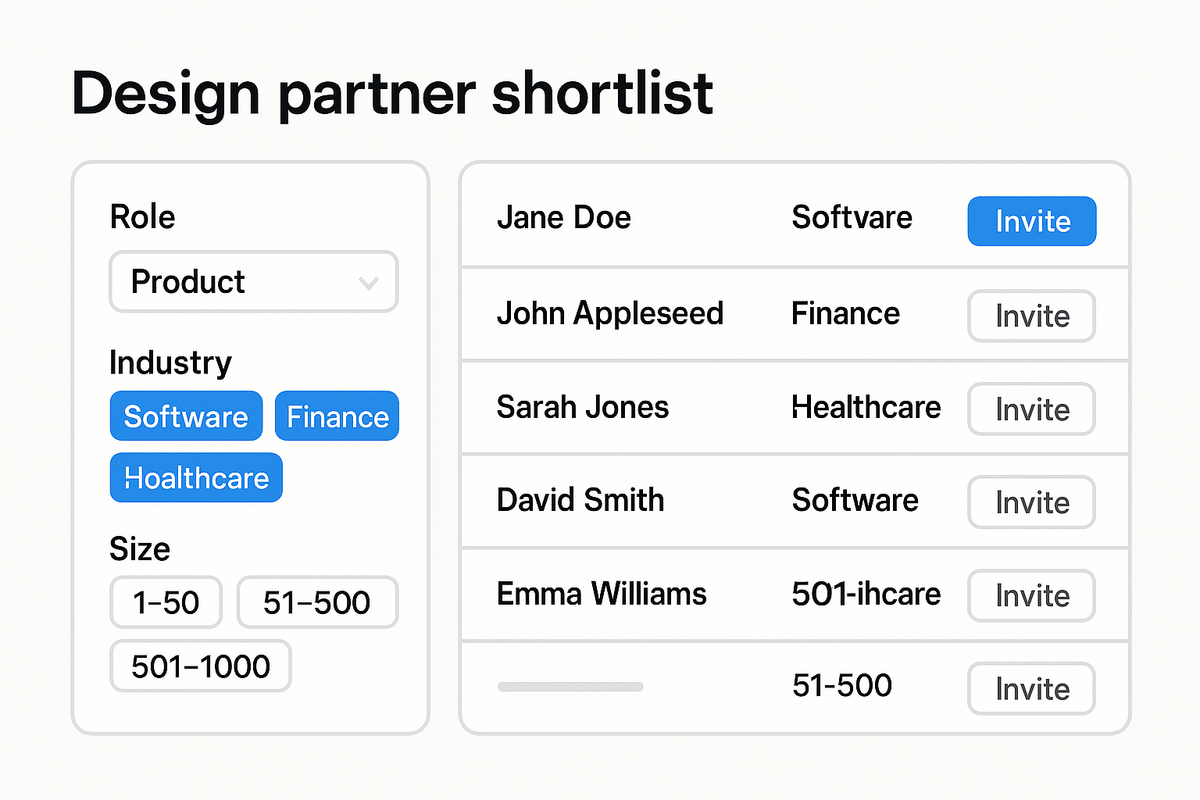
(Note: Turn your early validation into proof. If you are struggling with Slide 6, using a design partner template can help you lock in the evidence B2B decks need before a full raise.)
Hard-Slide Guidance: Nailing GTM and Competition
Two slides usually reveal whether a founder truly understands their market: Go-to-Market (GTM) and Competition.
Building the GTM Slide
There are many frameworks prioritizing different aspects of GTM strategy, but strong GTM cannot be built purely on hypothesis. Your GTM slide should start with firm prioritization of your ICP. If the ICP is wrong, your channel plan is mostly theater.
Show evidence for your pain-solution fit and your distribution hypothesis. Know the metrics that will prove whether those bets are working or invalidated.
Building the Competition Slide
A competition slide with generic "price" and "quality" axes usually says more about the founder’s positioning exercise than the market. Saying "we don't have competitors" is generally a red flag: if you don't know your competitors, you might not fully know your market.
Research the market to choose specific, non-universal separating axes. For example, when plotting SaaS tools for social media management, strong axes might be "one platform vs many platforms" and "growth-first vs full management." Plot your competitors truthfully based on real differentiators.
FAQ
What is the best pitch deck template for a B2B startup?
The most effective template follows a standard 10-slide order: Title, Problem, Customer / ICP, Solution, Market, Traction, Business Model, GTM, Competition, and Ask. This proven structure minimizes friction so investors can immediately assess your traction and market understanding.
Can I raise with no traction if my pitch deck design and narrative are incredible?
Usually, no. Founders often misunderstand the pitch deck template as a way to compensate for missing evidence. A great deck organizes proof; it does not replace it. If you have no MRR, no first traction, or no validated GTM, polish won't fix the gap.
Should I send the deck ahead of the meeting?
Yes. Investors want to scan the facts before they invest time in a call. A strong, standardized deck lets them quickly find your traction and ICP. If your deck relies on a voiceover to make sense, your slides are likely not clear enough.
How long should my pitch deck be?
Stick to the 10 essential slides. If you have deep technical architecture, extensive case studies, or complex unit economic breakdowns, push those to an appendix. Keep the main deck focused on the core narrative structure.