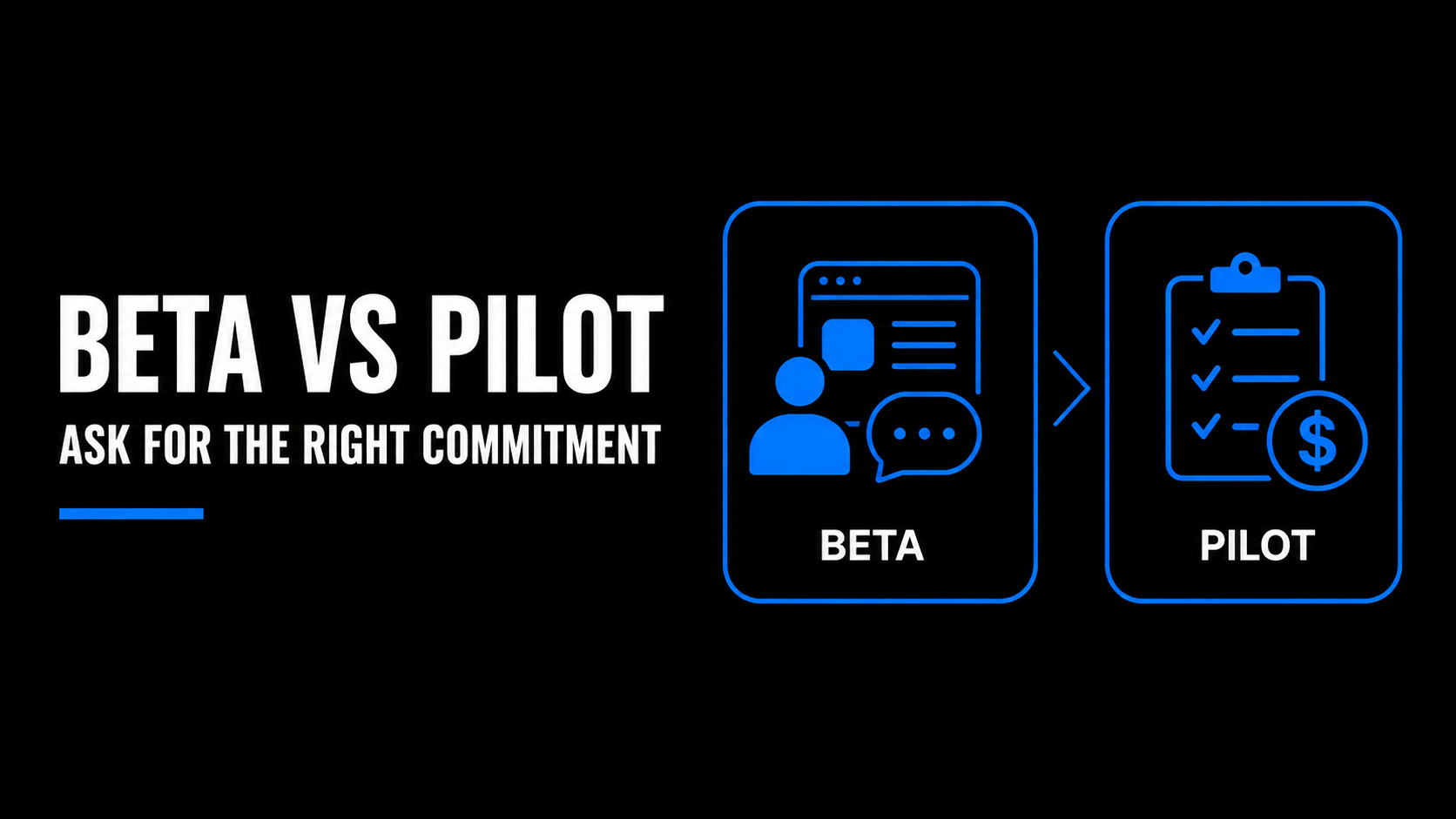
A beta customer helps you learn whether the product works for a real user. A pilot customer helps you learn whether a real buyer will commit budget, time, access, and internal sponsorship to solve the problem. The mistake is using “beta” as a soft word for a commercial relationship, then wondering why the account never converts. Choose the relationship type based on product readiness, customer risk, and the kind of evidence you need next.
TL;DR: Ask for the smallest real commitment that matches your evidence
Use a beta when the product is still proving usability, workflow fit, or core value. Use a pilot when you need commercial validation with named success criteria, a buying path, and a realistic conversion conversation.
Choose a beta customer when the product may still break, onboarding is rough, and your primary need is usage feedback.
Choose a pilot customer when the product can deliver a narrow business outcome and the customer can define success in advance.
Avoid calling something a beta if you are really asking for procurement access, stakeholder time, or a paid evaluation.
Read this as a decision guide, not a naming exercise.
Core definitions
Beta customer. An early user or account testing an unfinished product so you can learn about usability, workflow fit, bugs, missing features, and value clarity. For a broader beta overview, see how to work with beta customers.
Pilot customer. An account using the product in a limited commercial evaluation with agreed scope, success criteria, support expectations, and a possible path to rollout. If you are ready for that stage, read how to get pilot customers.
Success criteria. The pre-agreed conditions that tell both sides whether the pilot answered the decision it was meant to test.
Buying path. The practical route from trial use to a customer decision, including buyer, approver, budget process, review needs, and timing.
Beta customer vs pilot customer comparison
Start with the comparison, then use the decision tree to choose the ask.
Decision area | Ask for a beta when... | Ask for a pilot when... | Founder decision rule |
|---|---|---|---|
Product readiness | The product is usable but incomplete, fragile, or still missing obvious workflow pieces. | The product can deliver one narrow outcome reliably enough for a real account. | If failure would mostly teach you product lessons, choose beta. If failure would affect a business evaluation, choose pilot. |
Payment expectation | You mainly need access, usage, and feedback. Payment may be optional or deferred. | You need evidence that the buyer sees enough value to commit money, budget process, or equivalent internal effort. | Consider charging when the customer is evaluating business value, not merely helping you debug. |
Support burden | You expect high-touch onboarding, bug reports, and frequent product changes. | You can define support boundaries, response expectations, and implementation scope. | If support is unpredictable, do not present it as a clean pilot. |
Feedback depth | You need qualitative feedback on pain, workflow, UI, missing features, and value perception. | You need feedback tied to measurable outcomes, stakeholder adoption, and purchase blockers. | Betas answer “does this work for users?” Pilots answer “will this account buy or expand?” |
Success criteria | Success is learning: usage patterns, objections, missing workflows, and product gaps. | Success is pre-agreed: a workflow completed, cost reduced, cycle improved, risk lowered, or decision made. | If you cannot write success criteria, you are probably not ready for a pilot. |
Buying path | The user may not own budget and may simply be a helpful early tester. | The account can identify a buyer, sponsor, timeline, and next commercial step. | No buying path usually means beta, research, or design partner work, not a serious pilot. |
Short decision tree
Is the product still unstable or likely to need frequent manual rescue? If yes, ask for a beta customer. Keep the ask honest: “We are looking for early users who can test the workflow and give structured feedback.”
Can the product deliver one narrow business outcome without heavy founder effort? If no, stay in beta or design-partner discovery. Use beta customer feedback questions to learn what must change before a commercial evaluation.
Can the customer name the problem, owner, success criteria, and next decision step? If yes, ask for a pilot. Define the pilot around the customer’s decision, not your desire for a logo. Use pilot customer success criteria before kickoff.
Is there a meaningful commitment beyond “happy to try it”? If yes, you may be in pilot territory. The commitment might be payment, implementation time, data access, stakeholder meetings, or a dated decision review.
Does the relationship need formal terms? If the customer is paying, sharing sensitive data, involving multiple stakeholders, or expecting defined deliverables, compare design partner agreements vs pilot agreements before you proceed.
When to charge beta customers
You can consider charging a beta customer when the product already creates meaningful value and the customer is not simply donating feedback. But do not confuse “can charge” with “should force payment immediately.” A paid beta can be reasonable when the customer receives a usable outcome, understands the early-stage risk, and agrees to the tradeoff in plain language.
A pilot is often easier to frame as paid because it is a business evaluation rather than casual testing. If the customer wants implementation support, stakeholder alignment, custom setup, success reporting, or priority support, the relationship may have moved beyond casual beta testing.
A practical positioning rule: if the customer is asking “will this help our team decide?” you are probably in pilot territory. If they are asking “can we try this and tell you what breaks?” you are probably in beta territory.
Founder mistakes to avoid
Calling it a beta to avoid a pricing conversation. This delays the commercial truth you need.
Calling it a pilot when there are no success criteria, owner, budget path, or decision date.
Letting a friendly user become the entire account signal. A happy user is not the same as a buying process.
Over-customizing for one beta account before you know whether the pattern repeats.
Giving unlimited support in a “free pilot” without defining scope or the next decision.
Treating feedback volume as validation. Useful feedback is not the same as purchase intent.
External reality checks
The distinction matters because pilots and beta programs are both forms of learning, but they test different risks. The Lean Startup’s build-measure-learn framing is useful here: early product work should be tied to validated learning, not activity for its own sake (The Lean Startup methodology).
For commercial readiness, use customer discovery discipline. The National Science Foundation I-Corps program emphasizes testing hypotheses through customer discovery rather than assuming demand from internal conviction (NSF I-Corps customer discovery).
If you are deciding whether a pilot has enough evidence to move toward purchase, remember that B2B buying often involves multiple stakeholders, not only one enthusiastic user. Treat one champion’s enthusiasm as useful signal, then test whether the account can support a real decision.
Illustrative math: If a founder spends 20 hours supporting a free “pilot” that has no buyer, no success criteria, and no decision date, the cost is not zero. At a hypothetical internal value of $100 per founder hour, that is $2,000 of opportunity cost spent on an account that may only be a beta tester. The exact number is illustrative; the point is to price founder attention as a scarce resource.
Will beta customer vs pilot customer actually get you to first customers?
The label will not get you to first customers. The commitment behind the label might. A beta gives you product learning; a pilot gives you commercial learning when the buyer, success criteria, and next decision are real.
Founders overuse “beta” because it feels low-pressure. That can be useful when the product is genuinely early, but it becomes a hiding place when the real question is whether anyone will commit money, time, access, or internal reputation to the problem.
Ask for the relationship that matches the evidence you have. If the product is still risky, ask for a beta and learn quickly. If the product can solve a narrow business problem, ask for a pilot with clear terms, a defined outcome, and a path to a customer decision.
FAQ
Should I ever call a paid early customer a beta customer?
Yes, if the customer clearly understands that the product is early and the main purpose is learning while still receiving value. If the relationship includes success criteria, implementation support, stakeholder reviews, and a buying decision, “pilot” is often clearer positioning.
What if the customer refuses to pay for the pilot?
Do not treat refusal as an automatic no. Look for other commitment signals: executive sponsor time, data access, implementation resources, user participation, security review, or a scheduled decision meeting. If they will not commit anything meaningful, it is probably a beta, not a pilot.
Can a beta turn into a pilot?
Yes. A common path is beta first, then pilot once the product is stable enough and the account can define a business outcome. The transition should be explicit: new scope, new success criteria, new timeline, and a clear next commercial step.
How long should a beta or pilot last?
There is no universal duration. The right length is the shortest period needed to answer the specific risk. A beta ends when you have enough product learning to make the next build or positioning decision. A pilot ends when both sides can judge the agreed success criteria and decide whether to continue.