TL;DR: Concept validation testing moves your idea from qualitative interviews to quantitative evidence. Stop relying on warm feedback. Drive cold traffic to a landing page and measure real paid intent to see if strangers will actually act on your promise.
What is concept validation testing?
It is a quantitative method to measure whether cold traffic will take a specific, high-friction action toward buying a proposed product. Unlike surveys that ask what people might do, concept testing forces users to make a real choice, providing hard data on market demand before you build anything.
It happens all the time. A founder has an idea. They talk to friends, advisors, and a few friendly prospects. The idea testing phase seems to go well. People say they would use the product. The founder feels momentum and decides the concept is validated.
Then they launch. They put the offer in front of cold traffic. Nobody buys.
Your idea is not validated because people understood it. It is validated when the right strangers act on it. Qualitative customer interviews are great for explaining why people care and what hurts. But concept testing is the mathematical counterpart to those interviews. It tests whether the market will actually move.
The Signal Ladder: From Polite Lies to Paid Intent
Most founders mistake encouragement for demand. A waitlist signup is a soft signal. It feels good, but it is not the same as someone trying to buy. You need to know what action counts as a real signal.
Here is how to rank the strength of your validation signals:
Polite feedback (Weakest): They do not want to hurt your feelings.
Survey interest (Weak): They like the idea in theory.
Email signup (Low): They want to see what happens next.
Demo request (Medium): The pain is sharp enough to spend time on.
Checkout start (High): They are willing to consider the price.
Deposit/payment (Strong): They need the problem fixed right now.
LOI/revenue (Strongest): The business commits budget to the solution.
You want to design a test that pushes users as far up this ladder as possible. Getting honest feedback through talking to users requires stepping out of the comfort zone of simple surveys.
The Extreme Fake-Door Test
If you want definitive proof, test for real paid intent.
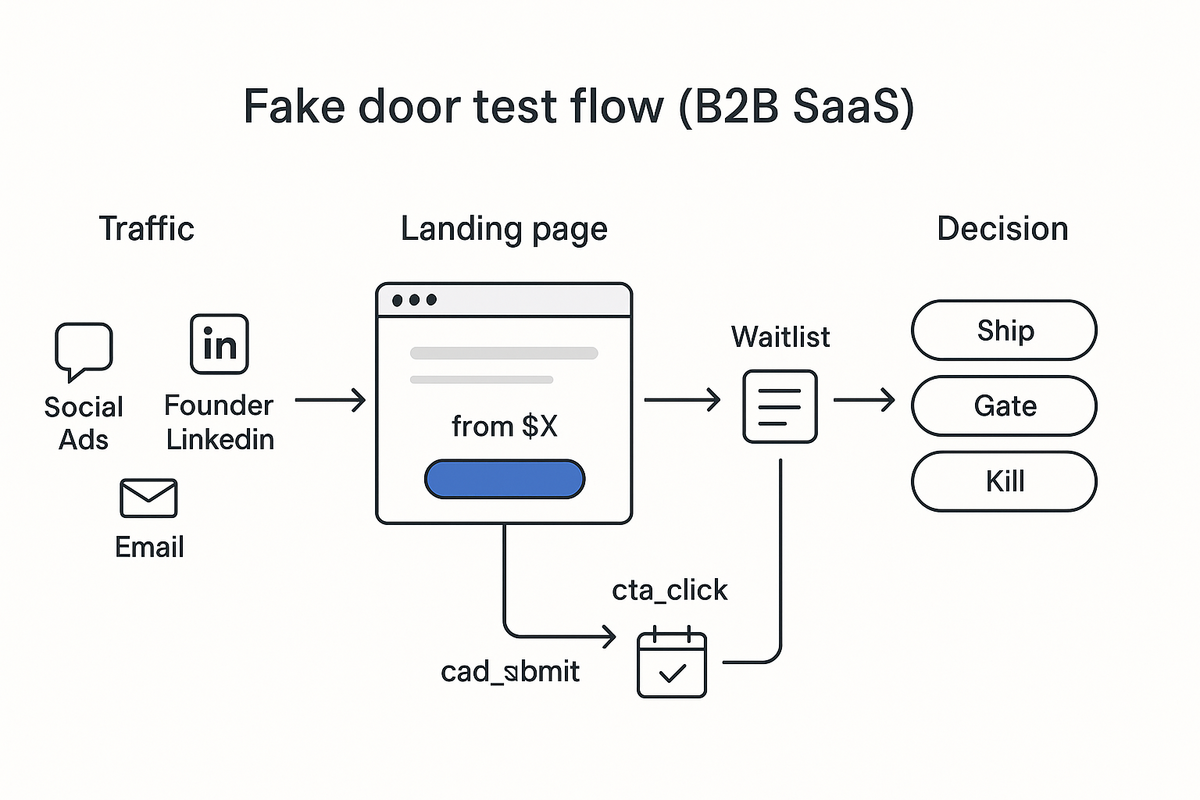
One of the strongest practical checks you can run is a fake-door test that pushes all the way to a transaction. You run an ad to a landing page. The page makes a clear promise and offers a buy button. The user clicks buy and actually completes a payment for a product that does not yet exist.
You then immediately reverse the bank charge. You send them an honest note explaining that capacity just ended or the beta is full. You apologize, confirm their money is refunded, and put them on a waitlist.
The goal is not to trick people or cause harm. Ethical fake-door testing requires immediate refunds and clear follow-up. But this approach proves with real money that people need the solution. It builds trust, and it gives you undeniable evidence that your acquisition and retention assumptions are grounded in reality. You can find more structural variations in these fake door test examples.
Designing the Test
A concept test uses targeted ads to drive cold or semi-cold traffic to a landing page. Paid ads buy speed, not truth. Bad targeting or weak copy can ruin the test. You need a clear sequence.
Hypothesis: Define your target and their exact pain point.
Audience: Pick the segment based on market research. Focus on a specific niche, like green SMBs, before testing.
Ad: Create the creative and copy that interrupts their day.
Landing Page: Make a clear promise and explain the value.
Conversion Event: Pick the action that proves intent. Aim for the top of the signal ladder. Track fake door test metrics carefully.
Decision Rules: Set a clear threshold before you launch. Define exactly what conversion rate means you proceed, revise, or stop.
Do not run the test just to see what happens. Set your threshold first. Understand what metric will invalidate your hypothesis for now. The math you establish here will eventually drive your measurement of product-market fit. If you do not know what failure looks like, you are just running an expensive ego boost. Frameworks for early product-market fit rely on hard metrics, not feelings.
Concept Validation Testing Formula
To prevent false positives, define these parameters before turning on your ads:
Traffic Source: Where will the cold traffic come from?
Audience: Who exactly are you targeting?
Budget Guardrails: Set a strict limit to buy enough clicks without overspending.
Traffic Minimum: Wait for a highly targeted sample before reading the conversion rate.
Test Duration: Run the test long enough to account for daily behavioral variations.
Landing Page Conversion Rate: How many visitors start the action?
Paid-Intent Rate: How many visitors complete the high-friction action?
Cost Per Signal: How much does one validated intent cost?
Proceed/Revise/Stop Threshold: At what number do you build, change the offer, or kill the idea?
Test-Planning Checklist
Before you launch your concept test, run through this scorecard:
The landing page directly addresses a specific, painful problem.
The core offer is clear and free of jargon.
The target audience is narrow and clearly defined.
The conversion event requires real effort or money.
The success threshold is written down.
Analytics and tracking are active.
A plan is in place to handle successful conversions (e.g., immediate refund, waitlist email).
FAQ
What is a good conversion rate for concept validation testing?
There is no universal number because friction varies. The goal is not to hit a benchmark, but to establish a baseline cost for acquiring a highly qualified user. If it costs too much to get a small deposit, the unit economics are probably broken.
How much traffic do I need?
You need enough data to trust the math. If you only send a small group to a page and nobody buys, you have not invalidated the idea; you just have not tested it enough.
Can I use a waitlist instead of payment?
You can, but it provides a weaker signal. A waitlist shows mild curiosity. A payment proves real urgency. If you use a waitlist, increase the friction by asking qualifying questions to ensure the intent is genuine.
What do I do when customers complain about a missing feature during testing?
Celebrate. In most cases, founders overcomplicate the product. Customers do not care about the features you think they do. If they complain about something specific missing, it means they are actually trying to use the product to solve a real problem. It is a strong positive signal.
Is it okay to ask for payment when you have nothing built yet?
Yes, it is often the strongest approach. This is how you prove real demand. Think of it as providing them custom development for a fraction of the cost. If it is a problem they cannot solve on their own, asking for payment validates that they truly need it fixed.