A fake door test is only useful if you know what the numbers mean after the click. Founders often overread the first metric that looks good: ad click-through, landing-page clicks, waitlist joins, or polite replies. The job is to separate curiosity from demand so you can decide whether to keep testing, change the page, run more discovery, or start pilot conversations.
TL;DR: Treat intent depth as the signal
The most useful fake door test metrics move from shallow interest to costly action: click, signup, reply, qualification, and willingness to discuss a next step. Do not call a test successful because one layer looks strong while the next layer collapses.
A click is attention, not demand; use it to judge whether the promise is understandable enough to investigate.
A signup or waitlist join is stronger, but it still needs source, audience fit, and follow-up quality to mean much.
A qualified reply or pilot conversation is often one of the strongest fake-door signals because the user is spending time, context, and reputation.
Read the tables as interpretation ranges, not universal benchmarks.
Core definition
Qualified signal. An action from someone who matches the target customer profile and expresses a problem, urgency, budget, workflow pain, or willingness to continue the conversation.
Fake door test metric interpretation framework
Use this framework to read fake door test metrics without pretending there is one universal fake door test conversion rate. If you need the basics of setup first, start with the fake door test guide, then come back to this page for interpretation.
Step 1: Separate the test into signal layers
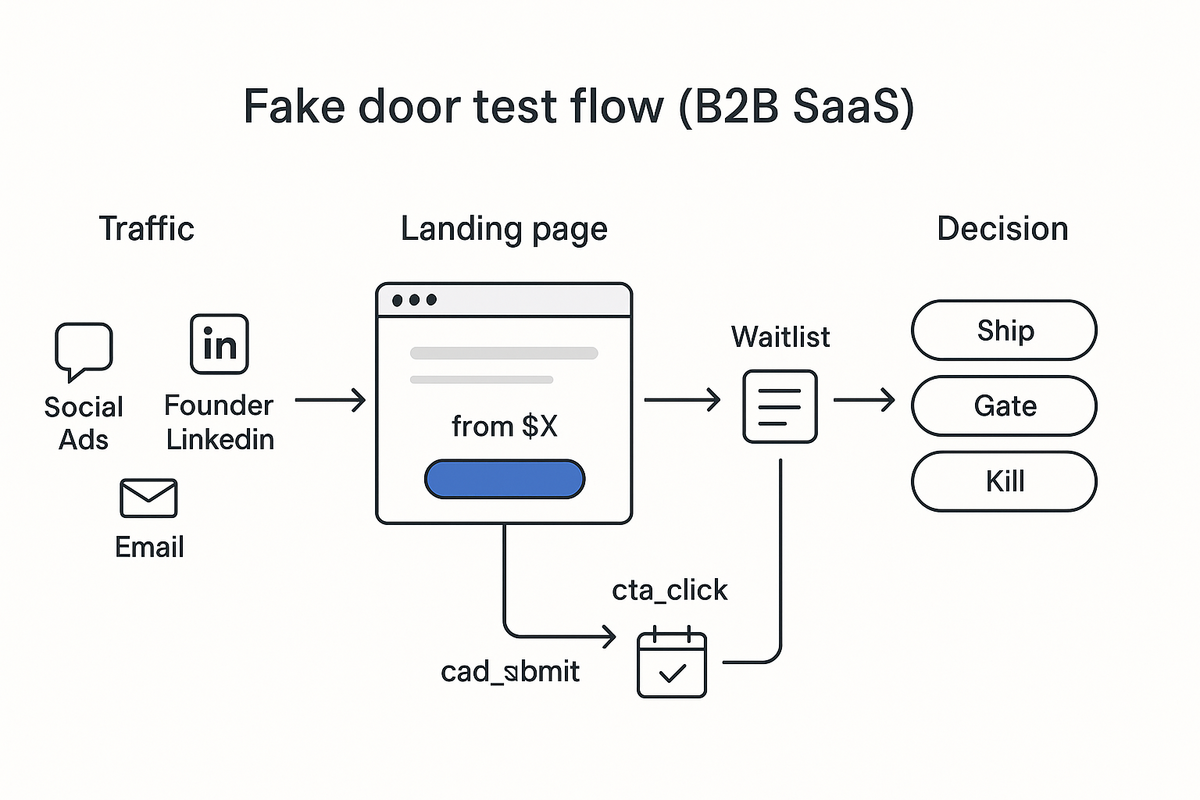
Do not average everything into one success number. Break the funnel into layers:
Impression to click: Did the promise earn attention?
Click to destination action: Did the page make the next step believable?
Signup or waitlist to reply: Did the person care after the first impulse?
Reply to qualified conversation: Did the need match your target customer?
Conversation to pilot discussion: Is there enough urgency to justify deeper work?
A fake door test is strongest when multiple layers point in the same direction. A high click rate with weak follow-through usually means the hook is interesting, but demand is not yet proven.
Step 2: Use metric bands as prompts, not verdicts
The tables below use cautious interpretation bands. They are not market benchmarks. They are a practical way to decide what to do next when sample sizes are small and traffic quality varies.
Click signal table
Metric | Weak signal | Mixed signal | Stronger signal |
|---|---|---|---|
Ad or post click-through | People notice but do not self-select | Some audience-message fit | Clear enough promise to investigate |
Internal product click | Feature may be easy to ignore | Useful if repeated by target users | Stronger if tied to an active workflow |
Search result click | Query may be relevant but broad | Intent depends on keyword specificity | Stronger when keyword shows problem urgency |
Use click data to improve positioning, not to approve a build. A click tells you the surface promise worked. It does not tell you the user would switch, pay, invite a teammate, or change a workflow.
For external context, Google Ads click-through rates vary heavily by industry and network, which is why a generic CTR target can mislead founders (Google Ads Benchmarks from WordStream). Treat that type of benchmark as a channel reference, not a product-validation truth.
Signup and waitlist signal table
Signal | Better interpretation | Watch out for | Next move |
|---|---|---|---|
Email signup | The promise earned low-friction intent | Free curiosity, weak persona fit | Send a short qualification email |
Waitlist join | User accepts delay for possible access | Novelty, not urgency | Ask what triggered interest |
Calendar request | User is willing to spend time | Incentive-driven calls | Run discovery before pitching |
Team invite or referral | Pain may be shared | Social courtesy | Ask who else owns the problem |
A waitlist is not demand by itself. It becomes more meaningful when people explain the problem in their own words, respond to follow-up, or ask when they can use the product. For examples of how different fake doors can produce different signals, compare the patterns in fake door test examples.
Step 3: Judge qualified replies more heavily than passive actions
Qualified replies are often more useful than raw signup volume because they reveal context. Ask three follow-up questions:
What were you trying to do when this caught your attention?
How are you solving this today?
What would have to be true for this to be worth trying?
You are looking for specifics: current workaround, cost of the problem, owner of the workflow, timing, and willingness to keep talking. The Mom Test is a useful book reference for asking about real past behavior instead of collecting compliments; that principle applies here even when the first touch came from a fake door (The Mom Test).
Qualified-reply signal table
Reply pattern | Interpretation | Founder response |
|---|---|---|
"Looks interesting" only | Weak; likely courtesy | Ask for current workflow or discard |
Describes a real current workaround | Stronger; problem exists | Run discovery and map alternatives |
Asks about timing, access, or limits | Stronger; active evaluation | Offer a pilot-style conversation |
Mentions budget, owner, or procurement | Strongest in this rubric; commercial context exists | Validate buying path carefully |
Step 4: Compare by traffic source
Fake door test success metrics change meaning depending on where the traffic came from.
Traffic source | Why it can mislead | How to read it |
|---|---|---|
Paid ads | Targeting can produce clicks without urgency | Segment by keyword, audience, and ad promise |
Communities | Social proof and curiosity can inflate engagement | Count replies from target buyers separately |
Existing product traffic | Users may click because they trust you already | Compare with actual workflow behavior |
Founder outreach | Higher context, smaller sample | Treat replies as discovery leads, not a market estimate |
Search traffic | Intent may be strong or vague | Separate problem queries from research queries |
If you are running a broader startup smoke test, use the same principle: channel affects signal quality. A founder-led test with a small group of targeted buyers can teach something different from a larger set of broad paid impressions.
Step 5: Look for proof of demand, not proof of attention
A useful fake door test answers one of three questions:
Does the target customer notice the promise?
Does the target customer take a next step?
Does the target customer reveal urgency, pain, or willingness to engage?
Only the third question starts to resemble proof of demand. For a wider set of demand signals, compare your result against proof of demand examples.
Misleading metrics to discount
Total page views without source quality.
Clicks from untargeted audiences.
Signups that never reply to a basic follow-up.
Waitlist joins from people outside the buyer or user profile.
Averages that hide one good channel and several bad ones.
High intent caused by a misleading promise you cannot actually deliver.
Survey answers about future behavior without evidence of current pain.
Even in testing contexts, keep claims conservative and clear. A fake door can test demand without overstating availability, pricing, or outcomes.
Step 6: Decide what to do next
Use this decision rule:
Result pattern | What it probably means | Next action |
|---|---|---|
Low click, low signup, no replies | Message or audience mismatch | Rewrite promise or change segment |
High click, low signup | Curiosity without trust or clarity | Improve page, offer, or next step |
Signup, no reply | Low-friction interest only | Tighten qualification and follow-up |
Few signups, strong qualified replies | Narrow but real pain | Run discovery and explore pilots |
Strong across layers | Worth deeper validation | Add to your validation plan |
If the result is promising, do not jump straight to building the full product. Add the next experiment to a business validation plan: discovery calls, concierge delivery, a manual pilot, pricing conversations, or a smaller feature test.
Step 7: Avoid common founder interpretation errors
The most common error is treating fake-door conversion as a scoreboard instead of a diagnostic. These mistakes are especially expensive:
Calling a broad-audience click rate "validation."
Comparing your numbers to another company's funnel without matching channel, audience, and offer.
Ignoring who converted.
Counting waitlist joins without follow-up.
Changing the product idea after every small sample.
Hiding the fact that the product or feature is not yet available.
Before deciding whether to build, check whether the same signal appears across a defined segment, a believable next step, and at least one real conversation.
Sample math: hypothetical example, not a benchmark
Imagine 1,000 targeted landing-page visitors produce 80 feature clicks, 18 waitlist joins, 7 replies to a follow-up, and 3 qualified discovery conversations. That is an 8% visitor-to-click rate, 22.5% click-to-waitlist rate, 38.9% waitlist-to-reply rate, and 42.9% reply-to-qualified-conversation rate. The useful signal is not "8% clicked"; it is that 3 target-fit people described enough pain to justify more discovery or a pilot conversation.
Will fake door test metrics actually get you to first customers?
Fake door test metrics can help you find the line between casual curiosity and real demand. They are especially useful when you read them as layers: attention, action, reply quality, and next-step willingness.
They break when founders treat the numbers as proof that a product should be built. A fake door is a discovery tool, not a revenue forecast. The right response to a promising result is usually more conversation, a sharper validation plan, or a small pilot, not a full roadmap.
The founder mistake to avoid is optimizing for the metric that feels best. If clicks are high but qualified replies are weak, you have a messaging or curiosity signal. If a few qualified buyers lean in hard, you may have a narrow demand signal worth pursuing carefully.
FAQ
What is a good fake door test conversion rate?
There is no universal good rate because the number depends on channel, audience, offer, friction, and sample quality. A lower conversion rate from highly qualified buyers can be more useful than a higher conversion rate from untargeted traffic. Read conversion by layer: click, signup, reply, qualified conversation, and pilot intent.
Should I use waitlist signups as the main success metric?
Use waitlist signups as a middle signal, not the final signal. A waitlist join becomes more meaningful when the person matches your target profile, responds to follow-up, describes a current workaround, or asks for access with a real use case.
How many responses do I need before trusting the result?
Do not use a fixed response count as a magic threshold. With small startup tests, trust increases when responses are consistent across a clearly defined segment and when the same pain appears in follow-up conversations. If the audience is broad or mixed, you need more segmentation before interpreting the result.
What should I do if clicks are strong but replies are weak?
Treat it as a curiosity signal. Improve the landing page, clarify the promise, add a better qualification step, or change the traffic source. Do not start building until you understand why people clicked but would not continue.