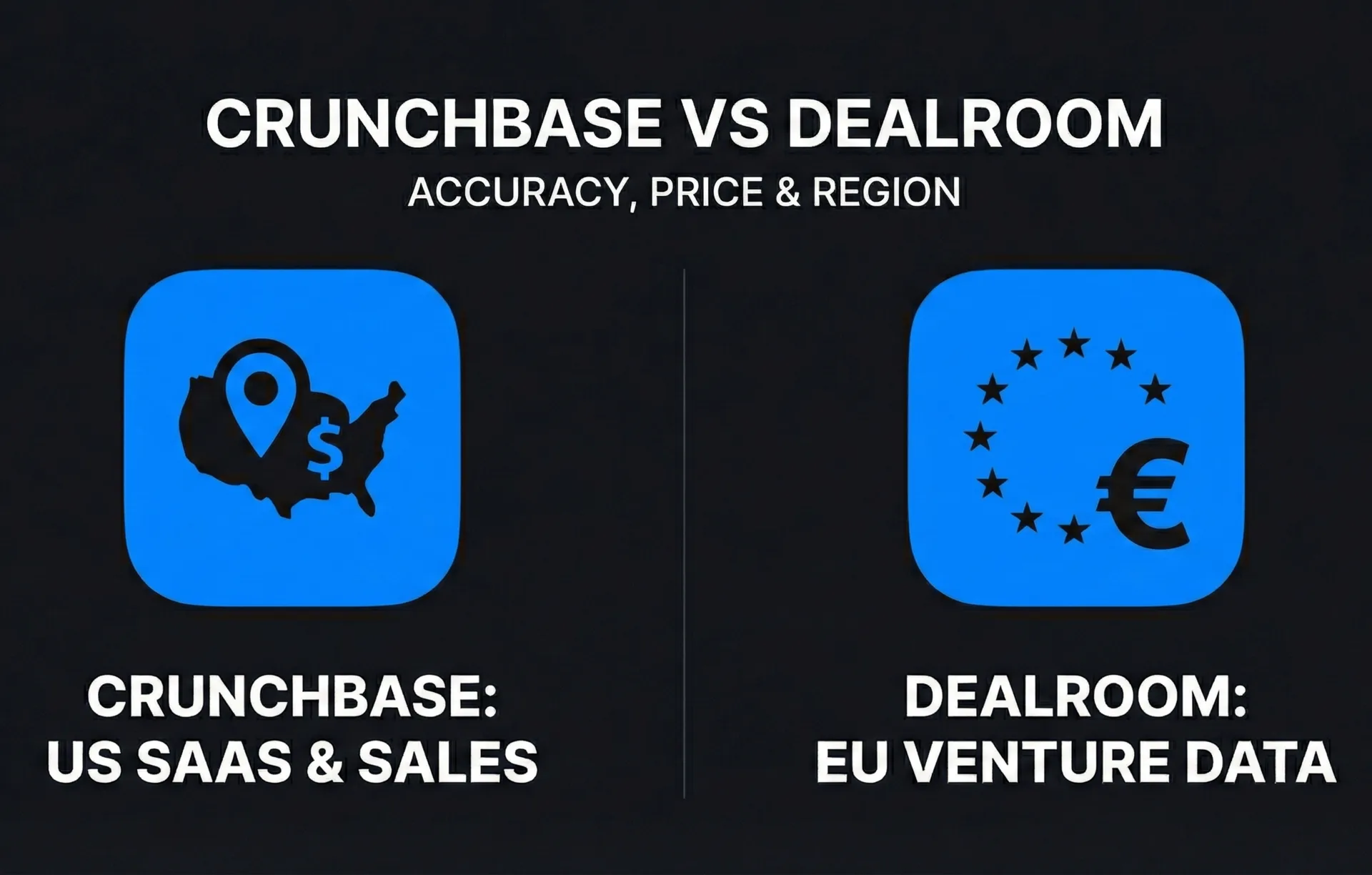
Crunchbase vs Dealroom: Data Accuracy & Price Comparison (2026)
last updated: Apr 27, 2026
Choosing between Crunchbase and Dealroom isn't about which tool has "more" data; it's about whether you need high-volume US sales leads or verified European venture intelligence. If you pick the wrong one, you will either burn your budget on data you can't use or starve your pipeline with noise.
TL;DR
Crunchbase is the "Yellow Pages" of startups: massive volume, global reach, and affordable for individual SDRs ($49/mo), but plagued by unverified user submissions. Dealroom.co is the "Bloomberg Terminal" for European VCs: expensive (€12,000/yr min), highly accurate government-verified data, but overkill for simple prospecting.
How to choose your data source: Read the comparison below.
- Benchmark: Crunchbase updates usually lag by 22–30 days in the US; Dealroom updates are faster in the EU due to ecosystem partnerships.
- Rule: If you sell to US SaaS, buy Crunchbase. If you invest in EU Pre-Seed, buy Dealroom.
- Warning: Do not confuse Dealroom.co (Data) with DealRoom (M&A Virtual Data Room). They are completely different software categories.
How to choose your data source: Read the comparison below.
Glossary
- Dealroom.co: The Amsterdam-based data provider focused on detailed startup ecosystem intelligence, government partnerships, and venture capital trends.
- DealRoom (VDR): A Chicago-based M&A project management and virtual data room software. (We are comparing Dealroom.co in this guide).
- Pre-Seed Signal: The ability to detect a startup before they announce funding (e.g., via employee growth, stealth mode hiring, or accelerator cohorts).
- Registry-Verified Data: Data sourced from official government filings (Dealroom strength) versus "Crowdsourced" data submitted by users (Crunchbase strength/weakness).
The Asset
Use this table to make your final budget decision. The "Winner" is defined by ROI for an early-stage B2B founder.
Benchmarks
To understand the true cost, you must look at the "Cost per Lead" calculation, not just the sticker price.
- Scenario: You need to find 100 qualified leads per month.
- With Crunchbase: Cost is ~$49/mo. You export 1,000 rows, filter manually, and find 100 good ones. Math: $49 / 100 = $0.49 per Lead (excluding labor).
- With Dealroom: Cost is ~$1,000/mo (amortized from the €12,000 annual minimum). You export 120 rows, and 100 are good because the filters are precise. Math: $1,000 / 100 = $10.00 per Lead.
- Insight: Unless a single lead is worth >$5,000 LTV and requires deep intelligence to close, Crunchbase is the mathematically superior choice for volume generation. For effective organization of this volume, use a structured Crunchbase Account Research Template.
Crunchbase vs Dealroom
The core difference lies in the source of truth. Crunchbase relies on a "Wikipedia-style" model where founders, investors, and community members submit data. This results in massive coverage (4M+ entities) but significant noise—outdated founders, dead startups, and inflated employee counts. It is excellent for volume. If you are building a broad outreach campaign, you should use our Crunchbase Search Strategy 2026 to filter out the junk.
Dealroom.co operates closer to a surveillance agency. They partner with local governments and 100+ tech ecosystems (e.g., Tech Nation in the UK, La French Tech in France) to access official business registries. This means if a startup exists legally in Europe, Dealroom knows about it before it even has a website. However, this level of intelligence comes with an "institutional" price tag, making it inaccessible for most early-stage founders compared to alternatives like Pitchbook.
Dealroom.co operates closer to a surveillance agency. They partner with local governments and 100+ tech ecosystems (e.g., Tech Nation in the UK, La French Tech in France) to access official business registries. This means if a startup exists legally in Europe, Dealroom knows about it before it even has a website. However, this level of intelligence comes with an "institutional" price tag, making it inaccessible for most early-stage founders compared to alternatives like Pitchbook.
Risks
Contract Lock-in (Dealroom): Dealroom strictly operates on annual contracts paid upfront. There is no monthly trial. If you buy it and realize the data doesn't fit your specific niche, you are out €12,000 with no recourse.
Data Decay (Crunchbase): The biggest risk with Crunchbase is "Zombie Data." Because it is crowdsourced, a startup that died six months ago might still look "active" on their profile. You must verify every domain before emailing. Relying solely on Crunchbase data without secondary verification will wreck your domain reputation.
Data Decay (Crunchbase): The biggest risk with Crunchbase is "Zombie Data." Because it is crowdsourced, a startup that died six months ago might still look "active" on their profile. You must verify every domain before emailing. Relying solely on Crunchbase data without secondary verification will wreck your domain reputation.
Will buying Dealroom actually get you to $10k MRR?
Probably not. Data is just fuel; your offer is the engine. You can have the most accurate, verified data on every pre-seed startup in Berlin via Dealroom, but if your outreach script is generic, you will fail. Use Crunchbase if you need volume in the US; use Dealroom if you are an investor needing truth in Europe. Just don't expect either to solve a lack of product-market fit. Fix your foundation before you launch.
FAQ
- You:Why is Dealroom so much more expensive than Crunchbase?Guide:Dealroom sells "Intelligence" to investors who write $1M checks. Crunchbase sells "Contact Info" to salespeople making cold calls. Dealroom's high price reflects the manual verification and granular ecosystem reports that VCs require to make investment decisions.
- You:Can I use Crunchbase for European prospecting?Guide:Yes, but expect higher "bounce rates." Crunchbase relies on user submissions. In Europe, where founders are more private and less likely to self-report to US databases, the data is often 3–6 months stale compared to Dealroom.
- You:Does Dealroom have a monthly plan?Guide:No. As of 2025, Dealroom operates on annual contracts (typically starting at €12,000). There is no "swipe credit card and go" option like Crunchbase Pro.
- You:What is the difference between Dealroom.co and DealRoom?Guide:Dealroom.co is a data provider. DealRoom is a Virtual Data Room (VDR) for M&A due diligence. They are unrelated companies.
Find where your first 100 customers are in 2 mins. — or browse all the free founder guides.
No-BS guides