Crunchbase vs Pitchbook: The Pre-Seed Founder's Decision Guide
last updated: Apr 29, 2026
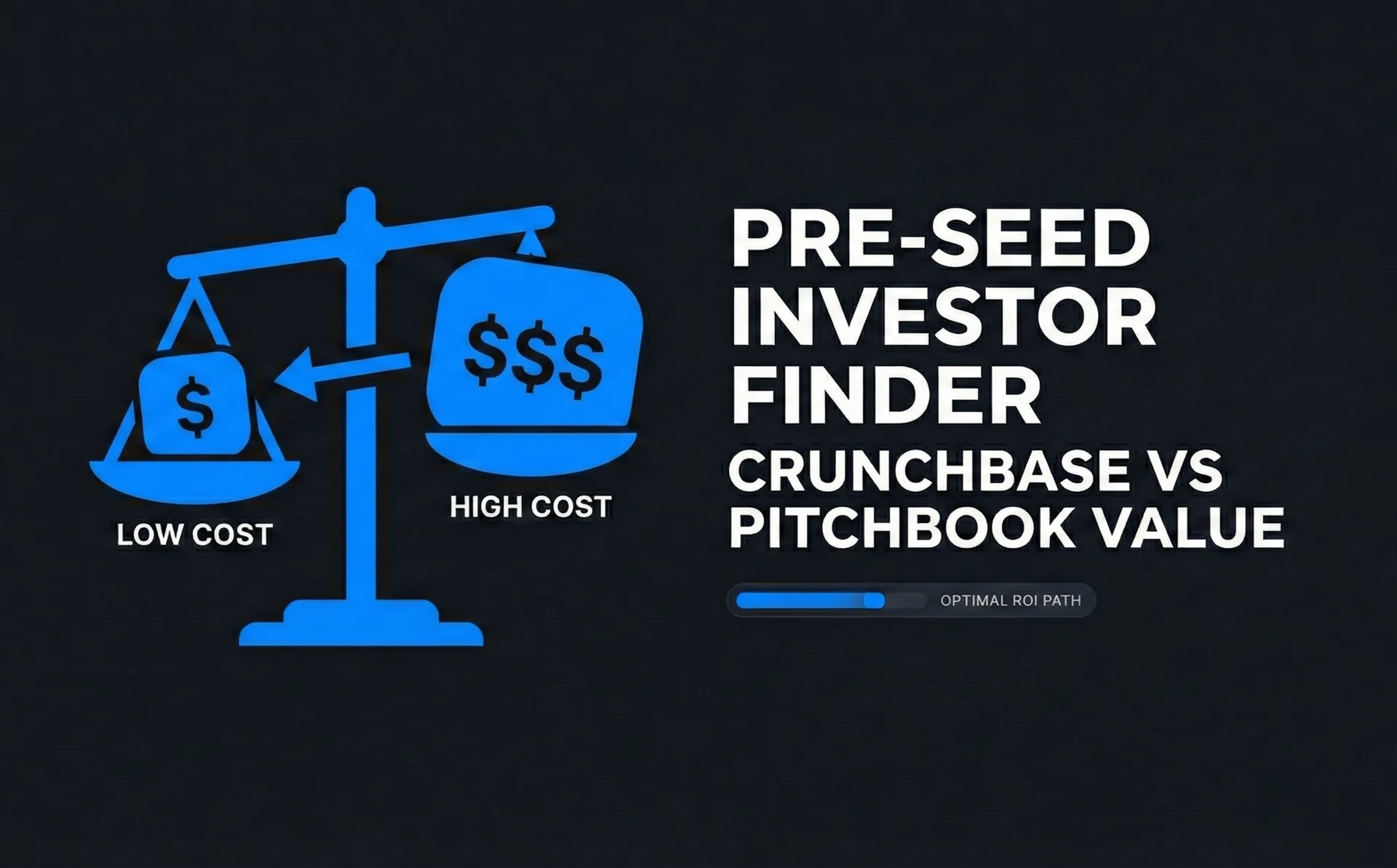
You are deciding between spending $500-600 or $20,000-25,000 to find investors. For a pre-seed founder, this is not just a software choice; it is an IQ test on burn rate management.-
TL;DR
If you have under $1M ARR, buy Crunchbase Pro. If you are a VC firm or Private Equity associate, buy PitchBook.
The Cheat Code:
How to read this comparison: Focus on the "Burn Rate Impact" in the Benchmarks section below before looking at feature lists.
The Cheat Code:
- Benchmark: PitchBook costs 40-50x more than Crunchbase Pro.
- Rule: Never spend >1% of your total raise on a database just to find the investors.
- Warning: PitchBook sales reps often enforce 3-seat minimums ($20,000-25,000/year), making single-founder access nearly impossible without a university login.
How to read this comparison: Focus on the "Burn Rate Impact" in the Benchmarks section below before looking at feature lists.
Glossary
- Pre-Money Valuation: The value of a company before it receives external funding. PitchBook excels at tracking this historical data, while Crunchbase often relies on estimates or user submissions.
- AUM (Assets Under Management): The total market value of the investments a VC firm manages. High AUM firms ($500M+) appear on both platforms; micro-VCs are often found faster on Crunchbase due to crowdsourcing.
- LPs (Limited Partners): The investors behind the VCs. PitchBook is the gold standard for finding LP data. Crunchbase has almost zero utility here.
The Asset
Use this decision matrix to validate your purchase. If you cannot check at least 3 boxes in the "PitchBook" column, you are burning cash unnecessarily.
Pre-Seed Data Decision Checklist
Pre-Seed Data Decision Checklist
Benchmarks
Do not look at the sticker price. Look at the runway impact. Here is the sample math for a typical pre-seed scenario.
Sample Math: The "Burn Rate" Impact
Scenario: You have raised a $500k friends and family round and have 10-12 months of runway (burning ~$41k/month).
The Verdict: PitchBook's data is 15-20% better, but it costs 4,000-5,000% more. For a pre-seed founder, that math never works.
Sample Math: The "Burn Rate" Impact
Scenario: You have raised a $500k friends and family round and have 10-12 months of runway (burning ~$41k/month).
- Option A (PitchBook): You spend $20,000–25,000 upfront.
- Option B (Crunchbase): You spend ~$588 upfront.
The Verdict: PitchBook's data is 15-20% better, but it costs 4,000-5,000% more. For a pre-seed founder, that math never works.
Crunchbase Pro vs PitchBook
Beyond price, the user experience dictates how fast you can work. Crunchbase is built for speed; PitchBook is built for analysts.
Winner/Loser Comparison
Winner/Loser Comparison
or independent verification, you can check how users compare data quality reviews on G2 or read a detailed PitchBook pricing analysis on TrustRadius.
Risks
1. The "Silver Bullet" Fallacy
Founders often buy PitchBook believing the high price tag guarantees investor replies. It does not. Access to data is not access to capital. Spending $25k reduces your runway, increasing the pressure to raise immediately, which investors can smell. This is a strategic error.
2. Data Decay in Crunchbase
Crunchbase relies heavily on community edits and AI scraping. Contact emails can bounce at a rate of 15–25%. You must pair Crunchbase with a verification workflow. Read our guide on exporting leads from Crunchbase to handle this efficiently.
Founders often buy PitchBook believing the high price tag guarantees investor replies. It does not. Access to data is not access to capital. Spending $25k reduces your runway, increasing the pressure to raise immediately, which investors can smell. This is a strategic error.
2. Data Decay in Crunchbase
Crunchbase relies heavily on community edits and AI scraping. Contact emails can bounce at a rate of 15–25%. You must pair Crunchbase with a verification workflow. Read our guide on exporting leads from Crunchbase to handle this efficiently.
Will buying data actually get you to $10k MRR?
Mastering investor search is a necessary step, but it is not the whole picture. Access to capital starts with access to information, but information alone does not print term sheets. Founders often use expensive tools like PitchBook as "procrastination purchases" — thinking that if they just had better data, the investors would say yes.
You can have perfect execution here, but if your other variables (Offer, Strength, Market Timing) are weak, your probability of hitting $10k MRR remains near 0%. PitchBook is a status signal for VCs; Crunchbase is a utility tool for builders. Do not confuse the map with the territory. Buy the tool that lets you move fast, break things, and close your round without bankrupting the company before you start. Once you have the tool, you need a method: check our guide on how to build a Crunchbase search strategy. Fix your foundation before you launch.
You can have perfect execution here, but if your other variables (Offer, Strength, Market Timing) are weak, your probability of hitting $10k MRR remains near 0%. PitchBook is a status signal for VCs; Crunchbase is a utility tool for builders. Do not confuse the map with the territory. Buy the tool that lets you move fast, break things, and close your round without bankrupting the company before you start. Once you have the tool, you need a method: check our guide on how to build a Crunchbase search strategy. Fix your foundation before you launch.
FAQ
- You:Can I share a PitchBook login to save money?Guide:Technically, no. PitchBook aggressively monitors simultaneous logins and IP addresses. If you get caught, they will lock the account and you lose the $20,000-25,000 investment. It is not a reliable strategy for a serious founder.
- You:Is Crunchbase data accurate enough for a pitch deck?Guide:Yes, for directional data (competitor names, recent round sizes). However, do not use Crunchbase for exact valuation multiples in a financial model. For rough benchmarks in a pre-seed deck, it is perfectly acceptable.
- You:Does PitchBook offer a monthly plan?Guide:No. PitchBook operates almost exclusively on annual contracts with upfront payment. Crunchbase Pro offers annual billing at a monthly rate equivalent (paid upfront), but the total check size is drastically lower.
Find where your first 100 customers are in 2 mins. — or browse all the free founder guides.
No-BS guides