TL;DR: Discovery is where you build a mental model of the customer and the problem they are trying to solve. Validation is where you ask for a costly action that proves real demand. Mixing the two up means you validate false positives and build the wrong product.
It happens all the time. A founder feels ready to build because every interview went perfectly. People loved the idea. They nodded along. They said they would definitely use it.
But look closer at the evidence. The founder used a paid interview panel that does not map to a real acquisition channel. They cannot name the alternatives the customer uses today. Most importantly, they never asked anyone to pay.
They did not validate demand. They collected polite feedback.
Founders often treat customer discovery and validation as the same thing: "talking to users." They are not. They are sequential phases with completely different goals, methods, and exit criteria. Trying to validate before you finish discovery leads to building the wrong product.
Discovery: Building the Customer Mental Model
The goal of customer discovery is to understand who has the problem, what they already do about it, and why. You are building a mental model of your ideal customer profile (ICP).
Do not ask "What do you think of this idea?" That question invites polite lies. Instead, study past behavior. How did they solve this problem last month? How much did it cost? Who approved the budget?
If you cannot name the alternatives your customer currently uses, you probably do not understand them yet. Discovery requires actual market research for startups to map the existing solutions, even if that solution is a spreadsheet or ignoring the problem entirely. As Steve Blank’s customer development methodology emphasizes, you have to get out of the building and see how customers actually work.
For example, a founder building an app for family outings started with the assumption that parents needed "event inspiration." In discovery interviews, they found out parents already know where to go. The real need was de-risking the trip: parking, timing, food, naps, and weather. Discovery changed the focus from inspiration to logistics.
Signals That Feel Real But Are Not Proof
Positive feedback on an idea
Feature requests from prospects
High survey completion rates
Praise from paid interview panels
Silence on objections (if they do not state objections, it means you have not extracted them yet)
Validation: Testing Demand with Costly Action
Validation tests whether your hypotheses survive contact with reality. Specifically, it tests whether people will give up money, time, or reputation to solve the problem.
Compliments are cheap. Switching costs money and effort. Validation means looking for a demand-revealing action.
You do not need a finished product to run a proper B2B product validation process. You can ask for a signed Letter of Intent (LOI), a paid pilot, or a design partner commitment. If the prospect refuses to commit, you have not validated demand. They might just be being nice. As a founder's rule of thumb, customers do not care about most of the features you assume they care about. They care about solving the problem. As highlighted by The Mom Test, people will lie to you if you let them.
Discovery
Goal: Build a clear mental model of the ICP and the problem.
Methods: Open-ended interviews, past-behavior questions, alternative research, extracting objections.
Exit Criteria: You know who has the pain, what they do now, and why they act that way.
False Positives: "They liked the idea." "They didn't have any objections."
Validation
Goal: Prove demand with behavior that costs the customer something.
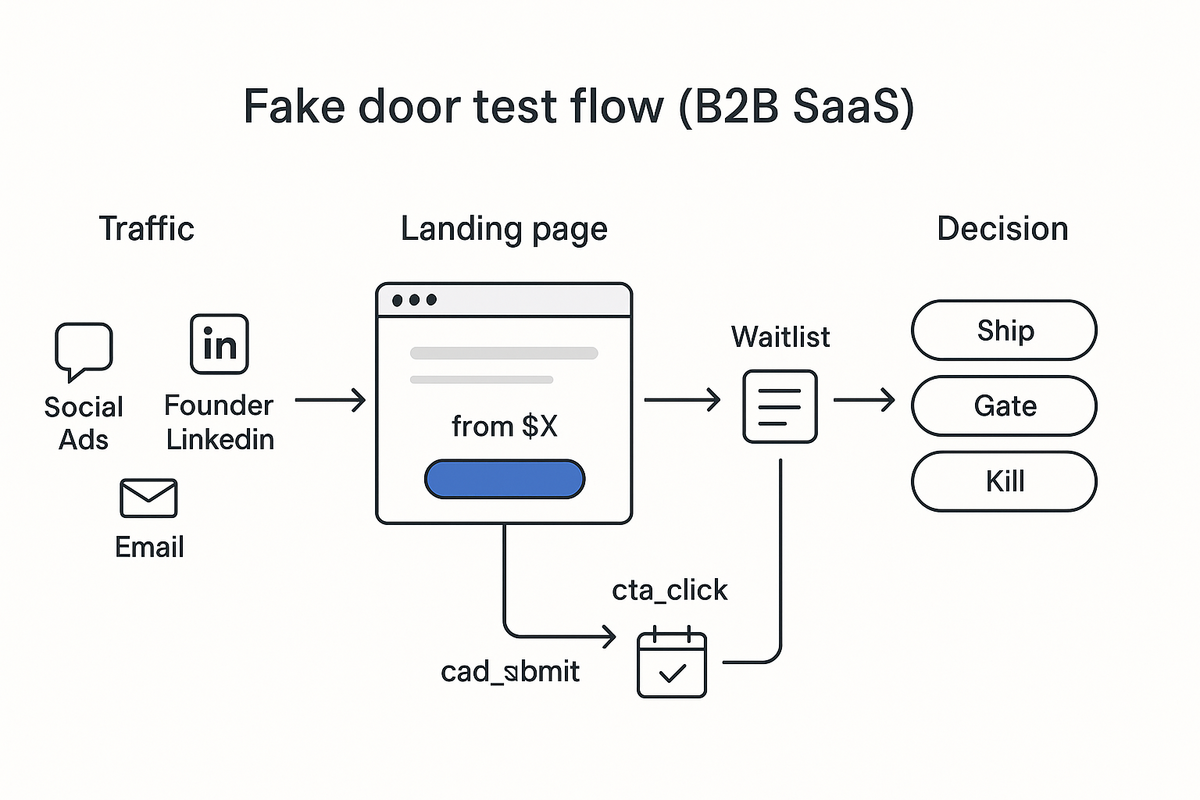
Methods: Paid pilot, pre-order ask, design partner agreement, fake-door test, repeatable outreach test.
Exit Criteria: You see repeated costly actions (money, time, LOI) from your target ICP to prove demand.
False Positives: Verbal enthusiasm, survey likes, or feature requests without commitment.
The Bridge: Why Sequence Matters
Discovery must come before validation because validation only works when you are testing the right customer, problem, and buying context.
Discovery creates hypotheses. Validation tests them.
If you try to validate before discovery is finished, you run the risk of testing a product no one actually needs. You might convince someone to prepay for a feature, but if you do not understand their underlying workflow, they will churn the moment they realize it does not fit their daily routine. For more on structuring these early conversations without biasing the customer, consult NNGroup user interviews guidelines.
First, figure out the reality of the market. Then, prove people will pay to change it.
FAQ
What is the difference between customer discovery and customer validation?
Customer discovery focuses on understanding the problem and building a mental model of your ideal customer. Customer validation focuses on proving demand by asking that customer to commit money or time to a specific solution.
How do I know customer discovery is real signal, not polite feedback?
Real signal comes from past behavior. Polite feedback comes from hypothetical questions. If a customer tells you how they spent three hours manually fixing a problem last week, that is a real signal. If they tell you they "would definitely use" a feature you haven't built yet, that is polite feedback.
When have I validated enough to build?
You have validated enough when customers commit money or significant time to the solution. Praise is not an exit criterion. Signed agreements, paid pilots, and scheduled implementation calls are.
Can I ask for money before the product exists?
Yes. Frame it honestly as early access, a paid pilot, or custom development. Think of it as providing them outsourced engineering at a fraction of the cost to solve a problem they do not have the resources to tackle themselves. If the problem is real, paying for a custom solution is a massive favor to them.