TL;DR
Founders often skip market validation and build products based on personal belief. Claiming "we have no competitors" usually means you do not understand the market or the customer. To avoid building the wrong thing, start with market and ICP validation. Define explicit invalidation metrics for your hypotheses. Before you write any code, secure a commitment through a manual pilot, a design partnership, or early LOIs. In B2B, polite interest is not a signal; you must actively pull objections from buyers to find real demand.
A founder starts building a B2B product based entirely on their own conviction. They pitch the idea and say, "We do not have any competitors." They say it like it is good news.
It is not good news. If you do not know your competitors, you do not know the market. If you do not know the market, you do not know the customer. This means you are building for yourself.
When a founder skips market validation and builds the product — and then builds the marketing funnel and acquisition systems — any failure becomes impossible to diagnose. If growth stalls, is the product wrong? Is the channel wrong? Is the pricing off? Or is there simply no real demand?
Founders want a systematic approach to prove their concept without over-investing in engineering. Product validation is the process of testing an idea against real market demand before writing code. It requires confirming a specific Ideal Customer Profile (ICP), verifying a painful problem, and securing a tangible commitment — such as money, time, or a letter of intent — to prove buyers will actually adopt the solution. Rigorous product validation protects your runway and ensures that any engineering effort aligns with real market pull.
The Market and ICP First
Before you test a product idea or ask buyers for feedback, you have to validate the market and your Ideal Customer Profile (ICP). If you need the full beginner version, you can review a general product idea validation process first.
Assess the market's growth, regulation pressure, and competition. Your goal is to find a highly specific, reachable ICP.
Consider a hypothetical European B2B sustainability software startup. Incoming EU regulations made large corporate buyers the obvious target. However, basic market research revealed a simpler, less competitive segment: medium-sized SMBs and consultants. These companies were not forced by regulation to report their sustainability metrics; they wanted to do it voluntarily for branding and mission benefits. By mapping the market first, the founders bypassed a heavily regulated, crowded space for an easier entry point — before they wrote any code. Skipping this step and ignoring ICP research is one of the most common market validation mistakes.
The Validation Ladder and Competitor Matrix
Validation should narrow down from the broad market to a specific buying trigger.
Market and ICP: Who is the target, and is the market accessible? Pass/fail signal: You can find and contact a viable segment where demand isn't purely blocked by heavy incumbents.
Competitor Map: Plot competitors on two market-specific axes to find your entry point. Pass/fail signal: You can clearly plot where your solution stands apart on factors that actually matter to buyers.
Hypotheses with Invalidation Metrics: Define exactly what will kill your hypothesis. Pass/fail signal: You have hard criteria for failure, rather than relying on gut feelings.
Early Commitments (LOIs & Paid Pilots): Secure Letters of Intent (LOIs) or paid design partnerships to prove intent. Pass/fail signal: Prospects agree to put their name, time, or budget behind a future solution.
Manual Pilot (Concierge): Sell the solution before building automation. Pass/fail signal: Buyers achieve the desired outcome and remain engaged when the process is done manually.
Automate: Build only after securing real commitment. Pass/fail signal: You have proven demand and can clearly justify the engineering cost.
For the competitor map, avoid generic axes like "price vs. quality." Pick two parameters that actually separate the competitors in your specific market. For the sustainability software example, the axes might be "regulated reporting burden" versus "need for guided implementation."
Hypothesis Table
To test your assumptions, use a compact hypothesis table. This forces you to define what invalidates your idea. For example, if you can't reach buyers quickly, the channel might be wrong.
Element | Definition | Example Invalidation Metric |
|---|---|---|
ICP | Who exactly has the problem? | Cannot find a sufficient volume of reachable buyers within the initial outreach period. |
Pain | What is the specific, painful workflow? | Buyers do not complain about this step without prompting. |
Workaround | How are they solving it today? (Incumbents, spreadsheets, agencies) | Buyers are satisfied with their current method. |
Trigger Event | What forces them to look for a new solution? | No clear event prompts a purchase. |
Commitment | What proof artifact shows demand? (Paid pilot, LOI, design partnership) | Refusal to commit money, time, or reputation. |
Extracting Objections
Founders tend to believe that if a product is flawed, buyers will offer objections voluntarily. That is rarely true. People are polite, and companies move slowly. Silence or a polite "keep me in the loop" is not approval. In B2B sales, you have to do the hard work of pulling objections out of the room.
A prospect who spends significant time explaining why your proposed workflow breaks their compliance review process is giving you strong data. A prospect who says the dashboard looks nice is giving you nothing.
Sell Before You Build: Commitments and The Concierge MVP
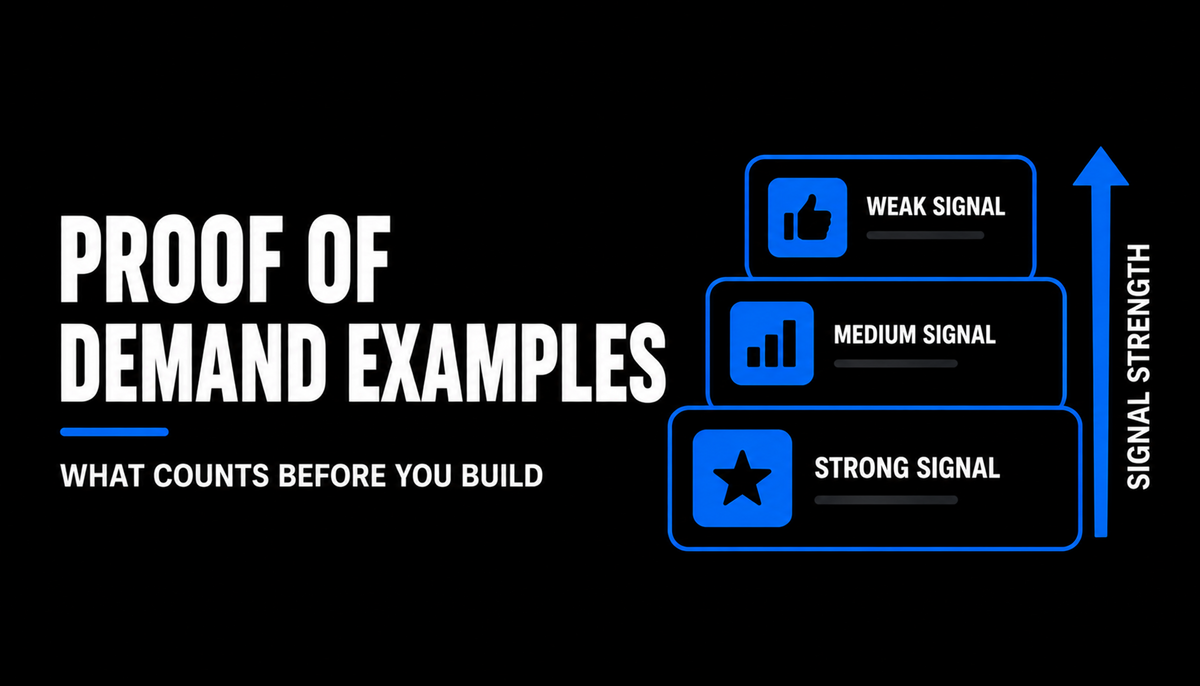
The strongest validation is a commitment. Not all validation signals are equal; you must weigh basic interest against stronger proof of demand examples. Letters of Intent (LOIs) are a helpful early step, showing that a company is willing to adopt your solution if specific conditions are met. However, in B2B, they are often weaker than a paid pilot, an introduction to procurement, or a signed design partnership. Use LOIs to open doors and set terms, but push for tangible skin in the game.
The most effective mechanism to secure that commitment before writing code is a concierge pilot. You sell the outcome to real buyers first, and you deliver the service manually. (This is a core component of building a concierge MVP, an approach that allows you to act as the software before writing the backend).
Instead of coding an automated platform right away, sell a pilot where the service is delivered entirely by hand — even if that means managing the workflow through WhatsApp or email. You prove the outcome manually. While B2C examples often show dramatic conversions (like illustrative cases of pilot testers agreeing to pay a subscription at the end of a trial), the B2B equivalent is seeing an enterprise user actively rely on your manual outputs. That is when you write the code to automate the process.
FAQ
How do you validate a B2B product idea before building?
Start by validating the market and defining a specific ICP. Map your competitors, establish strict invalidation metrics for your hypotheses, and actively extract objections from potential buyers. Finally, secure a tangible commitment — such as a Letter of Intent (LOI) or a paid manual pilot — before committing to engineering work.
If AI makes building a product so cheap and fast, why spend time validating instead of just shipping an MVP?
Because AI also makes it cheap to build the wrong thing faster. Validation forces you to stay focused on the most painful problem. Shipping cheap features does not lower the risk of entering the wrong market.
Are Letters of Intent (LOIs) the ultimate proof of demand?
LOIs are a helpful artifact, but they are not magic. In many cases, a paid pilot or a signed design partnership with clear success criteria provides a much stronger signal of actual commitment than an LOI. For more on early startup strategy, see Steve Blank's Customer Development methodology.
How do I know if my validation interviews are working?
You know they are working when you uncover concrete objections and learn how buyers currently spend money to solve the problem. For interview techniques, look to methods like The Mom Test. If prospects are only offering polite encouragement, you are not getting real evidence.