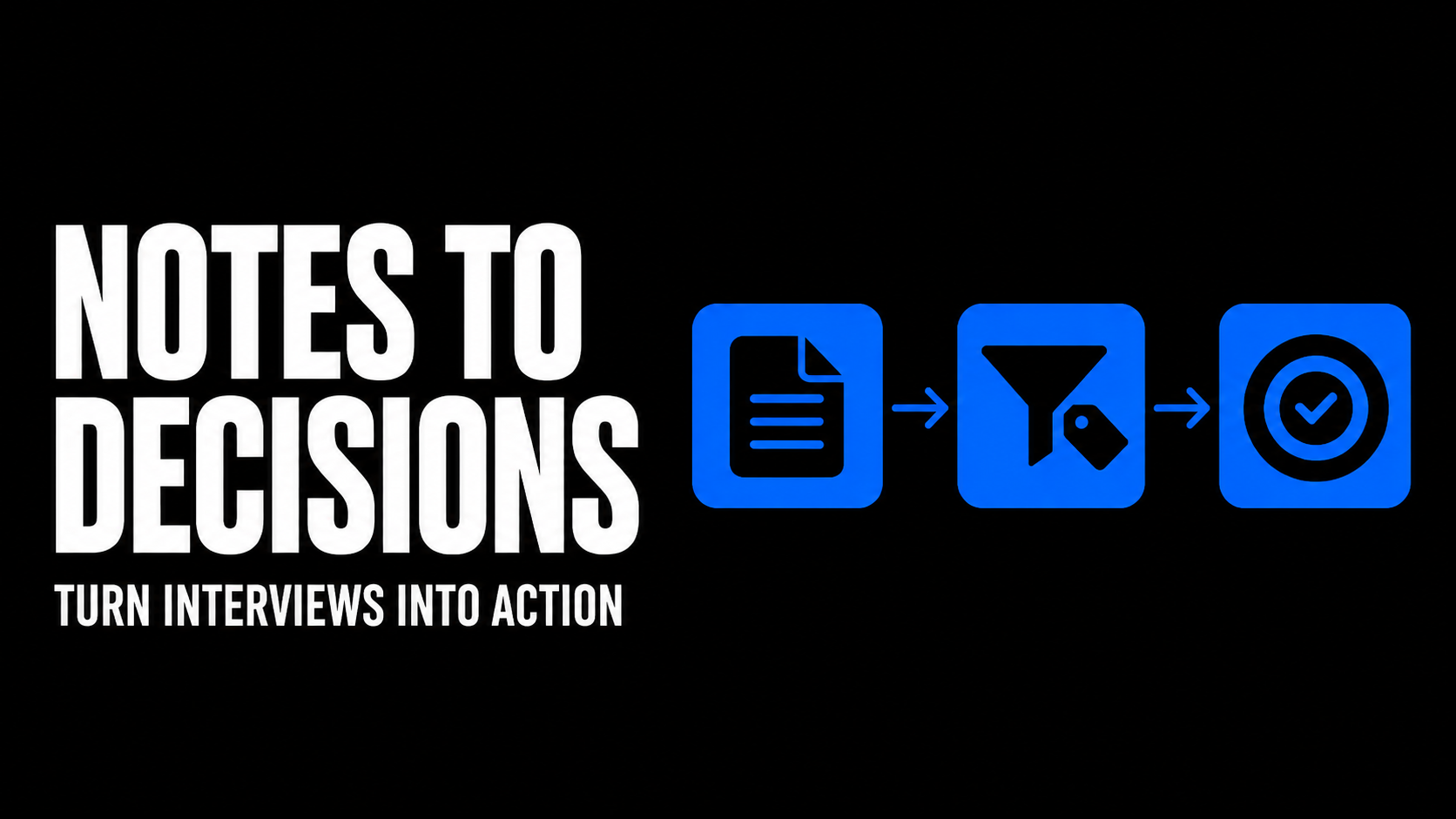
Customer discovery notes synthesis is the process of translating messy interview transcripts into concrete business decisions. Instead of just highlighting interesting quotes, founders use synthesis to tag evidence of pain, urgency, and budget. This forces a clear decision on what to build, how to price, or who to sell to next.
Many founders leave their early discovery calls with a giant, disorganized transcript archive. They highlight hundreds of quotes, drop them into Notion, and stare at the mess. They have hours of conversation but no clear answer to what the customer actually believes, fears, or needs next. This is where effective customer discovery notes synthesis becomes critical.
This happens because treating discovery notes like an academic research project turns them into a vague backlog instead of validation evidence. As Steve Blank established in the customer development methodology, discovery is not just about having conversations; it is about gathering evidence to test your assumptions. A transcript is not synthesis. Synthesis only starts when a note forces a decision.
If you did not define your hypotheses before you got on the call, you will not know what to tag afterward. You will just be trying to rescue meaning after the fact.
TL;DR: The Synthesis Workflow
To process notes without creating homework:
Start with your hypothesis. Know what you are trying to learn before the interview.
Read notes as cues, not transcripts. Spot the signals that help you reconstruct the prospect's mental model.
Separate quote, inference, and decision. What they said is a quote. What you think it means is an inference. What you do next is the decision.
Use the core tags. Systematically track pain, urgency, current workaround, buyer role, budget evidence, objections, and next-step signals.
Convert patterns into action. Use the synthesized evidence to narrow your ideal customer profile, revise your positioning, or push for a pilot.
The Seven Tags to Apply to Every Interview Note
You do not need a twenty-column spreadsheet, but you do need a repeatable way to pull signals out of your raw notes. These seven tags act as a lightweight pass to extract evidence that actually drives a business decision.
To help your team quote your findings easily, use this specific framework:
Pain: Tag this when the prospect describes the underlying problem they are struggling with. Often, the stated business problem is hiding a deeper emotional cost. For example, excess ecommerce inventory isn't just lost cash—it's a daily reminder of a bad ordering call.
Urgency: Tag this when you see pain-backed intent. How badly do they need this fixed? When people are in enough pain, they will take your call without an incentive.
Current Workaround: Tag this when they explain what they are doing right now to solve the problem. This is the core of the Jobs to Be Done framework, helping you understand their switching context and the progress they want to make.
Buyer Role: Tag this when the person confirms they have the authority to change the process or make a purchase.
Budget Evidence: Tag this when there is proof they have spent money to solve this issue in the past.
Objections: Tag this when they express friction, hesitation, or specific reasons why a solution might fail.
Next-Step Signal: Tag this when there is a concrete action. "I'll think about it" is not a next step. A scheduled pilot setup, an intro to a decision-maker, or a payment link is a next step.
If you are still struggling to capture these signals during calls, revisit your customer discovery interview script or adjust your customer discovery questions before your next round of interviews.
How to Synthesize Patterns Without Overreading the Data
It is easy to cherry-pick positive quotes and call it validation. This is why The Mom Test is so crucial: you must privilege concrete past behavior over polite hypotheticals. Make sure your voice of the customer interview questions are explicitly designed to extract usable quotes and language patterns about past actions rather than future wishes.
When you review your notes, do not just count how many times a feature was mentioned. Instead, score the strength of the evidence. A customer complaining about a problem but refusing to spend time or money fixing it is weak evidence. A customer who has duct-taped together three different tools to solve a problem is strong evidence.
Keep your outliers visible, especially if notes conflict. Conflicting evidence is highly useful because it often reveals different market segments, splits between users and buyers, or varying levels of urgency. Make sure your customer research questions dig into these discrepancies.
Turn Synthesized Notes Into a Founder Decision
The final step of synthesis is mapping your tagged evidence to a practical startup decision. Here is a compact framework showing how to go from raw quote to business action.
Synthesis Decision Framework
Raw Note | Tag | Interpretation | Decision Implication |
|---|---|---|---|
"We try to go to the park early because parking is a nightmare, but then the bathrooms are locked, and it ruins Saturday." | Current Workaround / Pain | The parent isn't searching for event inspiration. They are trying to avoid a failed outing and manage logistics. | Positioning: Change the messaging to focus on logistics and de-risking the trip, not discovering new places. |
"We built an internal script for this but it breaks every time the API updates. I just spent my weekend fixing it." | Workaround / Urgency | The problem is painful enough that they are dedicating expensive engineering time to it. | Roadmap: Build the integration they are currently maintaining manually and use it as the wedge feature. |
"This looks really cool, we'd definitely use it. Let's touch base next quarter when budgets open up." | Weak Next-Step Signal | They are giving a polite compliment, but there is no urgency or immediate intent to buy. | Validation: Do not count this as pipeline. Re-run willingness to pay questions on the next call. |
This table forces you to separate the raw quote from your inference, and your inference from the actual decision.
If the notes show a strong pattern of urgency and clear next steps, it is time to move forward with your business validation plan. If the notes are a mess of hypotheticals and polite interest, you need another round of discovery.
Common Customer Interview Synthesis Mistakes
Founders often fall into a few predictable traps when reviewing their notes:
Counting mentions instead of urgency: Just because 10 people asked for a feature does not mean any of them will pay for it. Urgency matters more than volume.
Mixing user and buyer evidence: A daily user might feel intense pain, but if the economic buyer sees no ROI, the deal will stall. Separate the tags.
Ignoring workarounds: If a prospect claims a problem is a top priority but has taken zero steps to solve it today, they are lying to themselves and to you.
Failing to define a next-step signal: Ending an interview without a clear action (a follow-up date, an intro, or a commitment) leaves the validation ambiguous.
FAQ: Customer Discovery Notes Synthesis
How do you synthesize customer discovery notes?
You synthesize notes by first defining your hypothesis, then reviewing the transcripts to tag specific evidence of pain, urgency, and budget. Finally, you map those tagged quotes to concrete business decisions about your roadmap, positioning, or ideal customer profile.
How many interviews do I need before I synthesize?
Do not wait for an arbitrary number like 20 or 50 interviews. Synthesize in small batches (e.g., 5 at a time) so you can refine your hypotheses and adjust your questions for the next round.
What do I do if the evidence is totally conflicting?
Conflicting notes usually mean you are talking to too broad of an audience. Narrow your focus. Check if the conflicting responses map to different job titles, company sizes, or current workarounds.
Should I use AI to tag and synthesize my notes?
AI is great for cleaning transcripts and extracting specific quotes, but outsourcing the synthesis means outsourcing your understanding of the customer's mental model. You can use tools to organize the data, but the founder must make the final decision on what the evidence means.
How do I synthesize notes from a sales call versus a pure discovery call?
A good sales process is discovery-led. On a sales call, you should still be tagging pain, workarounds, and urgency, but you are driving harder toward budget evidence and a concrete next-step signal.
When should synthesis trigger another round of interviews?
Run another round when your synthesis reveals that you have a pile of quotes but no clear understanding of the customer's current workaround, or when you cannot confidently predict whether someone will pay based on your notes.