TL;DR: Founders often call their first cohort of early users a "beta" simply to avoid the discomfort of asking for money. But willingness to pay is the only real proof of demand. A beta test is for finding bugs in a mostly shaped product. A design partner program is a low-risk, paid pilot where you work closely with a few serious customers to figure out what to build. If they will not pay or commit to regular feedback, you do not have a design partner.
You have a rough MVP and twenty interested users. You invite them to a free beta. Asking them for money right now feels premature. You assume you will collect feedback, improve the product, and start charging later.
Two weeks pass. The users report a few minor bugs. They say the interface looks clean. But they stop logging in, and you learn almost nothing about their actual workflow.
The problem is not that you called it a beta. The problem is that the word let you avoid asking for commitment.
Calling early customers a "beta" is a common founder escape hatch. You want feedback, but you want to avoid hearing "no" to a paid contract even more. You end up collecting loose feedback while dodging the only signal that matters: willingness to pay.
Understanding the difference between a design partner program vs beta early on saves you from building features nobody wants.
A beta is for testing a product you mostly know how to build. A design partner program is for learning what to build with a serious customer who commits time, workflow access, and usually money.
The Design Partner Mindset Shift
A design partner arrangement does not need to be a heavy enterprise contract. Think of it as a paid pilot.
You are essentially acting as their outsourced engineering team. You provide custom development to solve a specific problem they have right now, and you do it for a fraction of what an agency would charge.
You and the customer share the same goal. They get a tailored solution to a real pain point, and you get deep workflow access and a commercial signal. If it fails, it carries lower legal risk. It is a low-risk pilot, not a high-stakes commitment.
Treating this relationship like a passive beta test results in superficial feedback. You cannot rely on a manual or a video to onboard these early users. You must be highly available to remove early friction, because early friction easily kills conversion before the product is even proven.
Practical Framework: Beta Testing vs Design Partner Comparison
A beta program is useful when the product is mostly shaped. You need broader validation, bug reports, and usage data across different environments. A design partner is useful when the product still needs serious input from a real pilot customer to become useful.
Program Definition
Feature | Design Partner | Beta Tester |
|---|---|---|
Purpose | Shape the product alongside the customer | Find bugs and test usability at scale |
Ideal Stage | Pre-product or early MVP | Mostly shaped product ready for broad usage |
Participant Type | Highly selected, serious buyer | Broad audience, casual user |
Commitment | High (weekly meetings, deep workflow access) | Lower or asynchronous usage |
Payment Signal | Paid pilot or strong commercial intent | Often free or lower cost |
Execution & Outcomes
Feature | Design Partner | Beta Tester |
|---|---|---|
Feedback Loop | Structured, direct, tied to business outcomes | Unstructured opinions, bug reports, usage data |
Founder Involvement | Maximum capacity, manual onboarding, high touch | Minimal direct support, automated onboarding |
Success Metric | Willingness to pay, solving a core workflow problem | Broad usage, stable software |
Decision Rule | Run a design partner program when you need to learn what to build to solve a real problem | Run a beta when you know what to build but need to test if it works |
The Commitment Check
How do you know if you are talking to a design partner or just a casual beta tester? Use this commitment ladder to understand where your user sits across your early user programs:
Waitlist → Beta Tester → Pilot Customer → Design Partner → Paying Customer
To verify you have a real design partner, look for these three signals:
They pay before the product is finished. They understand they are funding early development to solve a problem they cannot fix themselves.
They expect custom development. They are giving you specific workflow requirements and pushing you to build them.
They require direct support. They expect you to be there to remove early friction, and they are willing to meet with you regularly to review progress.
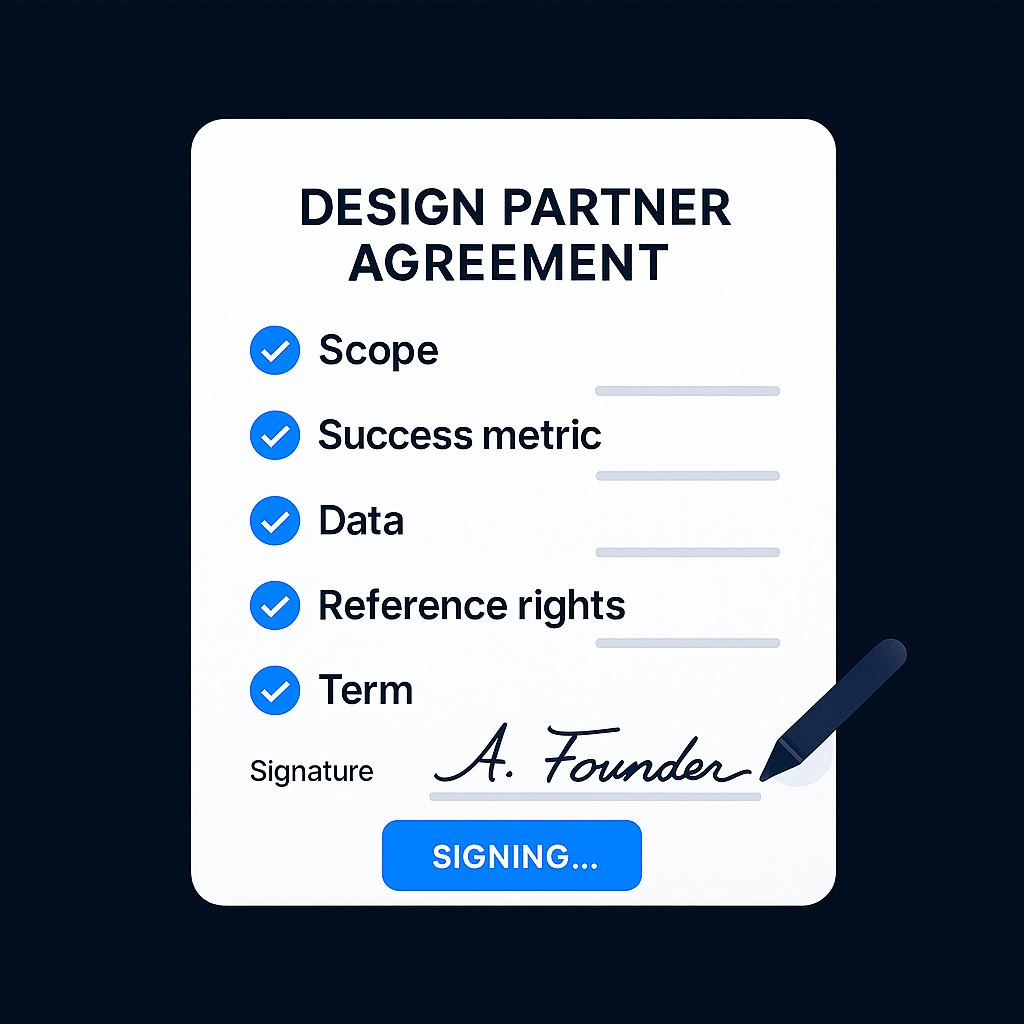
If nobody will pay, meet regularly, or let you into their real workflow, you may have interest. You do not have a design partner. Keep expectations clear and document the scope with a simple design partner agreement to avoid vague handshake arrangements.
You can read more about finding early signs of product-market fit from Lenny's Newsletter, learn about customer development from Steve Blank, or explore how to get your first customers with Y Combinator's startup library.
FAQ
Is a design partner the same as a beta tester?
No. A beta tester tries out a nearly finished product to find bugs or usability issues, usually for free and on their own time. A design partner works closely with you to shape what the product should actually be, committing their time, workflow access, and usually money.
Can a beta tester become a design partner?
Sometimes, but it requires a major shift in commitment. If a free beta tester starts asking for specific features, integrating your tool into their core workflow, and is willing to pay to prioritize development, you can transition them into a design partner.
What do founders overcomplicate about early user programs?
Founders often overcomplicate the legal side of design partnerships. A design partner arrangement should be treated as a pilot rather than a high-stakes commitment. Document the scope, expectations, and confidentiality, but keep it low-risk.
Is it really okay to ask for payment when you have nothing built yet?
Yes. It is the only way to prove real demand. You are offering them custom development for a fraction of the normal cost. If they have a real problem and lack the resources to solve it themselves, this is a big favor to them.
What if early customers complain about a missing feature?
Celebrate. In most cases, casual users simply leave. A customer complaining about a missing feature means they are actually trying to use the product to do real work. It is a strong positive signal.
How do I find these alpha customers or design partners?
You find them manually. This is not about a scalable acquisition process. Go to where the customers are, invite them directly, onboard them yourself, and ensure they get actual value out of the product.