TL;DR
Fake door testing forces a real demand signal before you spend months writing code. Clicks and soft praise don't prove demand; willingness to pay or act does. A strong test uses cold traffic, requires a high-friction action, and measures real intent without tricking users into a blind checkout trap.
Founders routinely fall into the same trap: they build from belief and soft interest. They pitch the grand vision to their network, collect warm encouragement, and polish the product for months. They avoid asking for money because the concept is "not proven yet" — only to learn too late that while people liked the idea, no one is actually willing to pay for it. In fact, a lack of market need is one of the top reasons startups fail, making early, harsh validation the turning point that saves companies.
Proof of demand beats vision. Fake door testing exists to create the moment of truth earlier, replacing polite lies with hard behavioral data before the product absorbs your time and capital.
What is a Fake Door Test?
A fake door test is not a survey asking people, "Would you use this?" It is a behavioral test designed to see if strangers will trade money, time, or reputation for your solution right now. (Note: fake door testing is one type of startup smoke test.)
Instead of saying "18 prospects loved the vision," a fake door test lets you say: "We sent 400 cold visitors to the page; 12 clicked the $99/month button and left their email after seeing the unavailable-product message."
The closer the user's action gets to real currency, the more seriously you should take the signal. You can think of this as a Signal Strength Ladder:
Signal | Friction | How much to trust it |
|---|---|---|
Click | Low | Weak. Shows initial curiosity. |
Email signup | Low | Weak. Shows top-of-funnel interest, not intent to buy. |
Booked call | Medium | Useful. They are willing to trade time to learn more. |
Letter of Intent (LOI) | High | Strong. Real business commitment, even if unpaid. |
Payment attempt or deposit | High | Very Strong. Real financial intent. |
Paid pilot | Highest | Absolute. The strongest proof of demand. |
The Traffic: Why Warm Audiences Lie
When acquisition and retention are your real unknowns, you cannot test your idea on your friends or your Twitter followers. Warm network bias will artificially inflate your demand signals.
You must test with cold or semi-cold traffic. If your actual business will rely on paid ads or cold outreach, your fake door test needs to use those exact channels to prove that you can acquire strangers profitably. Books like The Mom Test emphasize that getting honest signals from unbiased users prevents false positives that come from friendly networks.
Practical Framework: The Fake Door Test Canvas
Before you launch a landing page, map out exactly what you are testing and what will trigger a "go" decision. Use this checklist to structure your experiment:
ICP: Exactly who you are targeting (e.g., B2B SaaS sales managers)
Painful Job: Specific problem to solve (e.g., Extracting objections from recorded calls)
Promise: The core offer (e.g., Automated objection analysis report)
Channel: Where you acquire cold traffic (e.g., LinkedIn Ads)
Fake Door Action: The high-friction button (e.g., "$199/mo Buy Now")
Proof Shown: Credible sample before the ask (e.g., A full, realistic sample report)
Success Threshold: Actions required to justify building (e.g., 5 payment attempts per 100 visitors)
Follow-up Question: Asked after the click (e.g., "What current tool isn't working for you?")
Decision Rule: Next step based on the data (e.g., If <2%, kill. If >5%, build.)
If you are looking for inspiration on how to format your test, ranging from simple "coming soon" buttons to feature-level fake doors, review these fake door test examples.
The Caveat: Do Not Build a Blind Checkout Trap
Fake door tests are meant to force demand signals, but they are not an excuse to deceive users or charge credit cards for unavailable software.
More importantly, if your product's value depends on data, output quality, or personalization, a generic paywall will fail. You cannot expect users to click "Buy" on a black box. You must show the real value before asking for payment intent.
For example, if you are validating an automated reporting tool, don't just build a marketing page with a checkout button. Manually compile one detailed, accurate report as a free preview. Put it front-and-center to prove the output quality, and place your "$199/mo Automate this" button below it.
Measuring Success and Making the Decision
You need to define your success thresholds before the test begins. Don't let pricing paralysis slow you down — testing willingness to pay is more important than finding the perfect price. Rigorous experiment design, drawing from principles of Customer Development, ensures you don't build a product nobody wants.
Rule of Thumb for Proof of Demand:
Weak Proof: High clicks, many email signups, zero payment attempts. Your messaging works, but the offer or price doesn't.
Useful Proof: A few booked calls or detailed survey responses after hitting the fake door. People care enough to spend time complaining about the problem.
Strong Proof: Multiple payment attempts, signed LOIs, or upfront deposits from cold traffic. You have real validation.
Clicks are merely top-of-funnel signals. To understand how to define strict criteria for success and avoid false positives, review how to measure fake door test metrics.
FAQ
What if people get angry that the product isn't ready?
Be transparent immediately after they click the fake door. Explain that you are currently building the product, apologize for the inconvenience, and offer them early access or a discount when it launches. Never capture real money for vaporware.
Do waitlist signups prove demand?
No. Emails and waitlist signups are low-friction and provide weak signals. They indicate top-of-funnel interest, not actual demand. Always push for actions closer to money or reputation.
Is fake door testing the same as a startup smoke test?
Yes, fake door testing is a specific type of startup smoke test. While "smoke test" broadly refers to any early validation experiment, a fake door specifically simulates the final purchasing or onboarding step to measure true intent.
What is the strongest proof of demand?
The strongest proof is a paid pilot or an upfront deposit. Anything involving actual currency exchanged by a cold prospect proves that the problem is painful enough to spend money on right now.
Is fake door testing always the first step?
Not necessarily. Before running a traffic test, you often need to conduct customer discovery interviews to identify the painful job and understand the ICP.
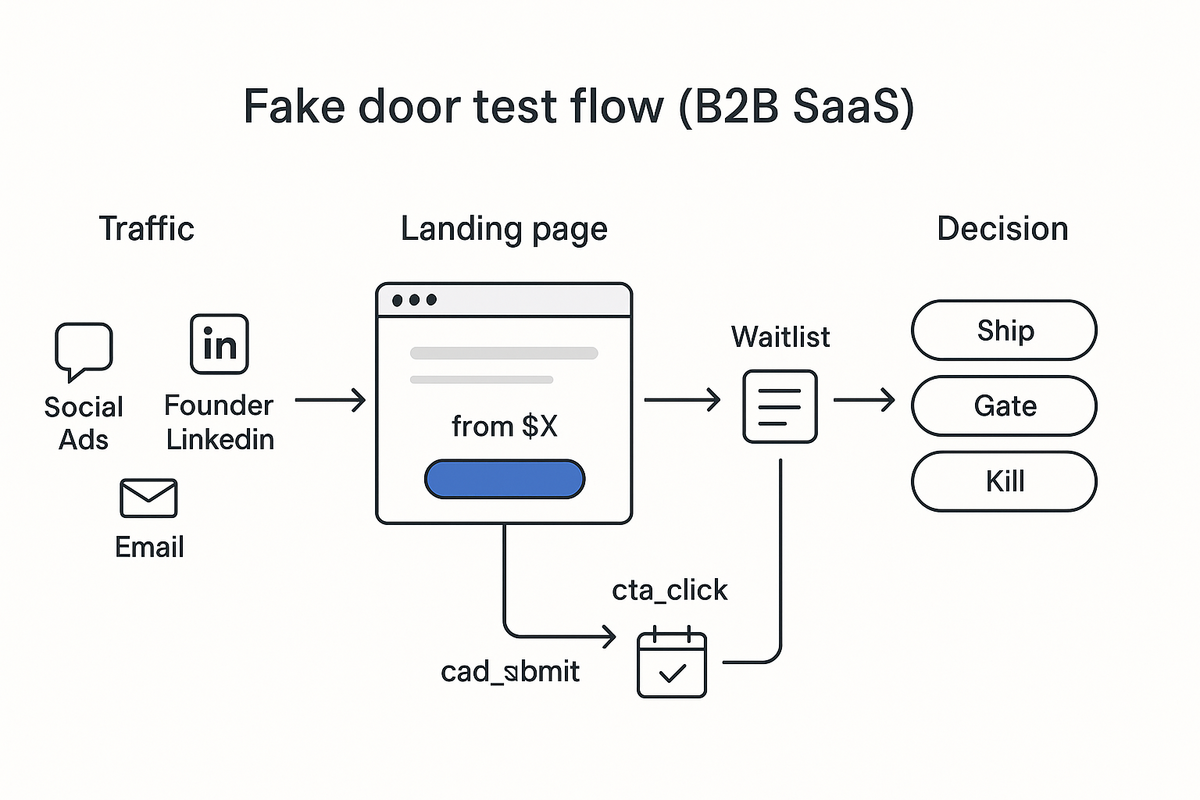
How do I run a fake door test in B2B?
Instead of a checkout page, your fake door action might be booking a discovery call, signing a Letter of Intent (LOI), or asking for a refundable deposit for a concierge pilot.