TL;DR: When to transition from founder-led sales vs hiring reps is a practical decision: can a new hire follow your exact steps and close a deal? Hiring sales reps before you validate the pitch yourself burns cash. Your early goal is learning, not scaling. Go where your alpha customers already are, invite them directly, onboard them, and ensure they get real value. You are only ready to transition to a hired team when you can hand over a documented playbook, known objections, and proof that customers will pay.
Founders often make the mistake of planning to hire sales reps before doing the manual work themselves. They treat early sales as a process to delegate. But delegating sales too early isolates you from the market. At the alpha stage, you need direct customer contact. You must have real conversations — whether by appearing on relevant ecommerce podcasts or attending offline events — to understand exactly what the market needs.
Before you can hand off a playbook, you must write it. Finding your first customers manually and helping them get actual value is the only focus that matters right now. Without willingness-to-pay proof, scaling a team will only scale your inefficiencies.
Proving the Motion First
Hiring sales reps before you prove the motion yourself is expensive. You need to know what objections prospects have. In most cases, they will not volunteer them. You have to surface those objections yourself during calls. You also need to know what parts of your pitch resonate and what falls flat.
Founders who try to skip founding sales find themselves managing reps who cannot close. The underlying value proposition has not been tested against reality. For context on why founders must lead early revenue generation, Y Combinator's guide on how to sell explains the mechanics of early customer conversations.
Triggers for the Founder Sales Transition
How do you know when it is time to stop doing everything yourself and start building a team? You need explicit triggers. Use this decision framework to evaluate your readiness.
You are ready to hire sales reps when:
You have a repeatable source of leads.
You have documented common objections and how to answer them.
You see a consistent close pattern instead of random wins.
Onboarding a new customer is no longer completely founder-dependent.
Your CRM notes and sales playbook are ready for someone else to read.
Decision Logic Table
Stage | Founder-Led Sales | Hired Sales Reps | Decision Logic to Transition |
|---|---|---|---|
Lead Generation | Manual outreach and direct invites | Predictable inbound flow or outbound lists | Hire when you have a repeatable source of leads that does not rely only on your personal network. |
Sales Playbook | Adaptive and unscripted | Standardized and documented | Transition when your CRM notes are organized and you have a documented founder-led sales B2B playbook. |
Customer Objections | Unpredictable | Known with proven rebuttals | Hire when you have documented objections and a predictable way to overcome them. Steve Blank's customer development principles emphasize the importance of this firsthand discovery. |
Conversion Metrics | Highly variable | Consistent and trackable | Transition when you see a consistent close pattern, without relying on arbitrary customer-count or revenue thresholds. |
Onboarding | Completely founder-dependent | Systematized handoff | Hire when onboarding a new customer is no longer completely dependent on the founder doing the manual work. |
Why Early Sales is Not a Scalable Process
At the beginning, finding customers is a manual process. The goal is to gather intelligence. You need to listen closely and use what prospects reveal during the call to position the product.
If you skip this work, your eventual sales reps will fail. They will face objections that you never uncovered. Navigating sales for founders is different from being a career sales professional. You are selling the vision while testing the reality of the product. Ignoring this distinction is a common pitfall; as CB Insights on why startups fail points out, neglecting to thoroughly understand customer needs often leads to failure.
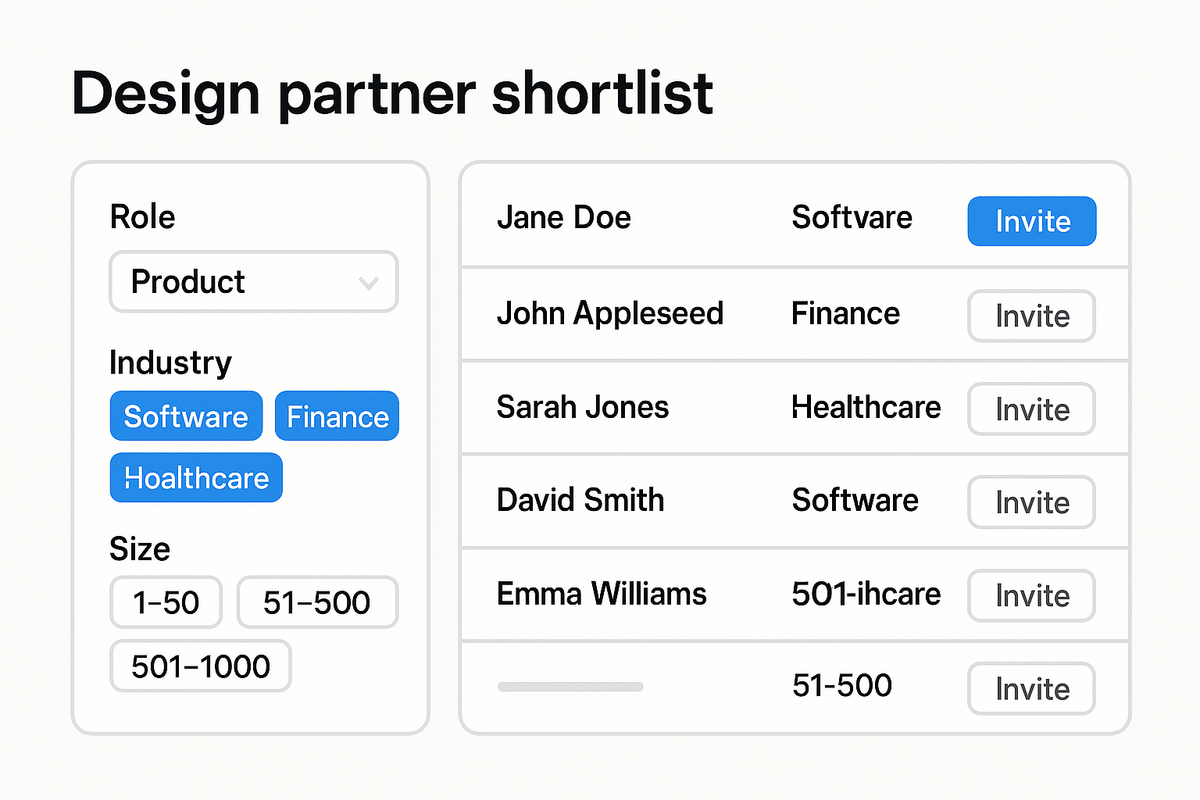
Before hiring reps, your immediate next step is to test your value proposition directly with early adopters. Use a design partner template to structure these initial relationships, ensuring you gather the exact objections and product feedback needed to eventually hand off a proven motion.
FAQ
When should a founder hire the first sales rep?
Hire your first rep when you have a proven motion, documented objections, a repeatable source of leads, and willingness-to-pay proof. Do not hire based on arbitrary revenue thresholds if the process itself is not yet predictable.What should be documented before hiring a sales rep?
You need a written sales playbook. This should include your exact pitch, a list of common objections with your proven answers, your lead generation process, and CRM notes that show how previous deals closed.Can I hire an agency instead of doing it myself?
Selling through agencies can work later, but in the beginning, you need the direct feedback loop. An agency only needs to be convinced once. They will not give you the raw market intelligence you get from talking to prospects directly.What if I am not good at sales?
You do not need to be a slick salesperson. You need to be an expert in your customer's problems. If you have a real solution to a painful problem, your deep knowledge will close deals better than a generic pitch.