A B2B founder can build a busy launch plan in an afternoon: LinkedIn ads, Product Hunt, cold email, SEO, partnerships, founder posts, maybe a webinar if someone gets ambitious.
The problem is not effort. The problem is that none of those tactics answer the first question:
Who has painful enough demand to respond this month?
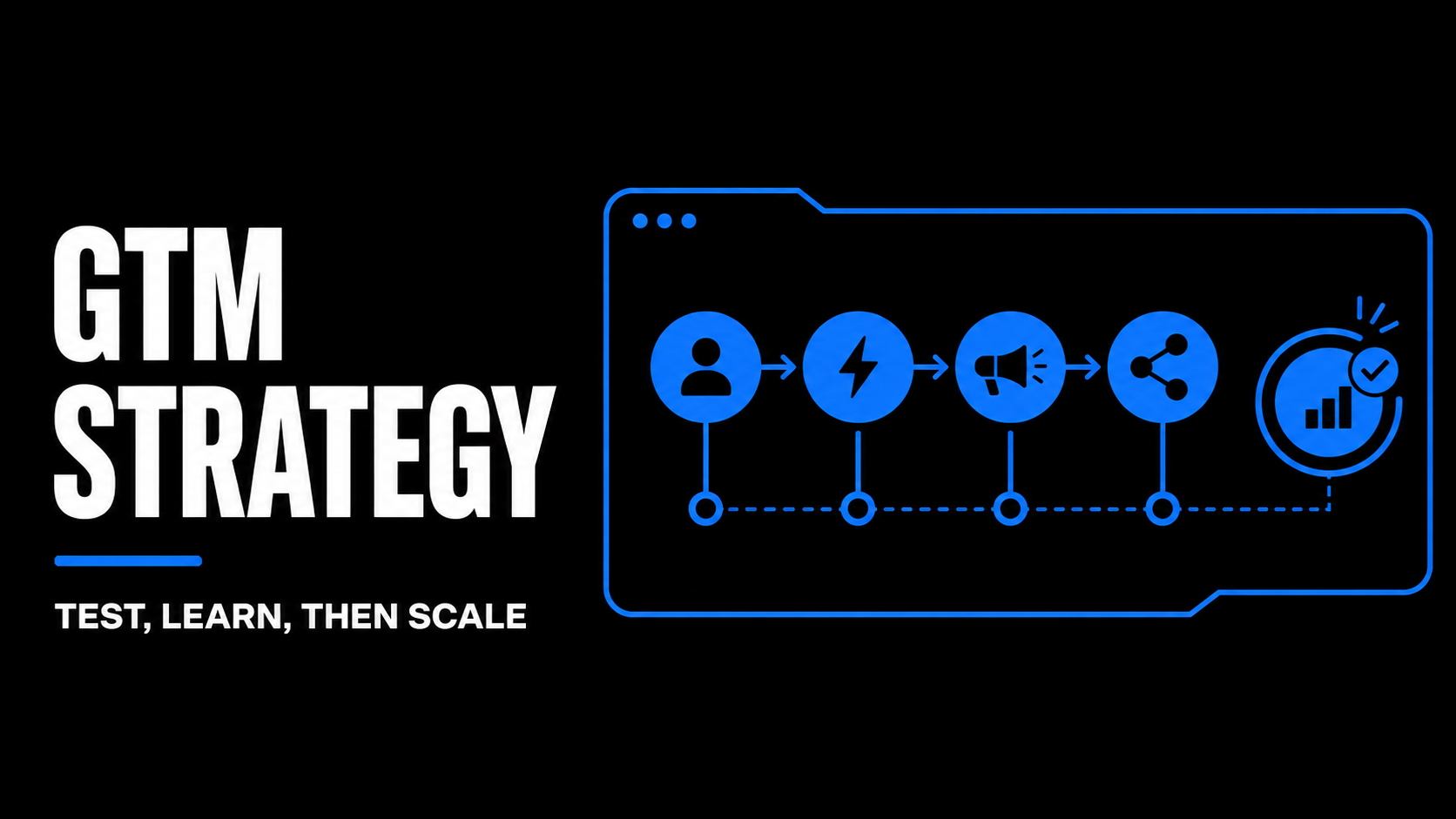
A GTM strategy stops activity from becoming a substitute for learning. It is the operating plan for finding the right customer, explaining why they should switch, choosing where to reach them, and deciding what evidence is strong enough to scale.
GTM strategy definition: A go-to-market strategy is the plan for bringing a product to a specific market through a specific customer, message, channel, and sales motion. For B2B startups, it should include ICP, positioning, GTM channels, traction tests, and clear scale criteria.
TL;DR
A useful startup GTM strategy answers five questions:
Who is the narrowest customer group with urgent pain, budget, and access?
What painful situation makes them willing to change now?
What promise makes your product worth switching to?
Which one or two channels can reach them with enough trust to create signal?
What traction test will tell you to stop, revise, or double down?
A good startup GTM plan is a learning system before it is a growth engine.
What Is GTM Strategy?
For an early B2B startup, a GTM strategy is the sequence for learning who buys, why they care now, why they would switch, where you can reach them, and what evidence is strong enough to scale.
Thing | What it answers | Common founder mistake |
|---|---|---|
GTM strategy | Who buys, why now, why us, where to reach them, and what signal matters | Treating channels as the strategy |
Marketing plan | How you create awareness and demand | Writing content before knowing the buyer |
Sales plan | How you qualify, persuade, and close buyers | Hiring sales before the founder understands the sale |
Launch checklist | What happens around a release or campaign | Mistaking launch attention for repeatable demand |
Product Hunt can create attention. It cannot tell you, by itself, who will buy. Paid ads can test message clarity, but only if the landing page is aimed at a specific buyer. Outbound can reveal urgency, but only if the list is tight enough to make replies meaningful.
Before you scale attention, prove the message deserves it.
Step 1: Define the ICP before you pick channels
If the ICP is vague, every channel looks plausible.
“B2B teams,” “SMBs,” “finance teams,” and “companies with lots of meetings” are not useful ICP definitions. They are markets, departments, or loose guesses.
A useful ICP is a buying situation.
Weak ICP | Better ICP |
|---|---|
B2B teams with lots of meetings | Customer success teams under renewal pressure with no reliable way to surface churn risks from call notes |
Finance teams | Controllers at multi-entity SaaS companies still closing books through scattered manual workflows |
DTC brands | Inventory leads at growing DTC brands that hit stockouts before seasonal campaigns |
HR teams | People Ops leaders dealing with a hiring spike after funding and a messy approval workflow |
The better version tells you where pain lives, who feels it, why now matters, and how you might reach them.
ICP scoring rubric
Score the first ICP against these seven checks before choosing channels:
Urgency: Why would they care this month? Strong signals include an audit, renewal, funding event, hiring spike, churn risk, or missed revenue.
Budget: Can this buyer pay without heroic approval? Look for existing spend, owned budget, or a clear cost of inaction.
Buying role: Who can approve or block the purchase? Name the buyer, user, influencer, and likely blocker.
Pain intensity: What breaks if they do nothing? Look for lost revenue, wasted time, compliance risk, or customer churn.
Current workaround: What are they using now? Common answers include spreadsheets, a manual process, a competitor, or an internal tool.
Reachability: Can you actually get to them? Check for warm intros, outbound lists, communities, search demand, or partner access.
Proof access: Can they validate the problem with you? Look for willingness to take calls, share workflows, review a prototype, or discuss pricing.
Your first ICP does not need to be the final market. It needs to be narrow enough that replies, objections, and demos teach you something.
Y Combinator’s startup advice is a useful reminder here: early traction often comes from direct outreach, close customer conversations, and doing work that does not scale yet. That is not a GTM failure. It is often the fastest way to learn what the repeatable motion should become.
Step 2: Build positioning around the switching moment
Positioning is not the tagline. It is the argument for switching.
A customer switches when a painful trigger makes the current workaround feel too expensive, slow, risky, or awkward to continue.
Use this formula:
Positioning part | Question | Example |
|---|---|---|
Trigger | What changed? | Renewal season is coming, and churn risk is unclear |
Current workaround | What are they doing now? | CSMs scan notes manually before account reviews |
Pain | Why is that no longer acceptable? | Risks are found too late or missed entirely |
Promise | What outcome do you create? | Surface expansion and churn risk from customer calls before renewal meetings |
Differentiation | Why you instead of the old way? | Built around CS workflows, not generic meeting summaries |
Proof | Why should they believe it? | Demo on their workflow, pilot results, customer quotes, product evidence |
This is where competitor work matters. You are rarely competing with “nothing.” You are competing with spreadsheets, internal workflows, habits, bundled features, consultants, or a better-known tool. The point is not to copy competitor language. It is to understand what customers already believe, what they already use, and what would make them change.
Sequoia’s product-market fit framework can also help founders think about market pull and product-market fit evidence. GTM should follow the strongest evidence of customer pull, not the channel that feels fashionable.
Step 3: Choose GTM channels by access, trust, and speed to signal
Early GTM channels are not growth trophies. They are places to test a buying hypothesis.
The right channel is the one that reaches a specific buyer with enough trust to create useful signal.
Direct Channels
Channel | Best when | Watch out for |
|---|---|---|
Founder-led sales | The buyer is reachable and the problem is complex | Low volume, strong learning |
Targeted outbound | You can define a tight account list and trigger | Weak lists create noisy results |
Warm intros | Trust matters and the market is networked | Friendly intros can hide weak positioning |
Community | Users gather in specific places and trust peer advice | Easy to lurk without learning |
Scalable Channels
Channel | Best when | Watch out for |
|---|---|---|
Technical content | Buyers search before buying or need education | Slow feedback unless paired with calls |
Partnerships | Another company already has buyer trust | Slow setup, unclear attribution |
Paid ads | There is active demand or a clear message to test | Wasteful if ICP and landing page are vague |
Product Hunt | You want launch attention and early user feedback | Often weak as a revenue signal for B2B |
Founders often want to test five channels because it feels balanced. In practice, it usually creates fog. If outbound is weak, paid is weak, content is early, and Product Hunt signups are mixed, what did you learn? Maybe the ICP is wrong. Maybe the message is vague. Maybe the channel is wrong. Maybe the offer is too soft.
Test one or two channels at a time so the result can create a decision.
If paid acquisition is one of your tests, do the page work first. A paid campaign pointed at a generic page mostly tests your ability to spend money. Use a specific promise, specific buyer, and specific conversion goal. This landing page for paid ads guide is the next step if paid becomes part of your GTM test.
Step 4: Run a 60-90 day GTM plan with traction tests
A 60-90 day GTM plan is not a forecast. It is an operating cadence for reducing uncertainty.
Treat the timing below as a planning range, not a benchmark. A complex enterprise sale may need a longer test. A narrow founder-led motion may create signal faster.
Timeframe | Focus | Output |
|---|---|---|
Weeks 1-2 | ICP and problem validation | Buyer conversations, narrowed ICP, problem notes |
Weeks 3-4 | Positioning and offer | Switching-moment positioning, first offer, target account list |
Weeks 5-8 | Channel tests | One or two active channels, weekly review, clear leading signals |
Weeks 9-10 | Conversion review | Objection patterns, qualified pipeline, demo quality, pricing feedback |
Weeks 11-12 | Decision | Stop, revise, or double down |
Do not make the test abstract. Write it like this:
Test element | Example |
|---|---|
Hypothesis | Heads of Compliance at small fintechs facing audits will respond to a message about reducing manual evidence collection |
Audience | A focused list of fintech compliance leaders with audit or regulator signals |
Channel | Founder-led outbound plus warm operator intros |
Message | Cut audit evidence prep from scattered Slack, email, and spreadsheets into one reviewable workflow |
Leading signal | Replies from buyers who describe the same manual pain |
Decision | Double down if conversations show repeated urgency; revise if pain is real but buyer is wrong; stop if the problem is low priority |
A weak test should create a decision, not another brainstorm.
Weak response does not automatically mean the product is bad. It may mean:
What happened | Possible meaning | Next move |
|---|---|---|
No one replies | Wrong buyer, weak trigger, bad list, vague message | Tighten ICP and rewrite around a sharper pain |
People reply but do not book | Pain is interesting but not urgent | Find a stronger trigger or higher-stakes segment |
Demos happen but no one advances | Product promise does not match buying need | Rework positioning or offer |
Users like it but buyers do not care | Buyer/user split is unresolved | Map approval path and economic buyer |
Signups happen but few match ICP | Channel creates attention, not pipeline | Keep as awareness, not core GTM |
This is why Product Hunt belongs inside a GTM plan, not above it. A launch can be useful for attention, feedback, and momentum. But after the launch, you still need to know which signups match your ICP, who engages, who buys, and what follow-up motion turns interest into revenue. Use this Product Hunt after-launch checklist if that channel is part of your rollout.
One-page GTM strategy worksheet
Use this as the working version of your GTM plan. Fill it out in order:
ICP: The narrow buying situation you are targeting first.
Painful situation: What is broken, costly, risky, or slow.
Switching trigger: Why they care now.
Current workaround: What they use today.
Buyer: Who owns the budget or approval.
User: Who feels the workflow pain.
Positioning promise: The outcome that makes switching worth it.
Differentiation: Why your product beats the workaround.
First channel: Where you can reach this buyer with trust.
Second channel: Optional, only if it tests a distinct path.
Traction test: The specific hypothesis you are testing.
Leading signal: Early evidence that the buyer cares.
Lagging signal: Pipeline, pilots, paid usage, or revenue evidence.
Decision rule: Stop, revise, or double down.
If you cannot fill this out, do not add more channels. Go back to customer conversations.
What to do before scaling
Scale comes after the customer and message are less mysterious.
Before hiring aggressively, increasing paid spend, building a content machine, or declaring a channel “working,” look for repeated evidence:
The same segment describes the same pain without being coached.
The same trigger makes the problem urgent.
The buyer understands the promise quickly.
Sales conversations produce real objections, not polite interest.
Prospects ask about price, rollout, security, timing, or integration.
One channel produces enough qualified conversations to improve it.
Your team knows what to stop doing.
Polite feedback is not traction. “This is interesting” is not traction. A busy launch week is not traction.
Traction is evidence that a specific customer group is willing to spend time, reputation, budget, or workflow change to solve the problem.
FAQ
What is a GTM strategy?
A GTM strategy is the plan for bringing a product to market through a specific customer, message, channel, and learning process. For B2B startups, it should answer who buys, why they care now, why they would switch, how you reach them, and what evidence tells you to scale.
What is the difference between GTM strategy and marketing strategy?
Marketing is one part of GTM. A go-to-market strategy connects ICP, positioning, sales motion, channels, launch activity, and traction tests. Marketing may create demand, but GTM decides which demand is worth pursuing first.
How narrow should my ICP definition be?
Narrower than feels comfortable. Your first ICP should be small enough that you can name the buyer, trigger, pain, current workaround, and likely channel. Narrowing the first GTM motion does not mean the company’s market is small. It means your learning is focused.
Should I launch before positioning is perfect?
Yes, if “launch” means testing with real buyers and learning. No, if it means spending heavily before you know who the message is for. Early positioning should be clear enough to test, not polished enough for a brand campaign.
How many GTM channels should a startup test?
Usually one or two at a time. More channels can feel productive, but they make results harder to interpret. If you test too many things at once, you may not know whether the problem is ICP, message, offer, channel, or timing.
What should be in a 60-90 day GTM plan?
A 60-90 day GTM plan should include ICP validation, positioning, channel tests, weekly review, conversion checkpoints, and a decision rule for whether to stop, revise, or double down. Treat the timing as a planning range, not a benchmark.
Is Product Hunt a GTM strategy?
No. Product Hunt is a launch channel. It can create attention, social proof, feedback, and signups. It does not replace ICP definition, positioning, sales follow-up, or revenue learning.
When should I use paid ads?
Use paid ads when you have a specific buyer, message, landing page, and conversion goal. Paid can be useful for testing active demand, but it becomes expensive guessing when the ICP and promise are vague.
When should I hire marketing or sales help?
Hire after the founder can explain who buys, why now, what objections come up, and which channel has shown signal. Hiring too early often turns an unclear founder problem into an expensive team problem.
What if my first GTM test is weak?
Treat it as information. Decide whether to stop, revise, or double down. Weak tests are useful when they sharpen the next move. They become expensive when they trigger another round of random tactics.