Market research is the process of gathering data about your target market, competitors, and customers. It helps founders validate assumptions with real evidence before building a product. A good process maps the market landscape, identifies a clear Ideal Customer Profile (ICP), and investigates past customer behavior.
TL;DR: Market research is not a formal report you write after building a product; it is the proof you need before starting. Skip hypothetical questions that only seek polite approval. Build an evidence ledger using basic market data, custom competitor matrices, and interviews focused entirely on past customer behavior to establish your ideal customer profile (ICP).
Practical Framework: Market Research Checklist
Write down the core assumption to test.
Scan trends, regulation, and broad segments.
Map competitors and substitutes on custom axes.
Interview customers about past purchases.
Interview experts about future shifts.
Compile findings into an evidence ledger.
Choose the easiest initial ICP and test the sales motion.
Founders often pitch investors with a claim they think sounds impressive: "We have no competitors."
Investors hear a red flag. They hear a founder who has not looked closely at the market, the substitutes, or the actual customer evidence. Building a product without competitors usually means building from personal beliefs instead of reality.
Your real competitor might not be another startup. It might be a spreadsheet, a consultant, or the customer's decision to do nothing.
Market research stops you from confusing polite agreement with market demand. You need concrete evidence before building or pitching: past invoices, ugly workarounds, or abandoned attempts. The final deliverable is a validated ICP and the evidence required to justify building for them.
Here is a practical process to research your market, uncover actionable surprises, and choose the right ICP.
1. Write down the belief being tested
Goal: Define what you need to prove.
Action: Write down the core assumption that must be true for your product to work.
Output: A single, testable hypothesis.
Every startup begins with an assumption. If you do not define what you believe to be true, your research will drift without focus.
Example: A B2B sustainability startup assumed demand would come exclusively from large enterprises forced to comply with incoming regulations like the EU Corporate Sustainability Reporting Directive (CSRD).
2. How to do market research online: Scan trends and segments
Goal: Establish the market baseline.
Action: Use public data sources to assess demand, size, and regulatory pressure.
Output: A map of the current market size and growth trajectory.
Before talking to anyone, run initial desk research online. You can use the SBA guide on market research to review the basics. Look at market growth and regulatory pressure. Use tools like the Census Business Builder to research locations.
Note that the SBA and Census provide US-focused data. If your market is European, look to Eurostat or specific EU directives instead. This desk research gives you the landscape and shows you where to look next.
3. Map competitors and substitutes
Goal: Understand the alternatives.
Action: Plot vendors and workarounds on specific, non-generic criteria.
Output: A custom competitor matrix.
Do not map competitors on generic axes like "price versus quality." That teaches you nothing.
Build your competitor matrix using the specific criteria that actually separate vendors in your market. For a social media SaaS tool, you might plot the market on "one platform versus many platforms" and "growth-first versus full management."
Plotting competitors this way reveals specific gaps and forces you to acknowledge real workarounds.
4. Interview customers about past decisions
Goal: Find evidence of real pain and spending.
Action: Ask about the last time the customer tried to solve the problem.
Output: A clear mental model of the customer and their buying triggers.
Founders often ask early leads, "Would you pay for this?" Customers will politely say yes, leading you to build products no one buys.
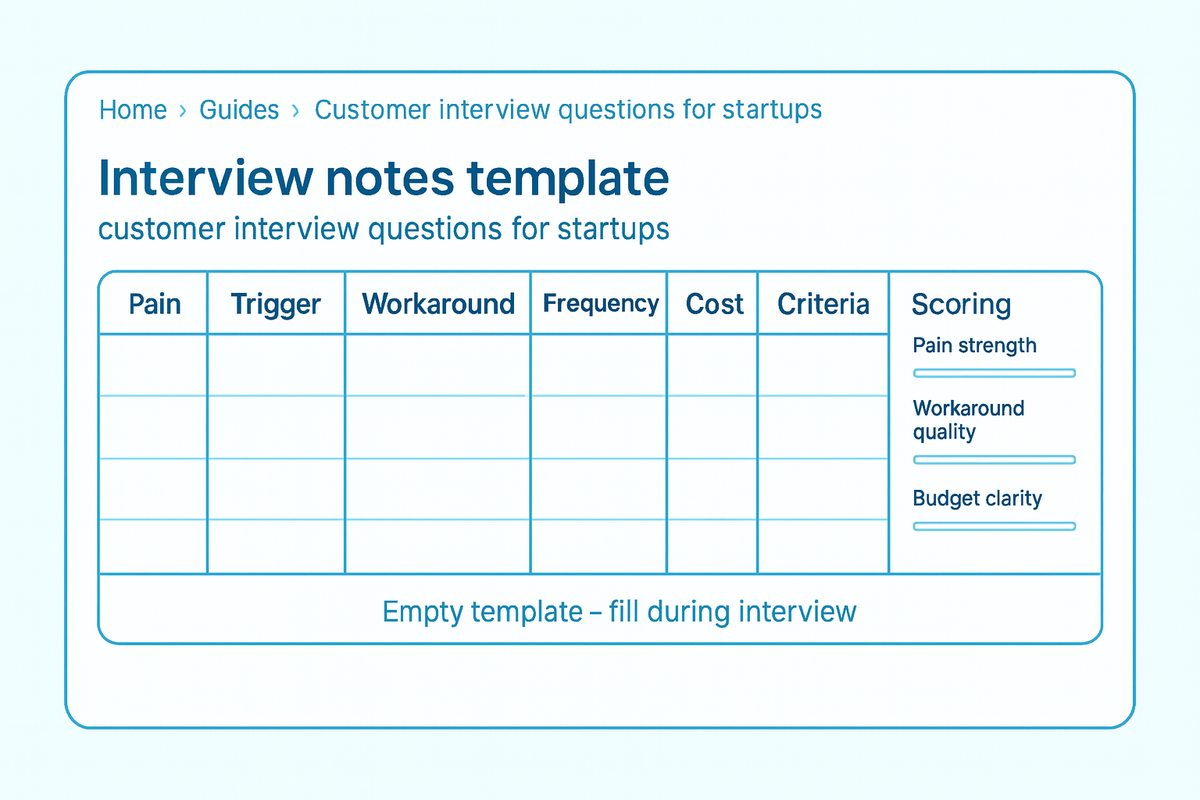
Instead, investigate past behavior. Ask for the story of the last purchase. To keep track of this, use a customer discovery kit to log your findings.
Use these interview prompts to uncover real behavior:
What triggered the decision? (Find the catalyst for change)
What did you do? (Discover the immediate action taken)
What else did you consider? (Identify competitors and substitutes)
What did it cost? (Quantify the budget and resources spent)
What happened? (Assess the outcome and remaining pain)
Leave each interview with a clearer mental model of the customer.
5. Interview experts about future changes
Goal: Look past current public data.
Action: Talk to industry experts about emerging risks and hidden segments.
Output: Identification of structural shifts and new opportunities.
Public data will not tell you everything. You need to look into the future of the market, advanced risks, and hidden segments.
Case Study: Finding a Hidden Segment
In the European sustainability example from Step 1, the team interviewed experts to check if restructuring pains recurred across the market. They discovered a hidden segment: small and medium-sized businesses (SMBs) were adopting ESG reporting voluntarily. They did not have to comply with the law, but they wanted the branding, marketing, and mission benefits. This revealed an underserved segment with clean sales-motion signals.
6. Separate facts and assumptions
Goal: Organize findings to make a decision.
Action: Create an evidence ledger.
Output: A clear record of what is known versus what is assumed.
Organize what you learned into an illustrative evidence ledger. This helps you review supported facts rather than guessing.
Question | Source | Finding | Next Test |
|---|---|---|---|
Who needs ESG reporting? | EU Regulation drafts | Large enterprises face incoming compliance laws. | Interview enterprise buyers on urgency. |
Who else cares about ESG? | Expert interviews | Some SMBs adopt voluntary reporting for brand benefits. | Pitch a small cohort of SMBs. |
7. Choose an initial ICP and test again
Goal: Pick a target and validate the sales process.
Action: Select the most promising segment and run a sales test.
Output: A validated ICP ready for product development.
A useful research process should change a decision. If it only confirms your opening slide, you probably did not test enough. The sustainability startup shifted their focus to the voluntary-compliance SMB segment based on their findings.
Choose your specific ICP based on the evidence. It tells you exactly who to talk to next.
For more details on specific methods you can use during this process, review the different types of market research available.
FAQ
Why is market research important?
Market research replaces assumptions with evidence. It proves that a real problem exists, that customers are willing to pay to solve it, and that a viable market segment is reachable before you spend time and money building a product.How can I do market research online?
Start with desk research using public data sources like the Census Bureau or the Bureau of Labor Statistics to understand market size and growth trends. Review competitors' websites, pricing models, and customer reviews to identify gaps in current solutions.How much market research is enough before building?
You have done enough research when you have a specific Ideal Customer Profile (ICP), documented evidence of past purchases or workarounds for the problem you are solving, and a clear understanding of the triggers that cause your ICP to buy.What is the difference between market research and customer discovery?
Market research looks broadly at market size, competitors, trends, and demographics. Customer discovery is a subset of this process that involves direct interviews with potential users to understand their specific problems, past behaviors, and buying motivations.How do I build a survey for this process?
Only build a survey after you have defined your ICP and core research questions through interviews. Once you are ready to quantify your qualitative findings, review these market research survey questions for B2B to ensure you are asking the right things.