TL;DR: Selling early SaaS is not about pitching a vision. It is an evidence-gathering mission to prove demand. Follow a strict four-step motion — qualify, discover, demo, propose — to uncover real problems, find out what buyers compare you to, and ask for money. Unpaid interest is not validation.
Founders often treat an early sales call like a product showcase. They avoid asking for money because the concept feels unproven. They dive straight into a feature demo. They leave the call happy when the buyer says the product looks cool.
But unpaid enthusiasm is just politeness. A nice call can produce no evidence. If you do not know the customer's alternatives, you are selling your own belief. Learning how to sell SaaS early on simply means running a basic, founder-led process to find real problems and test willingness to pay. You do not need complex sales jargon, expensive CRMs, or technical proof before you get customer proof.
Evidence Collection Over Validation Theater
Founders overcomplicate sales by treating it as a perfect script problem. They want the buyer to validate the product with compliments. The useful part of a call is not the compliment. The useful part is what the buyer already tried, what it costs them, and what they would replace.
To sell SaaS early, qualify the buyer, discover the pain, demo only the relevant proof, then propose a paid next step.
This four-step motion is a simplified founder-led B2B playbook. It only works if it produces evidence.
The Four-Step Sales Motion
1. Qualify
Confirm the market reality. Do not rely on hypotheses. Ask about their role, their company size, and if they actually own the budget for this problem. If they do not match your ideal customer profile, stop selling and start listening. You must verify if they have a real problem, rather than just professional curiosity.
2. Discover
Discover the real pain and willingness to pay. Do not ask, "Would you use this?" That creates a polite lie. Ask about past behavior. What happened last time the problem occurred? What did they try? Why did it fail? How often does the problem appear, and what does it cost?
You must also discover the perceived competition. Are they comparing your product to another app, a human, or an internal workaround? Good sales for founders relies on problem discovery, not convincing. For more on structuring these questions, customer development principles show how to dig into past behavior rather than future promises.
3. Demo
A demo should feel like proof, not a tour. Do not walk through every feature. Only show the specific part of the product tied to the pain they already named. Show exactly how the product replaces their expensive alternative. Proof of demand beats vision.
4. Propose
Propose based on perceived value, not a generic SaaS category. If you do not know what the buyer compares you to, you are pricing from your own belief.
Consider a fitness software product. If customers compare it to a standard tracking app, they expect to pay $20. You can reframe the category. Compare it to a $140-per-session human coach instead. The same product can look obvious at $45 a month. Identify the perceived competition, prove monetary value, and propose based on the value frame.
The Sales Evidence Framework
Use this structure to force evidence at every step, whether you are testing a small pilot or trying to avoid the common reasons startups fail without market need.
Qualify
Goal: Confirm ICP and problem
What to Ask: "How is your team currently handling this?"
Evidence Needed: Confirmed role, budget, and pain.
Red Flag: "We do not really track that."
Discover
Goal: Find cost and alternative
What to Ask: "What did you do last time this happened?"
Evidence Needed: Past behavior, current workaround cost.
Red Flag: Hypothetical praise.
Demo
Goal: Prove the solution
What to Ask: "Here is how this replaces your workaround."
Evidence Needed: Recognition that the specific pain is solved.
Red Flag: Asking for unrelated features.
Propose
Goal: Validate demand with money
What to Ask: "Based on the $5k you spend now, our pilot is $1k. Should we start?"
Evidence Needed: Concrete next commitment or payment.
Red Flag: "Let us check back in six months."
Before you leave the call, you should know:
Who you are talking to and what they control.
What they did the last time this problem happened.
What their current workaround costs them.
What they compare your solution to.
What concrete step they will take next.
Ask for Money Early
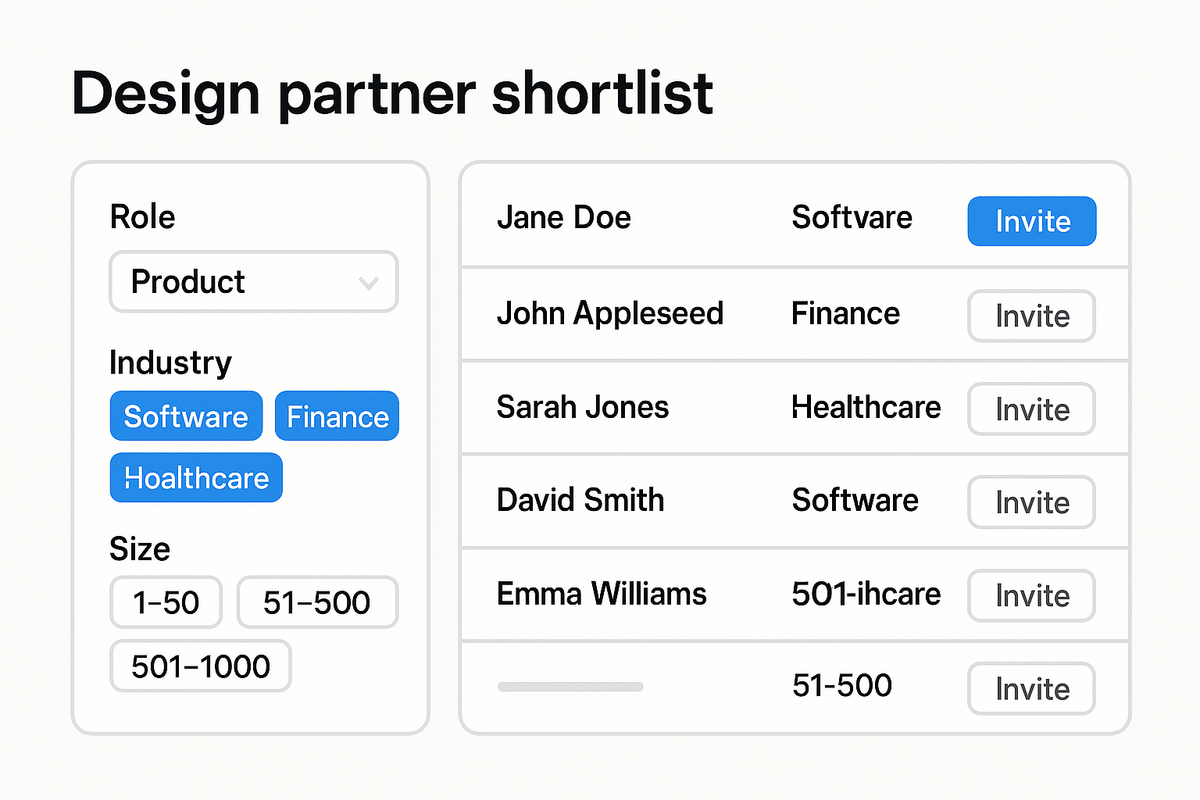
Pricing can change later. Avoiding money is the bigger mistake. No willingness to pay means no real value signal. Ask for payment even before the full product exists. You can frame this to early buyers as a design partner agreement. They get custom development for a fraction of the cost of an outsourced engineering team. This is how you prove real demand. Y Combinator's sales guide emphasizes that charging early is the only true test of value.
FAQ
What is the simplest way to sell SaaS as a founder?
To sell SaaS early, you need to qualify the buyer, discover the pain, demo only the relevant proof, and then propose a paid next step. You are looking for evidence of a real problem, not compliments.
How do I know they are actually buying, not just being polite?
Founders love asking, "What do you think about it?" That forces polite lies. You know they are buying when they commit to a concrete next step. Stop studying their perception of you and study their past behavior. Look for a current workaround, a stated cost of the problem, and a willingness to pay for a solution now.
When should I introduce pricing?
Introduce pricing during the proposal step, after you discover their perceived alternative. Anchor your price against what they currently spend to solve the problem, not against standard SaaS norms.
What if the product is not fully built yet?
Treat early sales as a design partner offer. Ask for payment to solve their specific problem. A paid pilot proves the problem is painful enough that they will fund the solution.