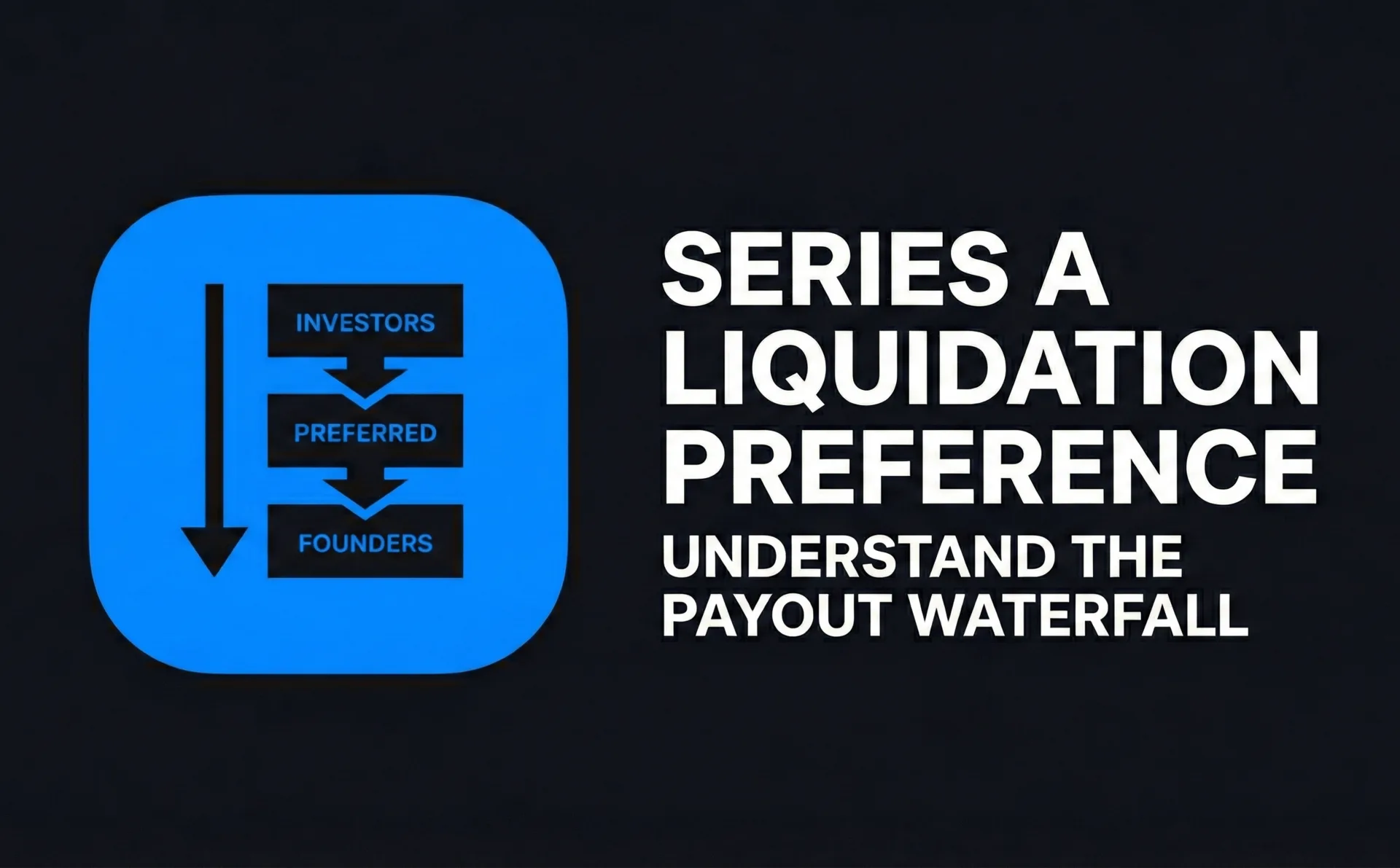
Liquidation Preference Framework for Series A (Waterfall Logic)
last updated: Apr 29, 2026
Receiving a Series A term sheet is an ego boost, but the valuation number is often a trap. You need to understand the waterfall logic to see how much cash actually lands in your pocket during an exit.
TL;DR: The Cheat Code
A liquidation preference framework defines the strict hierarchy of payout distributions during a liquidity event, ensuring investors recover their capital before common shareholders see a dime. It acts as downside protection for VCs and dictates whether founders get rich or just get acquired.
Key Bullets:
How to read this: Use this guide to audit your term sheet against market realities.
Key Bullets:
- Benchmark: Standard Series A terms are 1x non-participating preferred. According to recent data from Cooley, over 96% of deals follow this structure. Anything higher is aggressive.
- Rule: Always model the "downside scenario" (selling for less than the post-money valuation) to see if you get wiped out.
- Warning: "Participating preferred" creates a double-dip scenario where investors get their money back plus their percentage share, drastically reducing founder returns.
How to read this: Use this guide to audit your term sheet against market realities.
Glossary
- Liquidation Preference: The multiplier of the original investment (usually 1x) that an investor is guaranteed to receive before common stock holders are paid.
- Seniority (Stacking): The order of payout among different classes of preferred stock. Standard is usually "pari passu" (equal footing) or standard seniority (Series B gets paid before Series A).
- Pari Passu: A Latin term meaning "on equal footing." In a waterfall, this means Series A and Seed investors get paid back simultaneously and pro-rata, rather than one waiting for the other.
- Participation Cap: A limit on the total payout for participating preferred stock, typically set at 2-3x the investment amount.
The Asset (Copy This)
Use this waterfall visualizer to map out exactly how an exit proceeds. This logic separates "Paper Wealth" from "Bank Balance."
The Waterfall Visualizer
This framework assumes a hypothetical $40M Exit where you raised $10M Series A for 20% of the company, with $2M in venture debt.
1. The Creditor Wall (Debt)
Debt always eats first. Before any equity holder (you or the VCs) touches a cent, secured creditors are paid in full.
2. The Preference Hurdle (Preferred Stock)
This is where the term "Liquidation Preference" activates. Investors execute their right to get their principal back.
3. The Seniority Check (Stacking vs. Blending)
If you have multiple rounds (Seed + Series A), you must determine who stands in line first. Check your Cap Table SaaS Framework to see how this impacts your specific ownership.
4. The Common Pool (Founders & Employees)
This is the residual value. It is distributed to Common Stock holders according to ownership percentage.
Summary of Outcomes
The Waterfall Visualizer
This framework assumes a hypothetical $40M Exit where you raised $10M Series A for 20% of the company, with $2M in venture debt.
1. The Creditor Wall (Debt)
Debt always eats first. Before any equity holder (you or the VCs) touches a cent, secured creditors are paid in full.
- Logic: Gross Sale Price - Outstanding Debt = Distributable Proceeds.
- Sample math: $40M (Exit) - $2M (Debt) = $38M remaining.
2. The Preference Hurdle (Preferred Stock)
This is where the term "Liquidation Preference" activates. Investors execute their right to get their principal back.
- Standard Logic (1x Non-Participating): The VC chooses either their 1x money back ($10M) or their % ownership of the remaining pot ($7.6M). They choose the higher amount.
- Predatory Logic (Participating): The VC takes their $10M off the table immediately and still owns 20% of the remaining pot.
- Sample math (Standard): VC takes $10M (since $10M > 20% of $38M). Remaining pot: $28M.
3. The Seniority Check (Stacking vs. Blending)
If you have multiple rounds (Seed + Series A), you must determine who stands in line first. Check your Cap Table SaaS Framework to see how this impacts your specific ownership.
- Standard: Pari Passu. Seed and Series A split the preference pot pro-rata based on capital invested.
- Stacked: Series A gets paid their full preference before Seed sees a dollar.
- Impact: In a low exit (e.g., $15M), a stacked Series A might wipe out the Seed investors entirely.
4. The Common Pool (Founders & Employees)
This is the residual value. It is distributed to Common Stock holders according to ownership percentage.
- Logic: (Remaining Pot) * (Founder Ownership %).
- Sample math:
- Pot: $28M.
- Founder Share (e.g., 40%): $11.2M.
Summary of Outcomes
Benchmarks
To negotiate effectively, you need to know what is "market." You cannot argue from emotion; you must argue from data. Here is the reality for Q4 2024 and beyond:
- 1x Liquidation Preference: This is the overwhelming standard. Carta data indicates that 96–98% of Series A deals carry a simple 1x preference. If an investor asks for 2x, they are signaling that they view your business as high-risk or distressed.
- Non-Participating Preferred: Approximately 96% of deals are non-participating. This means investors get their money back OR their share of the company, not both.
- Participation Caps: In the rare 4% of cases where participation is included, it is almost always capped at 2–3x. Uncapped participating preferred is a "walking dead" term — if you see it, run or Renegotiate hard.
Participating vs Non-Participating
This is the single most dangerous clause in the term sheet. See our full breakdown of liquidation preference examples for deep-dive scenarios.
- Non-Participating (The Good): The investor is protected on the downside but behaves like a partner on the upside. They convert to common stock when the exit is large enough.
- Participating (The Bad): The investor gets their cake and eats yours too. They take their $10M principal off the top, and then re-enter the pool to take 20% of what's left. This "double dip" can cost founders millions in a median exit scenario.
Risks
Ignorance of the waterfall leads to two primary risks:
- The Valuation Trap: Raising at a high valuation ($50M+) feels like a win, but it sets a high preference hurdle. If you raise $15M at $50M pre-money, you must exit above $65M just to clear the preference stack. Anything less, and you might walk away with nothing despite building a "successful" company.
- The Seniority Wipeout: If you agree to "stacked" preferences rather than "pari passu," your Series A investors can drain the entire exit pool, leaving early angel investors and employees with $0. This destroys your reputation and employee morale.
Conclusion
Mastering the liquidation preference framework is a necessary defensive step, but it is not the whole picture. You can have a perfectly structured waterfall with 1x non-participating prefs, but if your other variables — specifically your ability to generate revenue — are weak, your probability of hitting $10k MRR remains near 0%.
Investors dictate terms when they have leverage. If you are pre-revenue or stuck at $2k MRR, you will accept whatever structure they offer to keep the lights on. The only way to negotiate a "clean" waterfall is to have the optionality that comes from being default alive. Build the revenue engine first; the legal structure is just there to protect what you build. Fix your foundation before you launch.
Investors dictate terms when they have leverage. If you are pre-revenue or stuck at $2k MRR, you will accept whatever structure they offer to keep the lights on. The only way to negotiate a "clean" waterfall is to have the optionality that comes from being default alive. Build the revenue engine first; the legal structure is just there to protect what you build. Fix your foundation before you launch.
FAQ
- You:What is the difference between participating and non-participating preferred?Guide:Non-participating investors must choose between their liquidation preference (money back) OR their share of the proceeds (conversion to common). Participating investors get both: they take their money back and then share in the remaining proceeds with common stockholders.
- You:How does a 'cap' affect participating preferred stock?Guide:A cap limits the total payout a participating investor can receive. For example, a 3x cap on a $5M investment means the investor stops participating once they have received $15M total. This prevents them from taking excessive upside away from founders in a massive exit.
- You:Why does debt get paid before preferred stock?Guide:Debt is a liability, while preferred stock is equity. In bankruptcy or liquidation law, creditors (lenders) always have seniority over owners (shareholders). This is why Venture Debt can be risky — it sits at the very top of the waterfall.
Find where your first 100 customers are in 2 mins. — or browse all the free founder guides.
No-BS guides