TL;DR
Saying "we have no competitors" usually means you have not looked carefully enough at what customers already do.
Market research examples for startups are concrete, evidence-forcing tests — like specific competitor matrices or behavior-based customer interviews — that validate a problem before you write code.
Strong market research forces evidence out of the market. It relies on previous real behavior, not hypothetical intent.
Do not expect objections to appear naturally in interviews. You have to actively extract them.
One reply from 500 cold emails is too low-volume to validate or invalidate a market.
Market research examples for startups are concrete, evidence-forcing tests — like specific competitor matrices or behavior-based customer interviews — that validate a problem before you write code.
Founders often mistake internal reasoning for market research. You might hear a founder say, "We don't really have competitors." This is usually a red flag. It rarely means the idea is perfectly unique. Instead, it means they have not mapped the market, do not know how customers currently solve the problem, and are treating their own assumptions as evidence.
If you cannot name the current alternatives — even if those alternatives are manual workflows, cobbled-together tools, agencies, spreadsheets, or doing nothing — you probably do not understand the market yet.
Good market research for startups is not a passive report. It is how founders replace private logic with market evidence before they waste engineering time. Here are four concrete examples of how to run research that produces a decision.
1. The Competitor Matrix That Actually Means Something
A generic competitor matrix uses universal axes like "price vs. features" or "basic vs. advanced." These rarely help you make decisions.
Instead, research the market to find the actual dividing lines. Let's say you are building a SaaS tool for social media management. After looking at the broader market, you might pick two category-specific axes that actually separate competitors, such as one-platform vs. many-platform and growth-first vs. full-management.
Mapping real alternatives on these specific axes shows you the clusters. It reveals crowded positions, neglected use cases, and exactly which Ideal Customer Profiles (ICPs) you should consider avoiding or pursuing. If your axes come from the market, the matrix clarifies your positioning.
2. Customer Interviews That Track Behavior, Not Intent
Asking a prospect "Would you use this?" is a friendliness test. Asking "What did you do the last time this happened?" is research.
Founders tend to believe objections will flow naturally to them. They rarely do. If interviewees seem agreeable, that is not validation. You have to actively extract objections from people.
When formatting your customer research questions, ask about the last time the problem occurred, the current workaround, the cost of doing nothing, and the friction involved in switching. Repeated recent pain combined with an active workaround is a strong signal to build. If you need a template, utilizing our customer discovery kit as a market research questionnaire sample doc can help keep your calls structured and objective.
The Research-to-Decision Framework
Each research tactic should ideally force a decision. Here is how to structure your approach:
Customer Interview
Avoid: "Would you pay $50 a month for this?"
Ask instead: "What did you do the last time this happened? What did you use?"
Signal: Repeated recent pain + active workaround
Decision: Validates problem severity; proceed with replacing the exact workaround.Competitor Mapping
Avoid: "Which features do our competitors lack?"
Ask instead: "Which specific tool or agency do you pay for right now to handle this?"
Signal: Discovery of a highly specific alternative or category cluster
Decision: Pivot positioning to attack the weaknesses of that specific alternative.ICP Prioritization
Avoid: "How big is the total addressable market?"
Ask instead: "Who can we reach today that has the most urgent need?"
Signal: High reachability + high urgency
Decision: Focus GTM entirely on the reachable segment; consider ignoring the broader TAM for now.Demand Testing
Avoid: "Does this landing page look good?"
Ask instead: "Why did you book this call today?"
Signal: Tangible objections + clear buying criteria
Decision: Rewrite landing page and sales scripts to address extracted objections.
(Note: If you are organizing this data across your team, you can download our customer discovery kit as a market research pdf so everyone runs the same validation checks.)
3. Prioritizing the ICP Before the GTM
Founders often overcomplicate research by treating it like a framework rather than a sequence of strict tests. A common mistake is developing a go-to-market strategy before firmly prioritizing potential ICPs.
The best early ICP is not always the biggest segment. It is the reachable segment with a painful problem. The key question is not what hurts your target demographic generally, but what hurts the people you can actually reach.
Define your ICP, your pain-solution hypothesis, and your distribution hypothesis. Before you collect any data, decide what metric will generally invalidate or greenlight each one.
4. Outbound Demand Tests with Real Volume
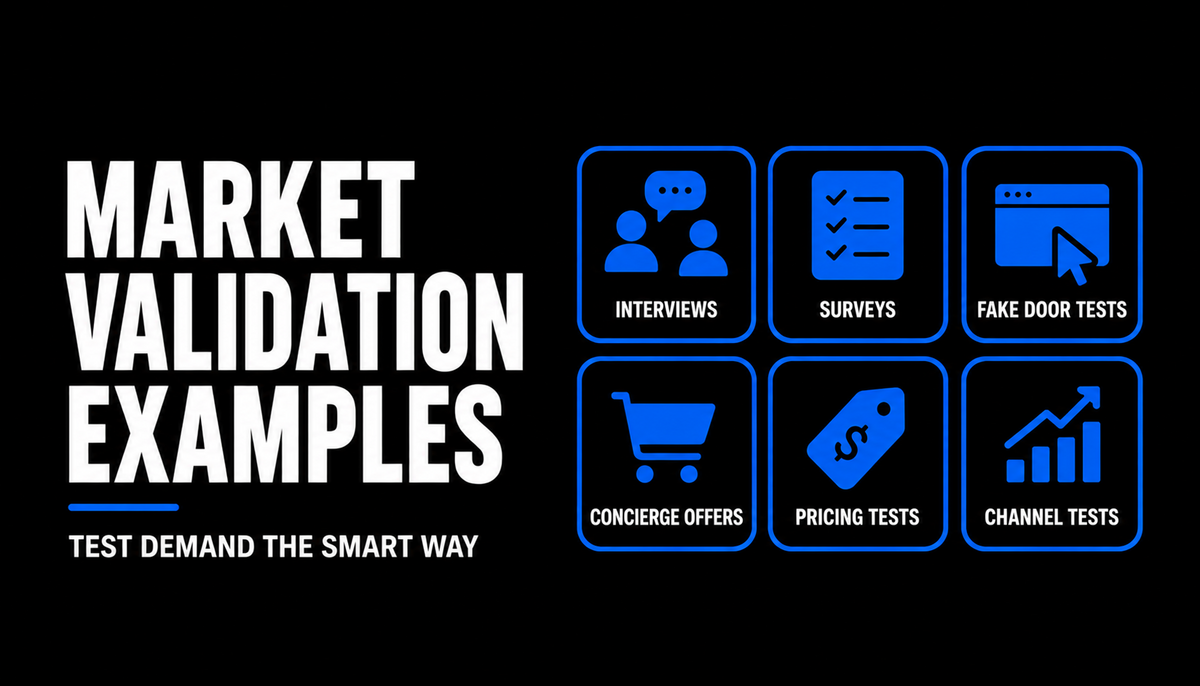
Running an outbound test is a practical way to gather market validation examples. You send focused messaging to a narrow ICP and track replies, objections, calls booked, and qualified interest.
But volume matters. One reply from a batch of 500 cold emails is not a market verdict. It is simply a low-volume test. It is not enough data to validate or invalidate your demand. It is a reason to inspect the message, the list, and the segment, and then run a larger test.
As noted in User Interviews 101 by NN/G, you need enough conversations to spot actual patterns, not just anomalies. Similarly, frameworks like the Steve Blank Customer Development process emphasize rigorous, sustained inquiry over single-point tests. For interviewing specifically, principles from resources like The Mom Test are critical: talk about their life, not your idea.
FAQ
What are examples of market research for startups?
Effective startup market research examples include creating competitor positioning matrices based on specific industry axes, running outbound email tests with enough volume to measure actual reply rates, and conducting customer interviews focused purely on past behavior rather than hypothetical intent.
How many customer interviews are enough for market research?
There is no universal number, but you should continue interviewing until you stop hearing new objections and start hearing the exact same behavioral patterns repeated. This happens after completing enough highly targeted interviews within a specific, reachable ICP.
If I can build an MVP quickly, why spend time on market research at all?
Because AI makes it faster to build things people do not need. Building is cheaper now, so building the wrong thing is easier. An MVP is about fixing the most painful problem for your reachable customers. Fast building does not remove the need for research; it makes weak research more expensive because your team can ship the wrong features faster.
Why shouldn't I just wait for users to give me feedback on the prototype?
Because waiting for feedback is passive. If a user tries your product and leaves, you learn nothing. If you interview them and they are polite, you also learn nothing. You must actively extract objections. Real research means forcing evidence out of the market before you commit months of engineering time.