Market research methods are the structured ways founders gather data to validate a market, understand customer behavior, and test demand. Rather than a list of generic tools, effective methods divide into secondary research to map the landscape and primary research to explain why buyers act.
TL;DR: Market research is not a choice between a quick AI query and expensive agency reports. It is an iterative process. Use desk research to map the visible market. Then, use direct conversations to explain customer behavior. Stop asking hypothetical questions and start studying how people already try to solve their problems.
"We don't really have any competitors."
When an early-stage founder says this to an investor, it is a red flag. It usually means the founder has ignored the spreadsheet, the manual workaround, or the decision to do nothing that already solves the customer's problem.
Early market research is a task for founders, not a task to outsource. Treating market research as a corporate luxury, or limiting it to a single AI search, leaves you building a company on untested beliefs, a trap frequently cited in startup failure post-mortems. An AI summary maps the obvious market, but it misses hidden segments, future dynamics, and the real reasons buyers act.
Choosing the right research method helps you gather accurate founder-led data without wasting months. While you can explore all the types of market research to see what exists, this guide focuses on the specific decision: Which execution method should you use, when, and why?
Primary vs. Secondary Research
Before choosing a specific method, know the difference between your two main toolsets. Secondary research (desk research) analyzes data that already exists, like public reports and search trends, to show you what is happening in a market. Primary research generates new data directly from your target audience, like interviews and behavioral tests, to explain why it happens. You need both to avoid building a product nobody wants.
The Core Methods: A Comparison Framework
Effective market research often starts broad and narrows down, working in iterative cycles. You move from the macro environment down to individual buyer behavior.
1. Desk Research (Public Data and Reports)
What it reveals: Market size, growth rates (CAGR), basic segmentation, regulatory pressure, and the current competitive landscape.
When to use it: At the very beginning, to test whether the market structure and ideal customer profile (ICP) are attractive.
What evidence it produces: Contextual evidence. It shows you the playing field.
What it cannot prove: It cannot prove that customers will actually buy your specific solution.
Start with secondary research. If the market is shrinking or dominated by monopolies, you need to know that before you start building.
2. Expert and Customer Interviews
What it reveals: Past customer behavior, workarounds, friction points, and actual purchase motivations. It can expose future dynamics and advanced competition that public sources miss.
When to use it: After mapping the market, when you need to understand why people act the way they do.
What evidence it produces: Directional evidence. It gives you a mental model of your customer.
What it cannot prove: It is not statistically validating. A dozen interviews do not guarantee broad market demand.
Desk research tells you what is happening. Direct conversations tell you why.
3. Credible Surveys
What it reveals: How common a specific pattern, preference, or pain point is across a larger group.
When to use it: When you have a clear hypothesis from interviews and need to see if it holds true at scale.
What evidence it produces: Quantitative evidence, but only if the sample is representative.
What it cannot prove: Deep reasoning. Surveys force people into multiple-choice boxes and cannot ask dynamic follow-up questions.
4. Behavioral Testing (Landing Pages & Experiments)
What it reveals: Whether people will actually act on a proposed solution.
When to use it: When you have a strong explanation for customer behavior and want to test demand before building the full product.
What evidence it produces: Behavioral evidence. A click or a deposit is stronger evidence than stated enthusiasm.
What it cannot prove: It validates one specific offer in one channel. It does not prove long-term retention or entire market viability.
5. Observation and Product-Usage Analysis
What it reveals: How users actually interact with a workflow, prototype, or competitor tool in real life.
When to use it: When what users say they do contradicts what they actually do.
What evidence it produces: Observational evidence.
What it cannot prove: It shows you what users struggle with, but often cannot tell you the strategic reasons behind their initial purchase.
This approach mirrors the core principles of Customer Development, pushing you to systematically test assumptions.
The Method in Action: Finding an Overlooked Segment
Here is how combining methods changes the trajectory of a company.
Consider a startup entering the European B2B sustainability software market.
The Desk Research: Public sources showed that incoming regulations were forcing a rapid market restructuring. Large corporations had to adapt to new compliance standards.
The Conversations: The team conducted expert interviews to check the pain points around this restructuring.
The Discovery: The conversations confirmed the pain points and revealed an overlooked segment. Medium-sized businesses were not yet forced to adapt, but they were voluntarily adopting ESG reporting. They did this for branding, marketing, and mission benefits.
If the founders had stopped at secondary research, they would have entered a highly competitive enterprise sales motion. Because they used primary conversations to check their assumptions, they found a different, less competitive segment.
What Must You Learn? (Method Selection Matrix)
Do not turn every method into an equally weighted option. Pick the tool based on the decision you need to make right now.
Desk Research: Best for mapping market structure & trends. Use at the idea stage. Fast time, low cost. Limitation: Tells you what, not why.
Interviews: Best for explaining the reasons behind behavior. Use at idea & prototype stages. Medium time, low cost. Limitation: Not statistically validating.
Credible Surveys: Best for checking how common a pattern is. Use at validation stage. Medium time, low-med cost. Limitation: Easily biased by poor design.
Search-Trend Analysis: Best for seeing broad demand shifts. Use at the idea stage. Fast time, low cost. Limitation: Lacks specific customer context.
Behavioral Testing: Best for testing whether people will act. Use at validation stage. Medium time, med-high cost. Limitation: Only tests one specific offer.
Observation: Best for seeing actual friction points. Use at prototype & live stages. Slow time, low-med cost. Limitation: Doesn't explain purchase intent.
Execution Tactics for Founders
When you run your own research, execution errors ruin your data. Here are two critical corrections.
1. Build an Emergent Competitor Matrix
Competitor analysis is customer research. Looking at alternatives reveals what buyers already value, tolerate, or replace.
Do not use a generic feature-comparison checklist. Your two-axis competitor matrix should use dimensions that emerge from your research. For example, when analyzing SaaS tools for social media management, the most revealing axes might not be price and features. They might be single-platform vs. multi-platform and growth-first vs. full-management.
Let the research define the battlefield.
2. Stop Asking "What Do You Think?"
If you directly ask a customer "Would you use this?" or "How do you like it?", you force them to give you a polite lie.
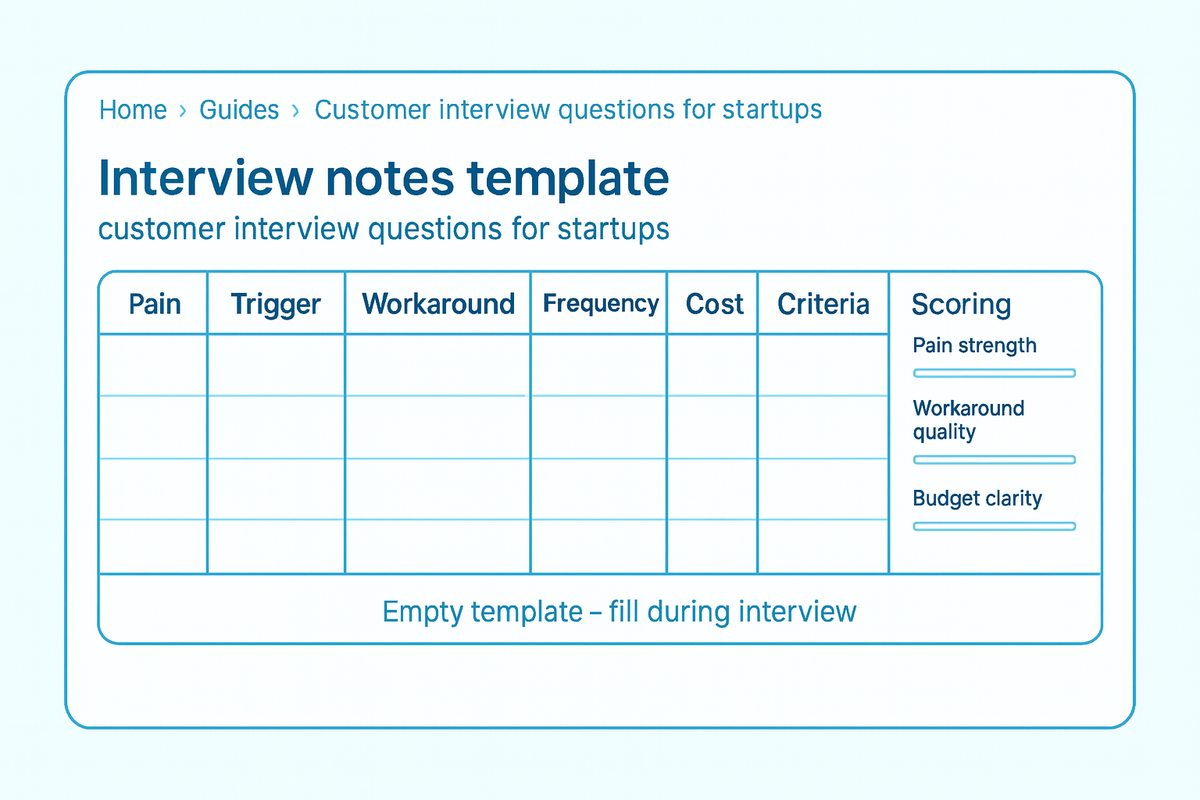
Instead, study past performance and behavior. Ask: "Tell me about the last time you faced this problem. What did you do, and what alternatives did you consider?" If you want to dive deeper into this, read our breakdown on how to write market research questions that actually uncover the truth.
FAQ
What are the main market research methods?
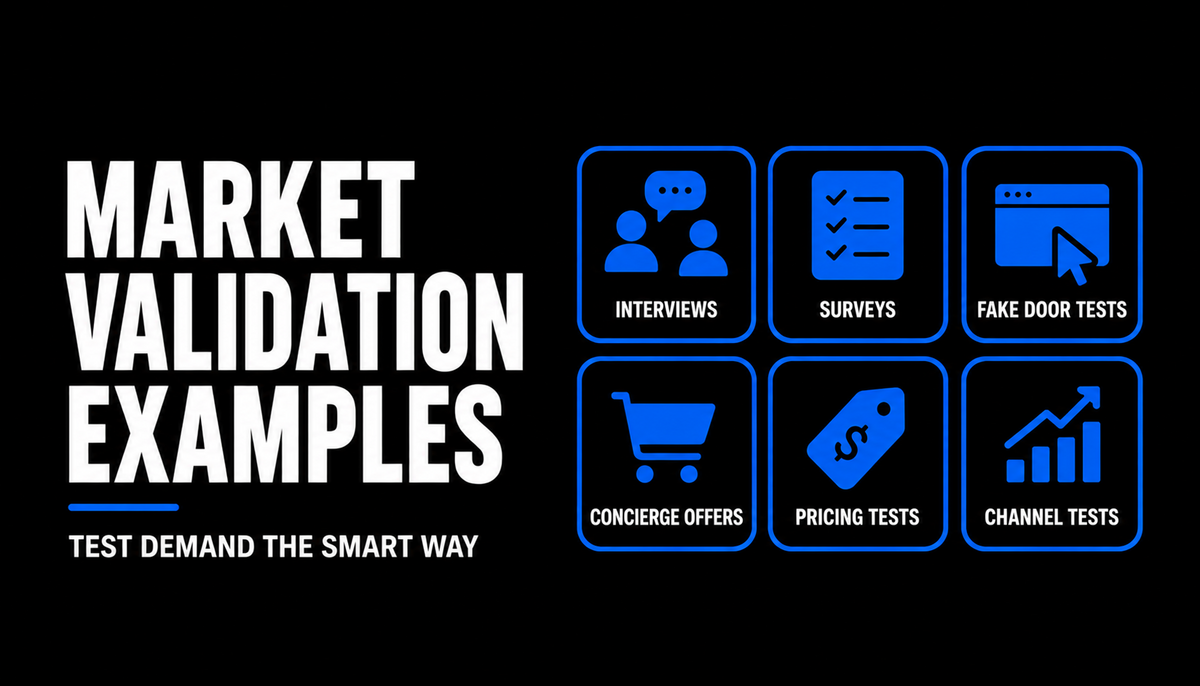
The main methods divide into secondary research (desk research, search-trend analysis, public filings) and primary research (interviews, surveys, observation, and behavioral testing). Secondary research maps the market you are entering, while primary research explains the specific behaviors of your target customers.
Which method is best for an early-stage startup?
Start with desk research to ensure the market is growing and structurally sound. Then, move quickly to expert and customer interviews. As Y Combinator's essential startup advice notes, talking directly to users is one of the only things early founders should focus on. Understanding why one person buys is more useful than polling a hundred people with a biased survey.
How much market research is enough before testing?
You have enough research when you can clearly articulate the customer's problem, their current workaround, and the exact trigger that causes them to seek a new solution. Once you have a strong explanation for their behavior, you are ready to test that hypothesis with a landing page or prototype.
Should I trust interviews or desk research?
Use both, for different jobs. Desk research should test whether the market and ICP are structurally attractive, focusing on growth, trends, and regulatory pressure. Primary interviews should explain customer behavior. You need desk research to avoid building in a dead market, and you need interviews to understand why a customer will actually pay you.
Can't I just use AI for all of this now?
No. AI and public sources are excellent for mapping the obvious market. But they synthesize what is already widely known. They cannot interview your specific target customer about a manual workaround they created last week. AI gives you the baseline; primary research gives you the edge.