TL;DR: Most validation surveys fail because they collect polite lies instead of intent. A strong survey avoids asking "would you use this?" and instead forces respondents to explain their past behavior, current workarounds, and budget constraints. If you want to capture real B2B demand, you must introduce buying friction early.
A market validation survey is a tool used to measure real demand for a product before building it. Instead of asking for opinions, it forces respondents to reveal past behavior, current workarounds, and willingness to pay.
It is easy to launch a startup validation survey, get 50 people to agree that a problem exists, and feel like you have a validated business. You spend six months building based on their nods. Then launch day comes, and none of those 50 people will open their wallets.
The survey did not test the market. It protected your beliefs.
Worse is the tiny signal illusion. A founder blasts hundreds of cold emails with a survey link, gets one enthusiastic reply, and uses it to declare the market validated. One reply from hundreds of cold emails is very low volume. It does not validate or invalidate the market. It is just a reason to keep testing.
When you design a market validation survey to make yourself feel safe, you get false positives. If you want to know if a market actually wants to buy, you have to stop asking for opinions and start measuring friction.
5 Rules for Survey Design
Before writing your questions, follow these rules:
Use neutral wording: Do not lead the witness. Ask how they solve a problem today, not how much they hate it.
Focus on past behavior: Hypotheticals are useless. If they have not spent time or money on the problem, they will not buy your solution.
Demand budget evidence: If a problem matters, people spend money on it. Find out how much they currently pay for workarounds.
Qualify respondents early: Ask role and budget questions upfront so you can ignore data from people who cannot buy.
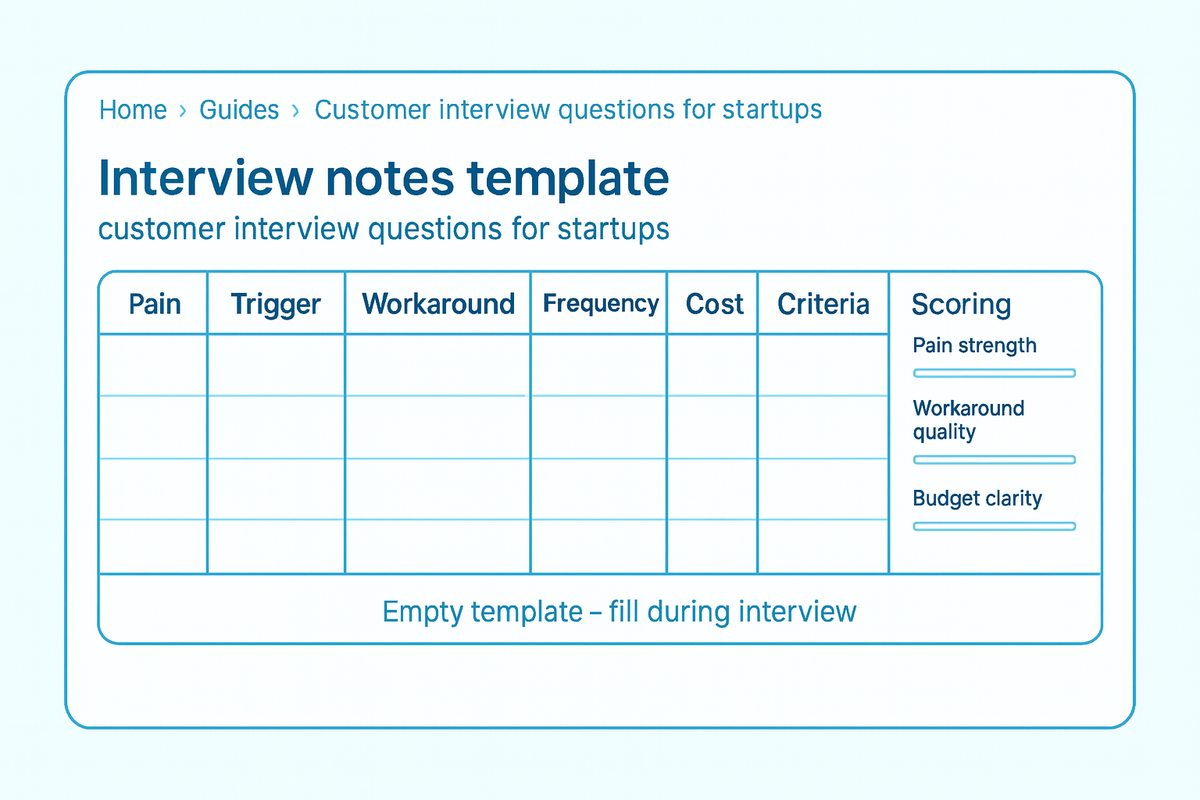
Plan your follow-up routing: A survey is just the first step. Route respondents who show strong intent directly into qualitative interviews using your customer discovery kit.
Why Opinion Questions Fail
Founders love to ask "what do you think about this idea?" or "how do you like it?"
These questions force polite lies. When you ask someone to evaluate your vision, human nature kicks in. They do not want to be mean, so they say it looks great.
But "looks great" is not B2B intent. Interest is cheap. A good survey does not ask people to predict their future behavior. It asks them to explain what they already did.
How to Ask About Past Behavior
If a respondent has never spent time, money, or political capital on the problem, they are probably not your ideal customer.
Instead of asking if a problem is annoying, find out how they currently solve it. If they are not using a manual workaround, stringing together spreadsheets, or paying for a competitor, the pain is not severe enough to warrant action. Learning how to write market research questions that focus exclusively on past behavior is the fastest way to filter out people who will never buy.
Bad vs. Better Validation Questions
Here is how to shift your B2B market validation questions from collecting opinions to capturing intent.
Bad validation question | Better intent question | What it proves |
|---|---|---|
"Would you use a tool that automates X?" | "What have you tried to solve X in the last 6 months?" | Shows whether the pain has already caused action. |
"Is X a major frustration for your team?" | "How many hours per week does your team spend on X?" | Quantifies the exact cost of the problem. |
"Would you pay $50/month for this?" | "How much have you spent trying to solve this in the past 6 months, and who approved that spend?" | Reveals budget reality and identifies the true buyer. |
"Which of these features do you like most?" | "What tool did you recently cancel because it failed at X?" | Uncovers the gaps in the current market. |
For more examples of behavioral framing, review this guide on B2B market research survey questions.
Adding Buying Friction
Eventually, you have to talk about money. Many founders think it is premature to ask for payment when the product does not exist yet. But avoiding the money question hides whether the problem creates real value. No money means no real value produced.
You can introduce willingness-to-pay friction thoughtfully. Once the respondent understands the context, you can offer them a paid design-partner spot. Frame the unfinished product as a highly discounted custom development opportunity.
For example, your survey could end with a pitch for paid design partners at a fraction of agency costs, asking for a deposit. Even a deposit requirement acts as friction. This separates polite supporters from real buyers.
A strong signal of demand is a signed letter of intent, a waitlist with a qualification check, or an introduction to procurement. Incorporating frameworks from experts like Steve Blank emphasizes the importance of stepping outside the building to secure these commitments.
Segmenting the Responses
Once the data comes in, group your respondents. Look for patterns in:
Role and buying authority: Do they actually own the budget?
Company size: Is the pain felt more acutely by SMBs or enterprises?
Current workarounds: Are they migrating from a specific competitor?
Urgency: Is this a problem they need to solve this quarter?
Segmenting helps you understand not just who answered, but who has the strongest intent. The Mom Test principles apply here. You are looking for evidence of commitment, not just compliments.
Choosing Who to Interview Next
A survey cannot prove product-market fit. Its job is to capture quantitative signals so you know who to talk to next.
If a respondent says they are "interested," that is a weak signal. If they are using a painful manual workaround, that is a medium signal. If they have budget, recently paid for an alternative, or agreed to join a paid pilot, that is a strong signal.
Take your strong signals and move them into qualitative interviews. The survey showed you the pattern. The interview will verify the "why" behind it. Structuring interviews effectively is crucial, and resources from NNGroup can provide excellent guidance on moderating these sessions.
FAQ
Can a market validation survey show real B2B intent, or is it just collecting polite lies?
It only shows real intent if it stops asking for opinions. Do not ask "what do you think?" or "how do you like it," and do not study hypotheticals. Design the survey around past behavior. Ask what they already tried, paid for, ignored, or worked around, and why.
Is it okay to ask about pricing or payment in an early survey?
Yes. For willingness-to-pay, add friction. Payment is not premature; it is the way to prove real demand. You can position it as a paid design-partner or custom-development offer at a fraction of an outsourced engineering team’s cost.
How many responses do I need for a market validation survey?
There is no hard benchmark. Focus on segment quality and follow-up interviews rather than raw numbers. Highly qualified respondents who commit to a pilot can provide enough signal to keep moving.
If people say they will buy my product in a survey, is my idea validated?
No. Hypothetical willingness-to-pay is not validation. You need real friction — a paid pilot, an LOI, or a booked demo — followed by qualitative interviews to understand the true mechanics of the problem.