TL;DR: An MVP’s cost is not the price to build an app. It is the minimum money needed to test if people will pay. Before you look at MVP development stats, try selling a manual pilot. Use cost benchmarks as strict limits to control your scope. Do not treat them as a required MVP budget.
Founders often ask how much an MVP costs to build. That is the wrong question. It makes them pay for software before they know buyers want it.
The real question is different. You need to know what it costs to test willingness to pay.
Overbuilding your MVP wastes runway. The cheapest way to test demand is often manual delivery. When you understand what is an MVP, you test the core problem first. You do this before you write any code.
The Core Mistake: Funding Software Before Validation
Many founders think they need polished software before asking for money. They see average cost stats and treat them as a target budget.
Consider a founder with an AI-personalized workout app and no traction. The first instinct is to build or remake the product. Instead, the right move is a manual pilot.
In a real case, we sold a 14-day pilot to 15 buyers. We delivered the AI personalization manually through WhatsApp. After the pilot, 40% of them bought the £60 subscription.
Only then did development make sense. The true benchmark is not the build cost. It is the validation cost needed to prove demand. Pay to validate the problem first. Then fund the software. This is how you actually approach customer development.
Minimum viable product cost stats: what founders should benchmark
When you prove buyers will pay, you need to understand development costs. Use these illustrative planning ranges to control your scope. Do not use them as an excuse to spend more.
Development Method | Hypothetical Planning Range | Best Used For |
|---|---|---|
Concierge / Manual Pilot | $0 – $500 | Testing willingness to pay manually. |
No-Code / Low-Code Tooling | $1,000 – $5,000 | Automating workflows after you see payment intent. |
In-House Lean Development | $10,000 – $25,000 | Building core features where data security matters. |
Outsourced Agency (V1) | $25,000 – $50,000 | Handling complex needs that you cannot build leanly. |
For B2B SaaS, an illustrative MVP could hypothetically cost anywhere from $0-$500 for manual validation to $25k-$50k for an outsourced V1, but the right MVP budget depends on what you need to learn before building.
If a method is cheaper, your total budget should drop.
The Cheap AI Trap
AI makes development faster and cheaper. This should be an advantage. Often, it becomes a trap.
Because coding is fast, founders add complex dashboards and dark modes. They ignore the core pain. They use a minimum viable product template but forget to keep it minimum.
With cheap tools, it is too easy to build what people do not need.
Use cost benchmarks to limit your scope. Keep your focus on the cheapest path to fix the main problem. Cheaper tools should help you ship the fix faster. They should not make the product complex. A strict minimum feature set stops scope creep.
Practical Framework: The Concierge Check
Run a concierge check before you pay for software. Sell the core promise to real buyers. Deliver the hard parts manually.
If you are building an AI data tool, wait to automate it. Sell a pilot to a small group. Do the work manually in the background.
If those users want to buy the premium version later, you have demand. Now you can build the software.
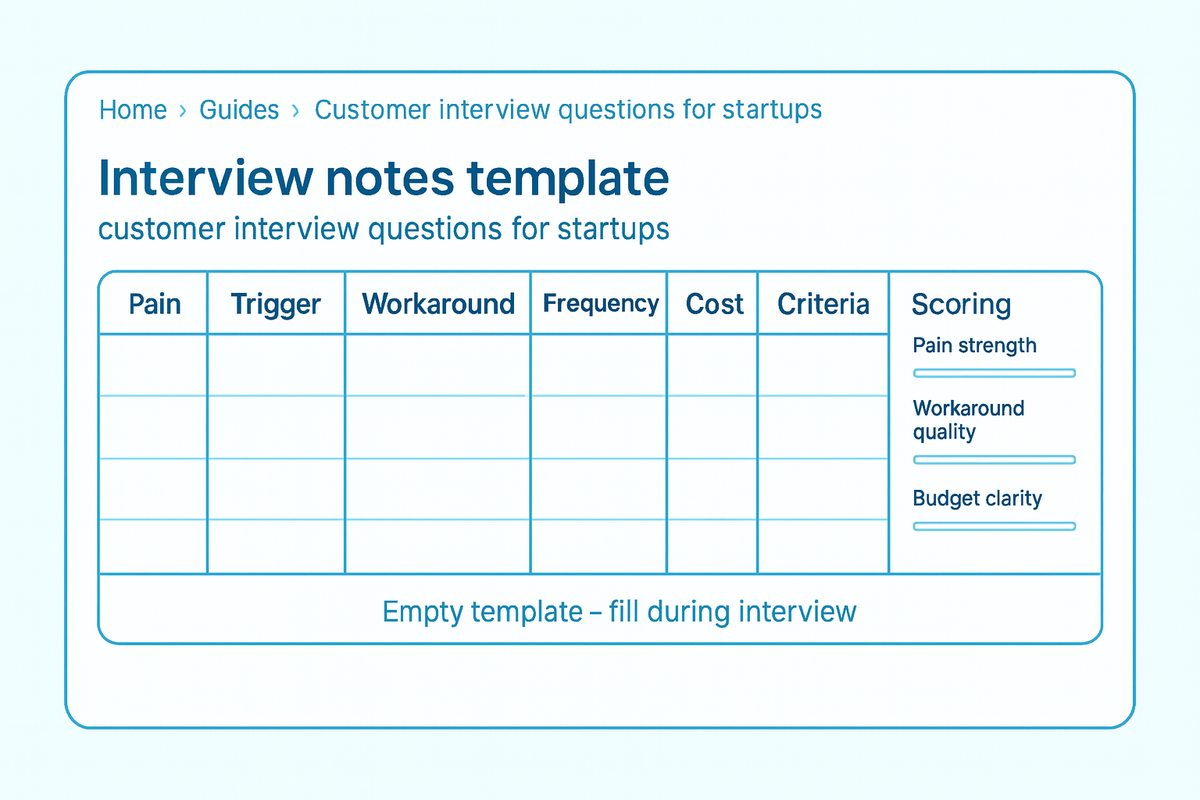
This turns a financial risk into a controlled test. You pay to validate the job first. You fund code only for workflows that buyers value. This is how to build an MVP that helps your business. Once you know what to build, having a structured customer discovery kit helps you gather the exact insights needed to guide development.
FAQ
What is the average MVP cost for B2B SaaS?
For B2B SaaS, a hypothetical MVP can cost $0-$500 for a manual pilot, up to $25k-$50k for an outsourced V1. The right budget depends entirely on what you must learn before you build.What if an agency quotes $50k for a proper MVP?
An agency quote for a first version is rarely a true MVP cost. A $50,000 build often includes extra features and scalable architecture. A real MVP might be a $2,000 no-code test. Treat large quotes as the cost of a full product, not a validation test.How do I know when I have spent enough to find product-market fit?
You do not buy product-market fit with an MVP budget. You have it when getting new customers feels easier. It feels like moving with demand, not pushing against it. You can learn how to measure product-market fit, but the best sign is buyers pulling the product from you.Should I spend money on a polished onboarding flow?
Do not spend your MVP budget on scalable onboarding for just 10 early users. Your goal right now is to understand your customer deeply. Manual onboarding on a call works best for this. Wait to build scalable flows until you know what needs to scale.