TL;DR
AI has made it incredibly fast to build products nobody wants. A true minimum viable product (MVP) is not a smaller version of your final software — it is a strict behavior test to extract objections and measure real demand. The examples below show how founders use manual work and sales commitments instead of writing code to prove their riskiest assumptions.
What is an MVP example? A minimum viable product example is a lightweight test designed to validate customer demand before building full software. Common examples include concierge services where founders manually perform the work, pre-sales presentations to secure early commitments, and single-function tools that solve one highly specific problem to measure repeat usage.
The Modern MVP Mistake
We have reached a strange era for software. A founder can use AI to ship a fully functional MVP in two weeks, complete with a dashboard, onboarding flows, and a dark mode toggle. They launch it, wait for the users to pour in, and hear nothing.
The lesson is not that they built too slowly or too cheaply. The lesson is that they built for themselves. They tested their own excitement instead of a customer's pain.
AI can help you build the wrong thing faster than ever. According to CB Insights, building a product with no market need is a top reason startups fail. The old MVP question was, "Can we build it?" The modern MVP question is, "Can we get someone to commit before we hide behind the product?"
A useful MVP is not a smaller product. It is a smaller bet.
Minimum Viable Product Examples by Industry
Founders often overcomplicate their first tests, treating the MVP stage as permission to build a fuller product. But minimum viable product design should be about maximizing learning with the absolute least effort.
If you look at successful companies, their earliest versions rarely resembled the automated platforms they became. The manual work is not a hack around the MVP. In many cases, the manual work is the MVP. Here are concrete minimum viable product examples to learn from.
1. The Concierge Delivery Test (B2C Logistics)
Consider a food delivery startup, which started as a simple website. The founders did not start by building a massive logistics and routing engine. They put up PDF menus of local restaurants and a phone number. When someone called, the founders manually drove to the restaurant, bought the food, and delivered it themselves.
This proved the core assumption: people wanted delivery from restaurants that lacked it, and they were willing to pay a premium. The automation came later. If you want more proof of demand examples, look for founders doing things that do not scale.
2. The Hard-Extraction Sales Test (B2B SaaS)
A B2B SaaS founder skips building software entirely and attempts to sell the proposed outcome directly to a highly specific ideal customer profile. They get the prospect on a call, present the solution, and actively extract objections. They refuse to end the meeting without a hard next step or a payment commitment.
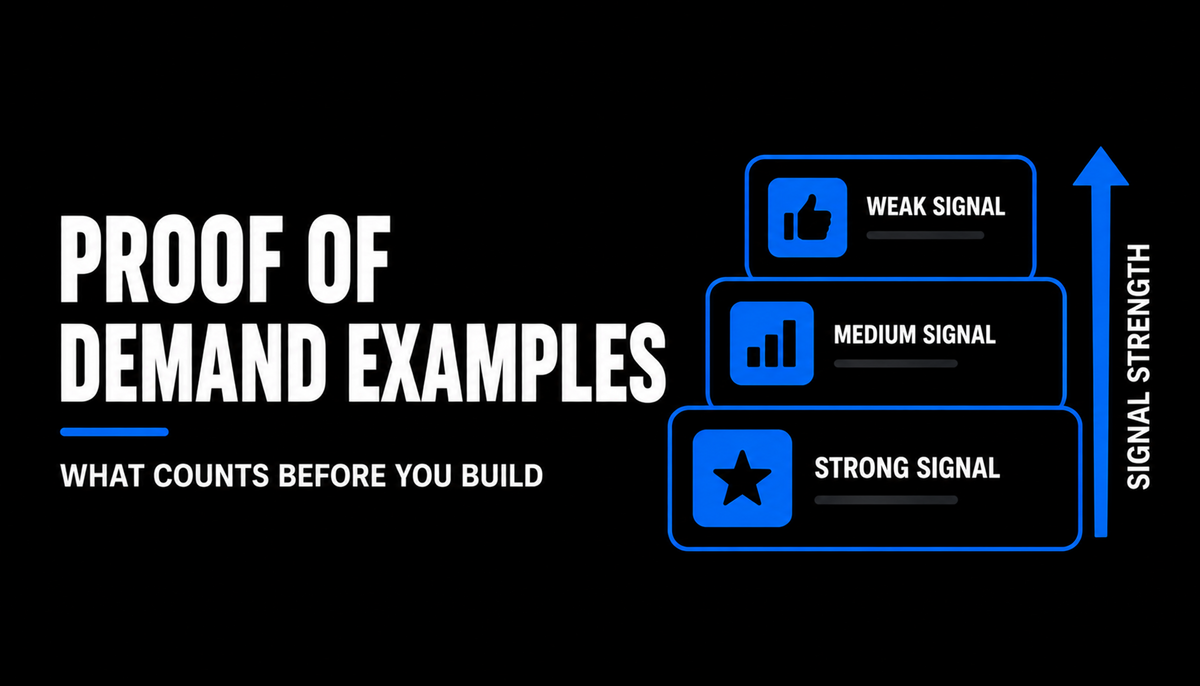
This works because it tests behavior over opinions. Dark mode is not validation. A booked call, paid pilot, purchase, redemption, or clear "no" is much closer to validation. You can often start with a smoke test startup to see if the market even cares.
3. The Narrow Tool Test (Internal Operations)
A founder building a complex data platform starts with a single-function script or a shared spreadsheet. They manually route and clean the data for the client each week. The goal is to see if the client repeatedly uses the output to make decisions. If the usage repeats, the core workflow is validated.
What These MVP Examples Have in Common
Instead of asking what features to include, ask what behavior you need to see.
B2C Logistics: Built a static site with a phone number. Manual work was driving to the restaurant and delivering food. Tested if people are willing to pay a premium for delivery. Lesson: Do things that don't scale first.
B2B SaaS: Built a pitch deck or presentation. Manual work was pitching directly and extracting objections. Tested if they will commit money or time to solve the pain. Lesson: Sell the outcome before building the tool.
Operations: Built a shared spreadsheet or script. Manual work was data cleanup and routing. Tested if this output solves the daily workflow. Lesson: Measure repeat usage, not initial excitement.
Practical Framework: The MVP Test Picker
To stop overbuilding, use this checklist to pick the right test for your riskiest assumption.
Assumption: People understand the value. Test: Build a landing page or a demo video.
Assumption: People will pay for it. Test: Do a sales call or run a paid pilot.
Assumption: We can deliver the outcome. Test: Run a concierge or manual service.
Assumption: People will use it regularly. Test: Ship a narrow functional product (a script or spreadsheet).
Assumption: The market is ready. Action: Stop building. Extract objections until you find the real pain.
Stop Assuming Silence is Validation
Founders often think a lack of negative feedback means they are on the right track. Someone looks at the demo, says it looks cool, and says they need to think about it.
Silence is not a positive signal. It usually means you failed to find the real objection. As highlighted in The Mom Test, prospects will rarely volunteer their deep concerns; you have to do the hard work of extracting them. If they say they need to think, you cannot let them off the call without figuring out exactly what is missing. End your tests with a commitment, a scheduled next step, a payment, a pilot, or a clear reason the buyer is saying no.
FAQ
What are good minimum viable product examples?
Good MVP examples include concierge services where founders manually perform the work (like early-stage delivery startups), pre-sales presentations to secure early commitments, and single-function tools that solve one highly specific problem to measure repeat usage.
What is an example of an MVP in SaaS?
In B2B SaaS, an effective MVP might be a simple pitch deck or a manually operated backend (like a spreadsheet) where the founder sells the outcome directly. The goal is to secure a paid pilot or hard next step before writing complex code.
If AI lets us build fast, why bother with an MVP instead of shipping the full product?
Because AI also makes it faster to build things people do not need. The point of an MVP is to show the smallest test of the most painful pain, not to show a feature-light product demo. You need to identify who can actually buy it, watch behavior over opinions, and manually extract objections instead of assuming silence means validation.
What do founders misunderstand about MVP examples?
They treat them as permission to build a fuller product. An MVP is not "what can we ship in two weeks." It is the smallest test around a clear pain-solution hypothesis. Extra polish is a distraction if it does not prove demand.
Should every MVP be a manual, no-code service?
No. Your MVP should just be narrow enough to test the riskiest assumption. If the risk is whether a complex algorithm can save time, you might have to code the core math. If the risk is whether people want the service at all, a manual concierge test is better.