Option Pool at Series A: The 'Top-Up' Guide & Math
last updated: Apr 24, 2026
Investors love to talk valuation because it strokes your ego. They love to hide dilution because it protects their wallet. The "Option Pool Shuffle" is the oldest trick in the Series A playbook, and if you don't do the math, you will pay for it with 3–4% of your company.
TL;DR
The "Option Pool Shuffle" happens when investors force the option pool to be created from the pre-money valuation, lowering your effective share price.
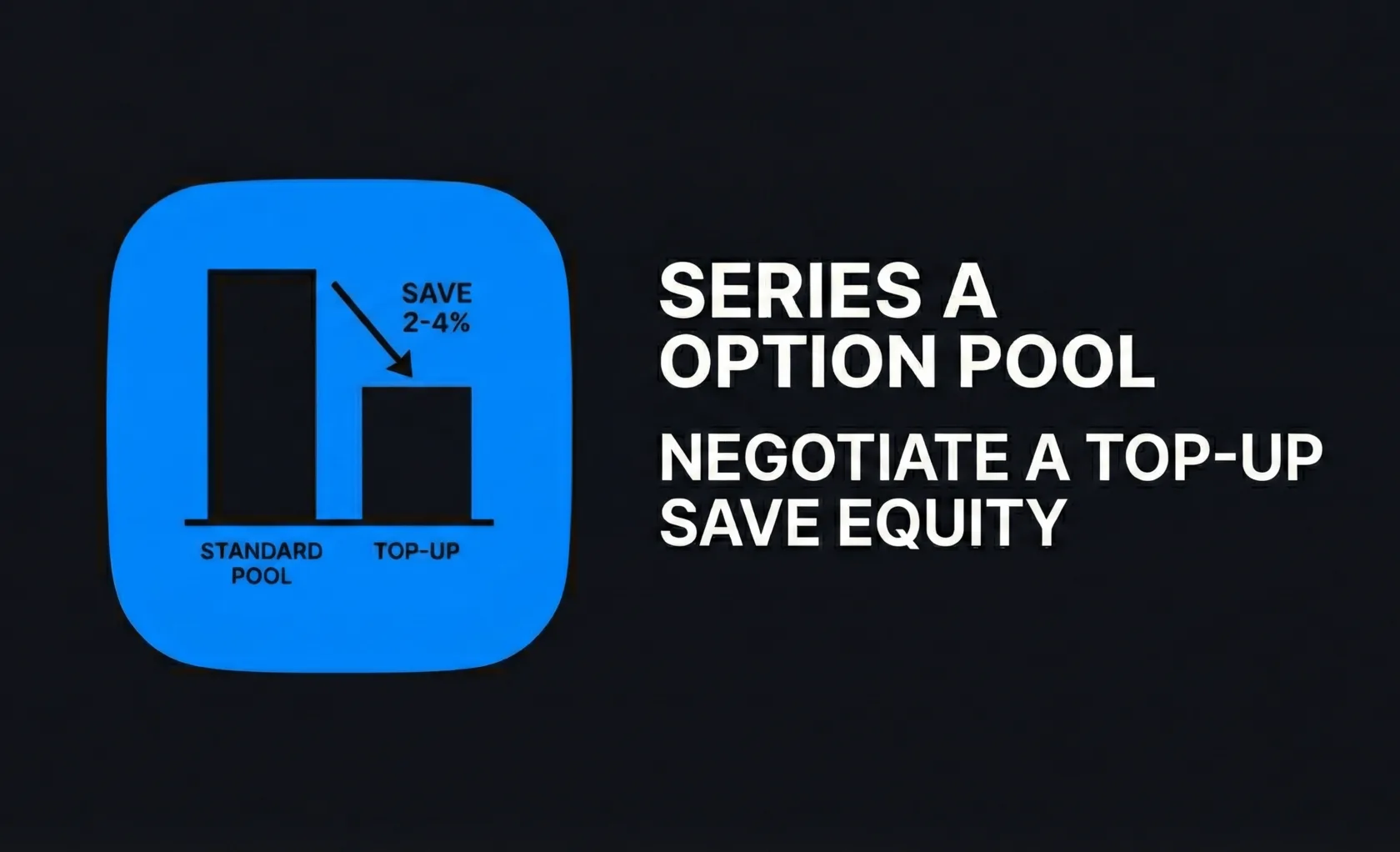
How to save 2–4% equity: Build a bottoms-up hiring plan to prove you don't need a generic 20% pool.
- Benchmark: 10–12% unallocated post-closing is the modern Series A standard (down from the old 15–20%).
- Rule: Negotiate a "Top-Up," not a "New Pool." Count your existing ungranted shares toward the target.
- Warning: If you agree to a "15% Pool" without a hiring plan, you are voluntarily lowering your valuation by millions.
How to save 2–4% equity: Build a bottoms-up hiring plan to prove you don't need a generic 20% pool.
Glossary
- The Option Pool Shuffle: A deal structure where the new option pool is carved out of the pre-money valuation. This means existing shareholders (you) pay for the dilution, not the new investors.
- Top-Up: The act of adding shares to your existing pool to reach a required percentage. If you have 4% unallocated and the VC wants a 10% pool, your "top-up" is 6%.
- Fully Diluted Basis: The total number of shares assuming all options, warrants, and convertible securities are exercised.
- Unallocated vs. Allocated: Allocated shares are already granted to employees. Unallocated shares are empty slots waiting for future hires. VCs care about the unallocated percentage.
How to Calculate the Option Pool Shuffle
Use this table to understand the cost of the "Shuffle" and the math to defend your equity. In this scenario, the investor offers a $20M Pre-Money valuation with a $5M investment, but demands a 15% pool.
Sample Math: The "Effective" Pre-Money
When the pool comes out of the pre-money, the investor is essentially saying: "We value your company at $20M, but $3.75M of that is empty space for future hires. So we actually value what you have built today at $16.25M."
The Formula:
Effective Pre-Money = Nominal Pre-Money - (Post-Money Val * Pool %)
When the pool comes out of the pre-money, the investor is essentially saying: "We value your company at $20M, but $3.75M of that is empty space for future hires. So we actually value what you have built today at $16.25M."
The Formula:
Effective Pre-Money = Nominal Pre-Money - (Post-Money Val * Pool %)
Benchmarks
Founders often accept the investor's request for a 15–20% option pool because they believe it's "standard." It's not. Data from Carta's equity guide suggests that modern Series A pools often hover around 10-15% for unallocated shares. The goal is to cover hiring for the next 18 months, not the next decade.
Standard Ranges:
Standard Ranges:
- Seed: 10% (often established at incorporation)
- Series A: 10-12% (Top-up of existing pool)
- Series B: 5-10% (Top-up)
How to Negotiate the Option Pool
This is where the negotiation happens. You likely can't change the fact that the pool comes out of the pre-money (it is the industry standard for Series A), but you can negotiate the size of it.
Pre-Money Pool (VC Preference):
Post-Money Pool (Founder Preference):
Pre-Money Pool (VC Preference):
- Mechanism: The pool is created before the new money enters.
- Result: Existing shareholders (founders + angels) take 100% of the dilution for the pool.
- Leverage: Low. This is the default in almost every Series A term sheet.
Post-Money Pool (Founder Preference):
- Mechanism: The pool is created after the new money enters.
- Result: Dilution is shared pro-rata between founders and new investors.
- Leverage: Very High. Hard to win this point, but worth asking if your round is oversubscribed.
Risks
Getting the option pool size wrong has downstream effects that go beyond a simple percentage point on the cap table.
- Over-Dilution: If you create a 20% pool but only use 10% before your Series B, you diluted yourself unnecessarily. While unissued shares technically "return" to the pot, you lost the voting power and economic value during the interim years.
- The Signaling Trap: Some founders fear a small pool will signal "we can't hire." The opposite is true. A precise, smaller pool based on a hiring calculator signals operational discipline.
- Liquidation Impact: A larger pool lowers the price per share. If you have complex liquidation preferences, a lower share price can exacerbate the hurdle you need to clear to make money on an exit.
Will optimizing your option pool actually get you to Series B?
Mastering the option pool shuffle is a necessary step to preserve equity, but it is not the whole picture. You can negotiate the perfect 10% pool and save 4% of your company, but if your other variables — Offer, Strength, Market Timing — are weak, your probability of hitting your next revenue milestone remains near zero.
The option pool is a derivative of your business value. If you have no revenue, you have no leverage, and the VC dictates the math. The "Shuffle" is the #1 way founders lose equity, but failing to sell is the #1 way they lose the company. Optimizing the pool doesn't get you to sales on its own, so you gotta think strategically about how to get to $10M ARR. Fix your foundation before you launch.
The option pool is a derivative of your business value. If you have no revenue, you have no leverage, and the VC dictates the math. The "Shuffle" is the #1 way founders lose equity, but failing to sell is the #1 way they lose the company. Optimizing the pool doesn't get you to sales on its own, so you gotta think strategically about how to get to $10M ARR. Fix your foundation before you launch.
FAQ
- You:How big should my Series A option pool be?Guide:The modern standard is 10–12% unallocated immediately post-closing. If an investor asks for 20%, they are using outdated benchmarks or trying to lower their effective price. Counter with a detailed hiring plan.
- You:Does the pool include existing grants?Guide:Usually, no. Investors typically require a pool of available, unallocated shares equal to ~10% of the post-money fully diluted capitalization. Existing grants (allocated options) are separate.
- You:Can I refuse the "Pre-Money" pool structure?Guide:Rarely. The "Shuffle" is industry standard for Series A. Your leverage lies in negotiating the size of the pool (e.g., reducing it from 15% to 10%) rather than changing the location (pre vs. post) of the calculation.
Find where your first 100 customers are in 2 mins. — or browse all the free founder guides.
No-BS guides