A paid pilot tests whether a customer values solving a problem enough to spend budget. An unpaid pilot tests only their willingness to accept free help. For early B2B startups, charging for an evaluation, even at a modest discount, establishes buyer commitment and creates real commercial proof. A structured free pilot is a narrow exception: use it only when enterprise procurement red tape would stall an otherwise qualified deal, and only after agreeing on written success criteria and commercial rollout terms before granting access.
TL;DR: Agreeing to a free pilot shows that a prospect will accept free help, not that they have budget or intent to buy. For early B2B products, a discounted paid pilot framed as a design partnership usually works best. The customer pays for hands-on problem-solving and direct influence on your roadmap, which forces them to assign internal owners. Reserve free pilots for high-value enterprise accounts where procurement delays would stall momentum, and avoid granting free access without written success criteria and pre-agreed conversion terms.
Defining Your Evaluation Terms
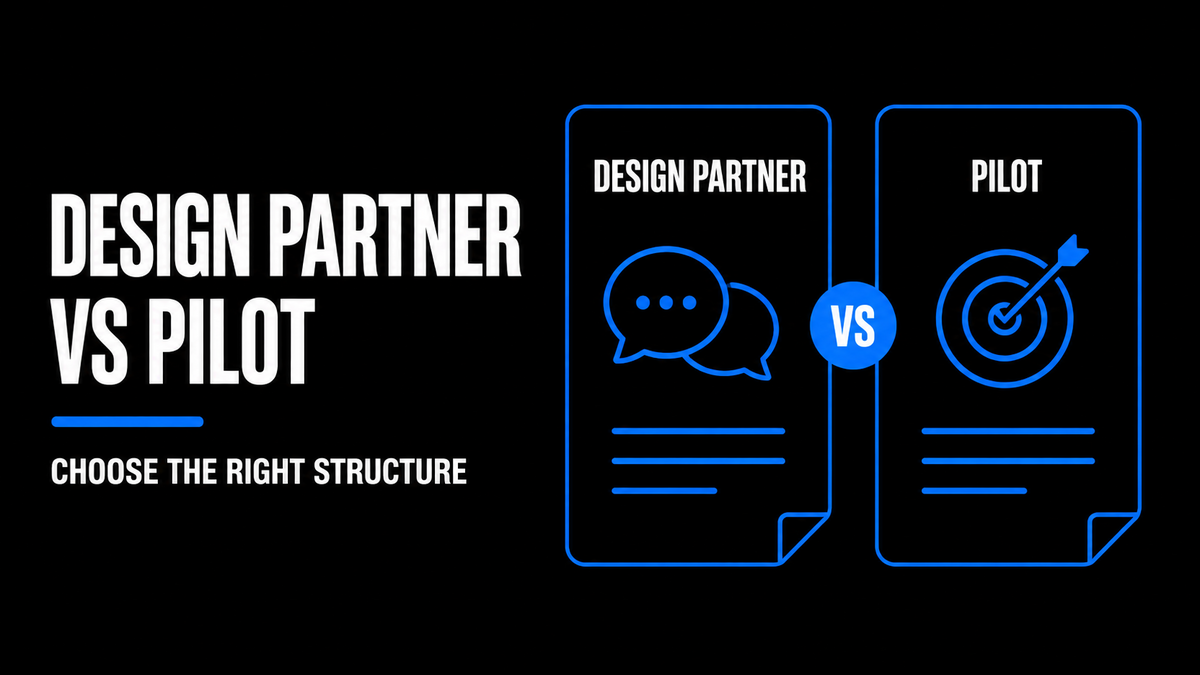
Early B2B sales conversations often blur different types of customer evaluations. Before picking a pricing approach, separate these three distinct models:
Paid Pilot: A short, fee-based evaluation where a customer pays to test your product against a specific business problem.
Structured Free Pilot (Proof of Value / POV): An unpaid evaluation with strict calendar limits, written technical success criteria, and pre-negotiated commercial terms that take effect upon success.
Free Trial: An unassisted, self-serve evaluation model designed for low-touch software where users sign up and onboard without direct founder intervention.
The False Comfort of Free Pilot "Validation"
Every B2B founder remembers the relief of their first pilot agreement. You spend forty minutes demoing an early product, the buyer nods along, and they agree to test it for a month. You log off, mark the opportunity as qualified pipeline, and tell your team that the market wants the product.
Then day thirty arrives. You send an email to review their progress. Silence. You follow up four days later. The buyer replies that their team got pulled into an internal reorg, nobody had time to log in, and you should check back next quarter.
That outcome is rarely bad luck. It is the natural result of an unpaid pilot.
Free help proves only that people will accept free things. It does not prove that a company has an urgent problem, that a buyer has budget authority, or that anyone will spend political capital to install your tool. When an evaluation costs nothing, the buyer risks nothing by ignoring it.
Real commercial validation comes down to one question: will the customer pay? Charging money, even a discounted introductory fee, forces the buyer to confirm that the problem actually matters to their business.
The Co-Development Reframe: Selling a Design Partnership
Founders often hesitate to charge for early pilots because of imposter syndrome. You look at your software and see the missing settings page, the slow queries, and the manual database updates you run late at night. Charging money for an unfinished product feels uncomfortable.
That hesitation comes from a basic misunderstanding: you are not selling finished off-the-shelf software. You are selling a bounded design partnership.
In an early pilot, the customer is not paying for polished enterprise software. They are paying for dedicated engineering attention, custom workflow integration, and the ability to influence your product roadmap to fit their setup. You act like an outsourced engineering team focused directly on their operational headache.
Behind the scenes, you might handle onboarding manually through white-glove setup calls or custom scripts while you build out the product. That concierge approach is completely normal in early software development.
To see how this works in practice, consider an illustrative concierge test used to validate demand before writing code. In one experiment for a workout app, the team sold a 14-day pilot to 15 real buyers. Instead of building the automation upfront, a person delivered the custom workouts manually over WhatsApp. When 40% of those testers converted to a £60 subscription at the end of the trial, the team knew they had enough commercial pull to justify building the software.
While consumer subscription numbers and small price points do not represent B2B benchmarks, these specific conversion metrics serve purely as an operational example of concierge demand validation, rather than an empirical B2B benchmark. The operating lesson is identical: early customers pay for an outcome and personal attention, not for polished code. You do not need a fully automated product to justify charging.
When you position the engagement as co-development, charging makes sense to both sides. The buyer gets software tailored to their workflow at a fraction of standard enterprise rates. You get paid validation, active user feedback, and a committed partner. If you need help structuring the initial pricing conversation without triggering procurement alarms, review our guide to writing a clear SaaS pricing proposal.
As Steve Blank highlights in his work on customer development, early customer commitments require direct executive engagement rather than casual evaluations that lack internal ownership.
Paid Pilot vs. Structured Free Pilot: The Core Comparison
Not every unpaid evaluation is an accident. In specific enterprise sales cycles, a structured, time-boxed free evaluation is the only way to bypass months of vendor onboarding. The difference is structure: an open-ended sandbox is a trap, while a structured evaluation is a commercial gate.
Criteria | Paid Pilot | Structured Free Pilot | Strategic Implication |
|---|---|---|---|
Buyer Commitment | High. The sponsor must find budget, get internal sign-off, and justify the expense. | Moderate to Low. Requires team time, but zero initial capital outlay from the buyer. | Paying forces the buyer to assign internal project owners to protect their investment. |
Procurement Friction | High. Often requires vendor registration, basic security checks, and invoice processing. | Low. Can usually proceed under a lightweight evaluation agreement or mutual NDA. | A structured free pilot can preserve momentum when legal red tape would delay testing for months. |
Implementation Speed | Moderate. Invoicing and vendor setup can add several weeks before access begins. | Fast. The customer team can start testing as soon as technical access is set up. | Fast starts help keep momentum, but speed matters only if the customer actually completes setup. |
Conversion Probability | High. Buyers who pay to test software convert at higher rates because budget is already committed. | Moderate. Converts only when tied to agreed success metrics and pre-negotiated commercial contracts. | Unpaid pilots without pre-agreed conversion milestones often turn into endless trial extensions. |
Feedback Quality | Actionable and direct. Paying customers demand that the software solve their stated operational problem. | Variable and polite. Users may report minor cosmetic bugs or quietly stop logging in when friction occurs. | If you need candid feedback to improve early software, charging money filters out passive users. |
The Decision Rubric: Deal Size vs. Product Readiness
Deciding whether to charge upfront depends on two main variables: your target Annual Contract Value (ACV) and your current product readiness.
The Pre-Pilot Decision Checklist
Before choosing between a paid pilot and a structured free pilot, check these six operational factors:
Budget Owner Identified: Has the economic buyer confirmed they have budget for the full contract?
Paid-Path Feasibility: Can the pilot fee run on a departmental credit card, or does it trigger formal vendor onboarding?
Product Readiness: Can the core workflow deliver results reliably, or does it require hands-on manual intervention?
Clear Success Metric: Have both sides agreed on one or two measurable targets that define a win?
Buyer Time Commitment: Has the customer designated specific team members to test the tool each week?
Post-Pilot Decision Owner: Is there a clear decision-maker responsible for signing the rollout contract once goals are met?
To ensure you are evaluating buyers with actual authority and urgency, review our framework on how to find pilot customers.
The Evaluation Framework
Target ACV Band | Early / Developing Product | Stable / Validated Product |
|---|---|---|
High ACV (Mid-Market / Enterprise) | Discounted Paid Design Partnership | Standard Paid Pilot or Technical POV |
Lower ACV (SMB / High Velocity) | Customer Discovery / Do Not Pilot | Time-Boxed Free Trial |
Quadrant 1: High ACV + Early Product (Discounted Paid Design Partnership)
The Situation: You are targeting mid-market or enterprise accounts, but your product still has rough edges and requires manual onboarding assistance.
The Move: Sell a discounted paid pilot. Set a fee that offsets your deployment costs and proves budget commitment. Frame the fee as a credit toward the first-year annual subscription once the pilot hits agreed targets.
Example: A startup selling pipeline data automation charges a sales team an introductory pilot fee for a 45-day rollout. The fee includes manual data mapping and bi-weekly pipeline reviews. The agreement states that if duplicate CRM records drop by 25%, the pilot fee applies as a full credit toward the annual contract.
Quadrant 2: High ACV + Stable Product (Standard Paid Pilot or Technical POV)
The Situation: Your software works reliably, but enterprise buyers require an evaluation before committing significant budget.
The Move: Charge a standard pilot fee. If enterprise security or procurement policies make paying for a pilot take months, pivot to a Structured Free Proof of Value (POV).
The Rule: Avoid granting free access without an agreed Master Services Agreement (MSA) and an order form that takes effect once technical criteria are met. In their resources on enterprise sales, Y Combinator's library highlights that pilots without pre-negotiated rollouts simply delay commercial negotiation until after the founder has lost bargaining power.
Quadrant 3: Lower ACV + Stable Product (Time-Boxed Free Trial)
The Situation: Your target deal size is under $10.000 per year, and onboarding is largely self-serve.
The Move: Do not run bespoke pilots. Offer a short, self-serve trial that requires a corporate email address and an onboarding checklist. Lower contract values cannot absorb the customer success hours required to run manual evaluations.
Quadrant 4: Lower ACV + Early Product (The Red Zone)
The Situation: Deal sizes are small, and the software is still incomplete.
The Move: Do not run pilots here. You will spend forty hours onboarding a customer who pays a modest monthly fee and churns the moment a bug appears. Step back, conduct qualitative discovery interviews, and build until the product can support self-serve users.
Running the Pilot Without Getting Ghosted
Pricing the pilot correctly gets you through the front door. Converting that pilot into permanent revenue requires operational discipline during the evaluation window.
1. Keep the Legal Footprint Proportional
Do not let early pilots get bogged down in twenty-page indemnification battles. Unless you are processing regulated financial records or protected healthcare data, treat the pilot as a shared-goal operational experiment. Use a lightweight agreement that defines data rights, liability boundaries, duration, and the commercial conversion price.
2. Silence Is an Unvoiced Objection
If a buyer goes quiet during week three of a pilot, do not assume everything is running smoothly.
Pilot users rarely send emails detailing why they stopped using a tool. They simply close the tab and return to their old routines. Founders often expect objections to surface automatically, but in reality, you have to do the work to pull objections out of people. If usage dips or communication drops, call it out directly. Ask:
"What is currently stopping your team from using the platform this week?"
"Who internally needs to see this work before we review conversion next week?"
"What would make your team decide not to roll this out company-wide?"
Extracting friction early gives you time to fix workflow bottlenecks before the evaluation period ends.
3. Tie Access to Pre-Agreed Milestones
Never start a pilot on open-ended terms like "let's test it for a month and see how it goes." Define one or two objective, verifiable metrics that signal success:
Cutting manual data export time from four hours to fifteen minutes.
Identifying at least ten high-priority security vulnerabilities in week one.
Integrating three core data tables with zero synchronization dropouts over fourteen days.
Once those technical bars are met, the pilot is successful. You are no longer asking if they like the tool; you are executing the pre-agreed next step. Once you reach this stage, follow our playbook on how to convert pilots to first paying customers.
The 5-Point Gate: Before You Offer Free Access
If you decide to offer a structured free pilot to land an enterprise account, make sure the deal passes this five-point evaluation gate first:
Budget Authority Verified: The economic buyer has confirmed that budget exists for the full rollout.
Written Success Criteria: Both teams signed off on one or two measurable targets.
Fixed End Date: The evaluation period is capped at 14 to 30 calendar days.
Pre-Agreed Commercial Next Step: The annual contract price and terms are reviewed before granting access.
Recurring Feedback Cadence: A bi-weekly check-in is scheduled on the economic buyer's calendar.
If a prospect refuses to agree to these five checks, they are asking for free engineering labor without any commitment to buy. Walking away from those conversations protects your time for qualified accounts. For a deeper look at the transition from early pilot wins to sustainable customer acquisition, read our tactical guide on converting first paying customers. Research from CB Insights on startup failure shows that misjudging market demand and pricing viability ranks among the top reasons new ventures collapse, a risk amplified when founders anchor their value at zero.
The Design Partner MOU Framework
When formalizing an early pilot, avoid informal handshake agreements. Use a structured design partner memorandum of understanding to define mutual obligations, measurable success targets, and pre-negotiated commercial pricing before access begins. If you need a practical contract foundation, use our structured design partner MOU to align expectations without triggering lengthy procurement debates.
FAQ
Does a free pilot prove demand?
No. Agreeing to a free pilot proves only that a prospect will accept free help. Real demand requires a willingness to commit budget or political capital. A paid pilot, even at an introductory discount, verifies that the problem is urgent enough for the buyer to pay to solve it.
Can an unfinished product be a paid pilot?
Yes, if you frame it as a design partnership rather than a finished software package. Early buyers pay for dedicated engineering focus, direct input on your roadmap, and hands-on help solving their problem. You can handle backend onboarding and data mapping manually while you build out the product.
What must be agreed upon before starting a free pilot?
Before granting free access, confirm five items: verified budget authority from the economic buyer, one or two measurable success criteria, a fixed timeline (such as 14 to 30 days), a pre-negotiated commercial contract that takes effect upon hitting success criteria, and a recurring check-in scheduled on the buyer's calendar.
How long should an early B2B pilot run?
Most B2B pilots should run between 14 and 30 days. Longer evaluations create pilot fatigue, where initial enthusiasm wanes and internal buyer priorities shift. If your product cannot show measurable progress within a month, narrow the scope of the pilot to a single workflow that demonstrates immediate value.
When does a structured free pilot make sense over a paid pilot?
A structured free pilot is practical when the target contract value is high (typically mid-market or enterprise) and standard procurement or vendor onboarding would delay testing by several months. In that situation, an unpaid technical evaluation with pre-agreed commercial terms lets the customer verify the product without getting stuck in legal review.