TL;DR
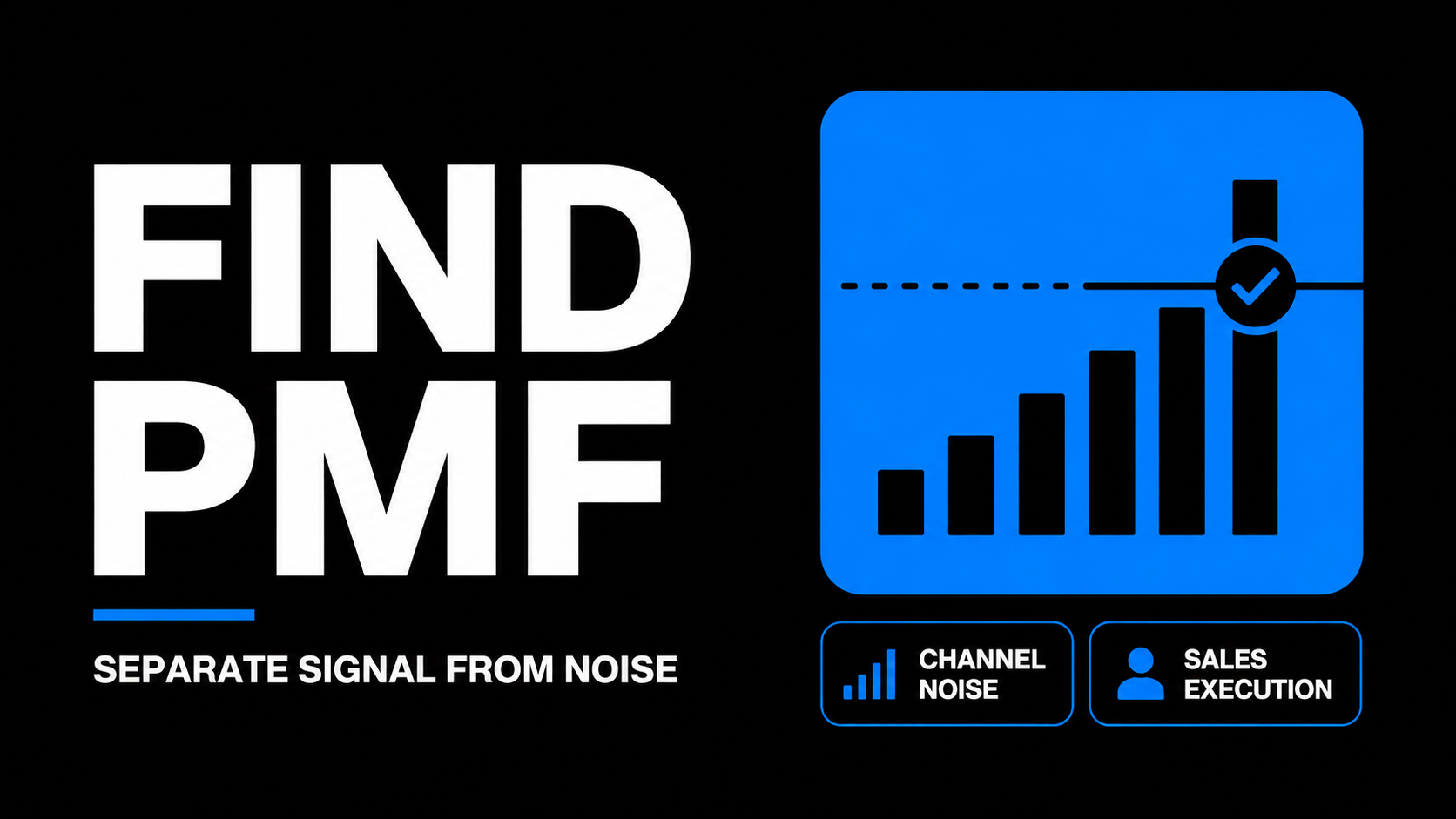
Product-market fit is the objective threshold of true demand that justifies scaling. Founders often confuse weak go-to-market results — like a failed channel test or a ghosted prospect — with a lack of product-market fit. To know if you are ready to scale, you must separate early channel learning from true product metrics like cohort retention, usage frequency, and qualitative market pull.
You run a free webinar or start a cohort test. You get 50 signups, decent attendance, and a few excited replies. But then, only one person converts to a paid user, and the most interested prospect completely ghosts you.
The immediate, panicked reaction for most founders is: "We don't have product-market fit."
But the evidence here is mixed. Fifty webinar signups prove that the value proposition resonates — there is proof of demand. The downstream drop-off and the ghosted prospect indicate that the sales motion or the offer is weak, not necessarily the core product. Most founders misread product-market fit not because they lack metrics, but because they collapse three entirely different problems into one: product demand, channel fit, and sales execution.
What Is Product-Market Fit?
Product-market fit is the objective threshold where a specific market repeatedly chooses, uses, pays for, and genuinely misses your product. It means being in a good market with a solution that can actually satisfy that demand, signaling that you have moved beyond early validation and are ready to scale.
As Marc Andreessen described in his classic guide to startups, the market matters more than anything. When you reach this threshold, the market pulls the product out of your hands. Usage, buying, and demand drive the company forward.
Before this point, scaling your spend is risky. Y Combinator warns that scaling before product-market fit often leads to burning cash on false positives. You need objective signals of true demand to justify scaling investments, which requires moving beyond the initial business idea validation.
Product-Market Fit signals checklist
There is no single metric for product-market fit. It is a pattern across retention, usage, and qualitative urgency. Use this checklist to measure where you stand:
Quantitative Metrics
Cohort retention: Is your retention curve flattening for a meaningful segment? This is the clearest proof that users keep getting value and integrating the product into their routines.
Usage frequency: Are qualified customers returning for active, repeated use?
The Sean Ellis test: If you ask active users, "How would you feel if you could no longer use this product?", do 40% or more say they would be "very disappointed"? (Used by companies like Superhuman).
Qualitative Signals
Revenue: Do you see a high willingness to pay?
Referrals: Is there word of mouth and unsolicited sharing?
Sales cycle: Are your deals closing faster?
Customer push: Are customers actively asking for more features or higher limits?
Early adopter enthusiasm, initial signups, and press coverage can be false positives. Real product-market fit requires the repeated actions of retention and revenue. Lenny Rachitsky notes that strong cohort retention is the ultimate test. Practical tests to validate your product idea help you gather initial signal, but true product-market fit is the sustained behavior you must measure before you scale.
Diagnostic matrix: product pull vs. channel fit vs. sales execution
When a test fails, you need to diagnose where the signal broke: market care, channel reach, or sales motion. A dead channel can make a live product look dead.
Signal | What It Measures | What Strong Looks Like | What a Failure Actually Means |
|---|---|---|---|
Webinar/Cohort Signups | Problem resonance and initial demand | High signup rate from the target audience | The market doesn't care about the problem, or the messaging is weak. |
Paid Conversion | Sales execution and offer strength | Consistent conversion from engaged prospects | Strong signups plus weak conversion means the sales motion is broken, the price is wrong, or the offer lacks urgency. |
Repeat Usage (Retention) | Product Pull | Users return to the product repeatedly | The product doesn't deliver the promised value or is too hard to use. |
Cold Outbound / Ads | Channel Fit | Cost-effective acquisition of qualified leads | The channel takes time to master, or the audience isn't active there. |
Ghosted Demo | Sales Execution | Prospects move predictably to the next step | This is a normal sales problem, not proof the product is unwanted. |
The "Dead Channel" mistake
Consider a founder who runs an Upwork campaign for a do-it-yourself product management tool and gets zero traction. They might conclude the product lacks product-market fit. In reality, Upwork buyers generally want someone else to execute the work for them, not DIY software. This is a clear channel mismatch, not a product failure.
FAQ
Does a failed or weak signal mean we do not have product-market fit?
Usually, no. A weak first acquisition channel, a prospect going silent, or poor traction on a specific platform can easily be channel-fit noise or a sales-execution issue. You must separate whether the market cares about the value proposition, whether your chosen channel reaches people who care, and whether your sales motion is working. Do not treat one early channel result as decisive proof against product-market fit.
How do you know when you are ready to scale?
You are ready to scale when you have objective, repeated proof of demand—specifically a flattening cohort retention curve and organic market pull (like unsolicited referrals or a high willingness to pay). Scaling before you hit these thresholds risks burning cash on early false positives.
Is there a strict retention threshold for product-market fit?
No single number applies to every business model. A consumer social app needs vastly different usage frequency and retention than an enterprise compliance tool. The goal is a flattening retention curve, meaning a stable percentage of users stick around long-term.
Can we use surveys alone to prove product-market fit?
Surveys are useful leading indicators, particularly the Sean Ellis test, but they must be backed by actual retention and revenue data. Stated intent is not the same as demonstrated behavior.