TL;DR: A product validation plan has one job: giving you a mechanism to say no. A plan trimmed to the bone tests three hypotheses — ideal customer profile, pain-solution, and distribution. If you do not decide the pass or fail numbers before the test starts, you are not validating. You are grading your own homework.
You finish a strategic document and look it over. It is genuinely good work. The hypotheses are listed, the test methods are chosen, and the timeline is set. Then you ask the one question the document cannot answer: what specific result would make you stop building? The answer is missing because no one wrote down a threshold before the test began.
A validation plan produces evidence. It is not a place to list your assumptions. Strategy built on untested assumptions is just a wish list. To fix this, you only need three hypotheses: your ideal customer profile (ICP), the pain-and-solution match, and your distribution. Each gets a strict metric, decided in advance, that resolves to either "proceed" or "invalidated (for now)."
What Is a Product Validation Plan?
A product validation plan is a formal document that outlines exactly how a startup will test its core business assumptions. It defines specific hypotheses, the testing methods used to gather evidence, who qualifies as a valid test subject, and the exact success metrics required to proceed.
Aligning Co-founders and Investors
A clear validation plan proves to stakeholders that you are making data-driven decisions based on real market signals, not just following your gut. When you hand this document to a co-founder or an investor, it changes the conversation from "Do we like this idea?" to "Did we hit the threshold?"
Investors want to see that you understand your market deeply and are actively de-risking the business. A formal plan aligns everyone on the milestones and metrics that actually matter. It sets an objective bar for success, ensuring the team stays focused on evidence collection rather than endlessly debating opinions. If you want to show stakeholders that you are serious about mitigating risk, present them with a structured plan that has clear go/no-go gates.
What Goes in a Product Validation Plan
Most templates stretch across twelve sections and test everything except the core business. A strong product validation plan contains exactly what you need to make a decision:
Hypothesis: The specific assumption you are testing.
Test method: How you will gather the evidence.
Valid test subject: Who exactly qualifies for the test.
Pass metric: The threshold, set in advance, that determines whether you proceed.
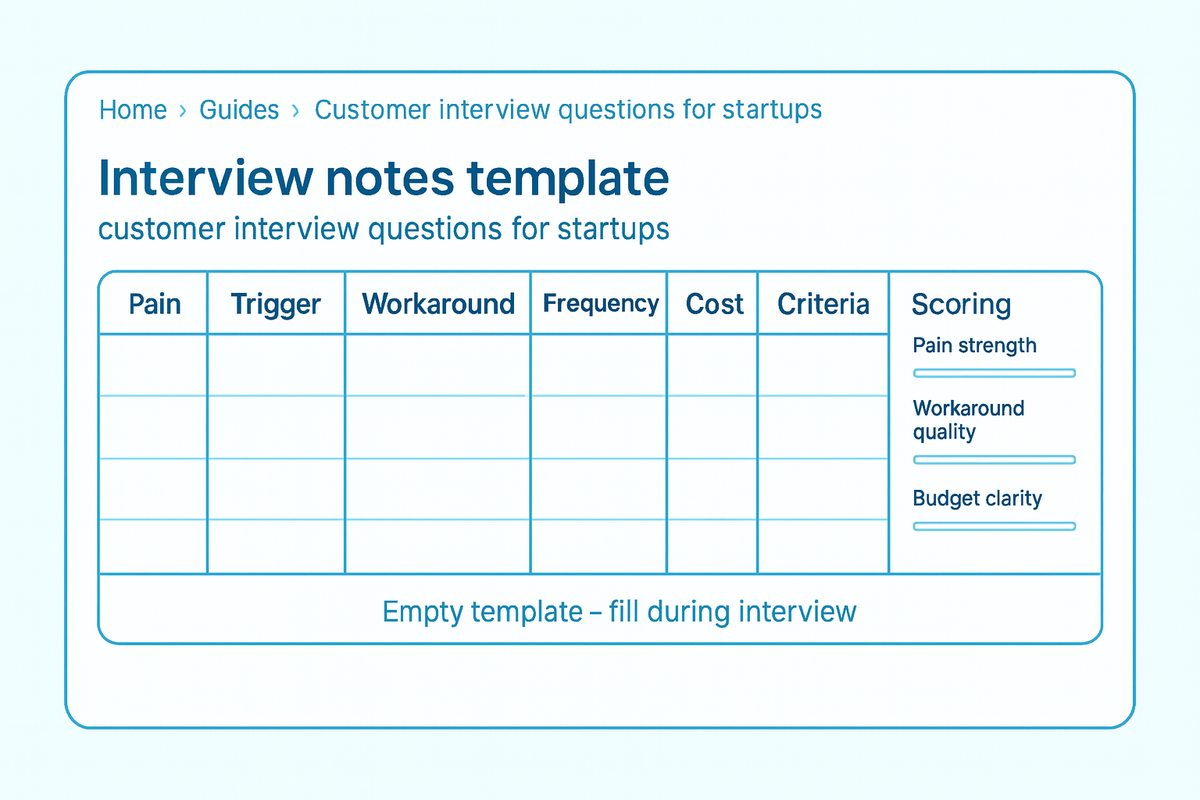
When defining your pain-solution match, you need to hear directly from your market. Conducting structured idea validation framework interviews lets you prepare hypotheses before discovery starts, giving you a clear signal on whether the problem actually matters to them.
Here is how that looks in practice. The numbers below are illustrative examples to show formatting, not universal targets:
Hypothesis | Test method | Who counts as a valid test subject | Pass metric (set in advance) |
|---|---|---|---|
Ideal Customer Profile (ICP) | Market and trend analysis. | The average buyer, not the loud edge case. | Proceed if market size is growing at 10%+ YoY; invalidated (for now) if stagnant. |
Pain-Solution | Structured interviews. | Representative companies matching your ICP. | Proceed if 40% of subjects report this as a top-three pain. |
Distribution | Outbound testing or targeted ads. | The actual person who holds the budget. | Proceed if customer acquisition cost stays below $150. |
If you need baseline expectations for your own metrics, look at these B2B product validation benchmarks to set realistic targets.
Plain-Text Framework Template
For easy copying into your own documents:
Hypothesis: [Insert assumption]
Test method: [Insert approach]
Valid test subject: [Insert exact profile]
Pass metric: Proceed if [Insert target]; otherwise invalidated (for now).
The Fake-Plan Check
Immediately after filling out your framework, run this four-question check to see if the plan will actually protect you from bad ideas:
Were the thresholds set before the test? Post-hoc thresholds are just storytelling.
Are the subjects representative of the real buyer?
Are we measuring frequency or just capability?
Does this test the market or only the product?
Three Ways a Validation Plan Gets Rigged
Founders rarely fake validation on purpose. They do it by doing real work on a test that was rigged before it started.
1. Testing on Flattering Inputs
A team tests their new automation tool. To get early feedback, they run it against a well-known, tech-forward startup. The tool performs perfectly. Then they release it to their actual ICP—dull, mid-size traditional companies — and the workflows break immediately.
A test run against a famous brand may validate nothing about your real use case. You must test on representative subjects, not flattering ones. The "who counts as a valid test subject" column in your plan is what fixes this structurally.
2. Validating Capability Instead of Frequency
Imagine spending a month building support for an unusual document file format. The validation plan asked, "Can our system handle this format?" It should have asked, "How often do users actually encounter this format, and what does it cost them when it fails?"
Proving you can handle a weird case feels like progress. Measure the frequency of the trigger case and the cost of the failure instead. A capability nobody triggers often is not a market.
3. Scoping to the Product While Skipping the Market
Most plans test the product design and ignore the market entirely. My read is that roughly 80% of how a startup turns out traces back to which market and which customer you pick. Are they in a growing segment? Who is the competition? Are they exposed to heavy regulation?
Those questions hit the business harder than the product ever will. You answer them with plain market research methods. Standard tools like those found in the SBA market research guide or Steve Blank's customer development framework help you understand your market before you write a single line of code. CB Insights notes that missing a market need is a top reason startups fail.
Early Onboarding is Evidence Collection
Your earliest onboardings are manual. You do this because you are collecting evidence, not running a process to scale. What you learn about how a customer's team actually works is the insight a competitor cannot copy from your landing page.
This early, hands-on work is an instrument for deep understanding. It does not mean onboarding stays manual forever, but skipping it removes your best source of market reality. When you know exactly what evidence you need to collect, structure your discovery process to gather it properly.
FAQ
How does a validation plan differ from a business plan?
A business plan outlines how you will operate and scale your company, assuming your core idea works. A validation plan outlines how you will prove whether the idea works in the first place by testing it against real market data.
Who owns the validation plan?
The founders own it. It is a tool for the core team to keep themselves honest, set objective thresholds, and avoid building a product nobody wants to buy.
What should I do if a hypothesis comes back invalidated?
If a test fails your predetermined metric, the hypothesis is invalidated (for now). This means you pause, analyze the data to understand why it failed, and either pivot the offering or target a different customer profile before writing more code.
What do stakeholders and investors actually accept as validation?
Proof of demand. Stakeholders look for signed letters of intent, revenue, or lined-up demos. A vision without traction reads as naive storytelling. Real progress always beats your vision.