TL;DR
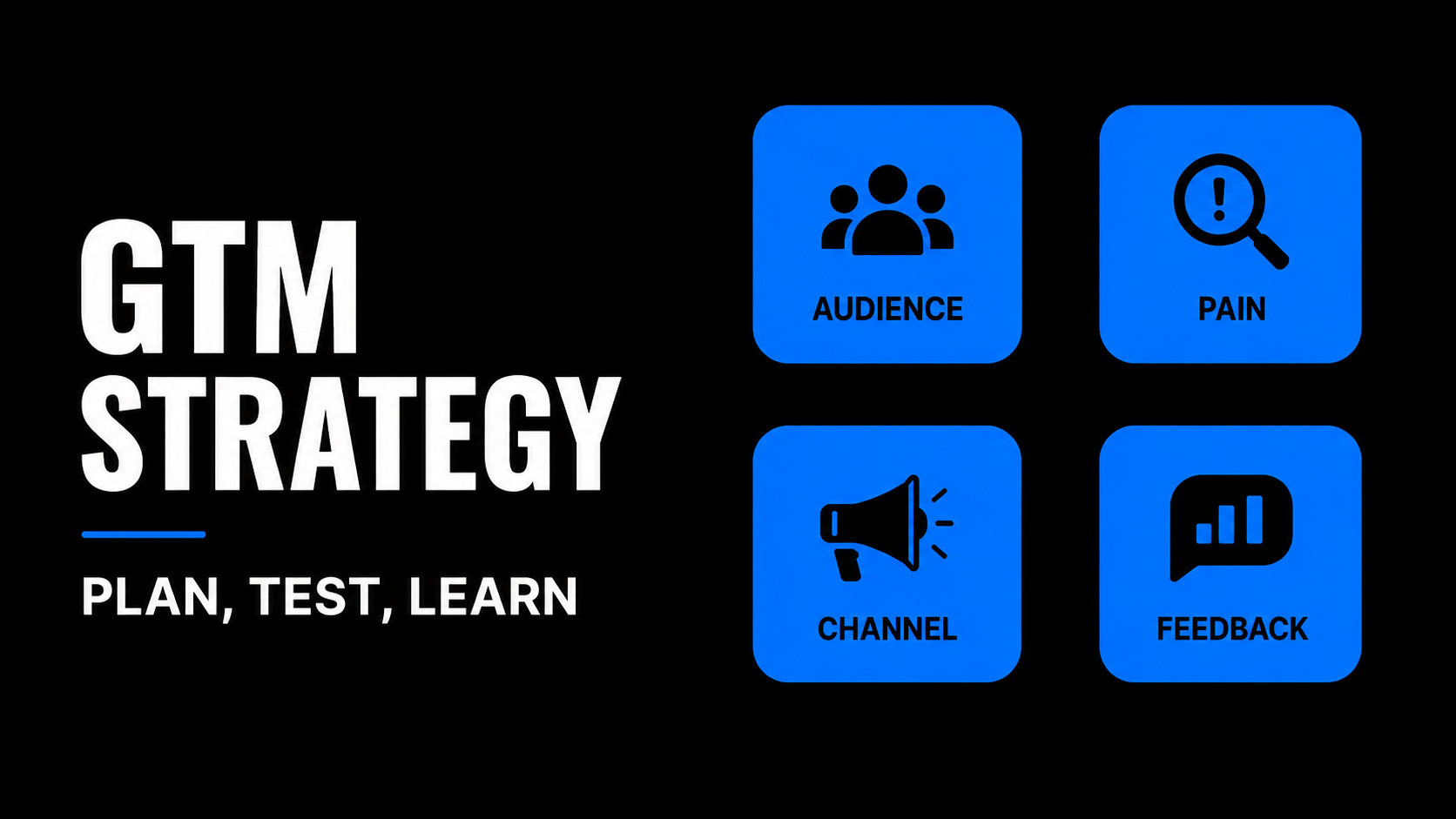
A startup go-to-market (GTM) strategy is not a list of marketing channels or a slide in your pitch deck. It is a learning system designed to prove that a reachable segment of people has a painful, repeated problem they will pay to solve. Founder-led GTM starts with identifying the audience you can actually access, validating their pain through past behavior, mapping a channel to that audience, and setting up a clear feedback loop to test unit economics.
What is a GTM strategy? It is your specific, evidence-driven plan for delivering your product to the right customers, through the right channels, at a price that sustains the business. A strong go to market strategy for startups focuses on finding traction and validation in a tight niche before attempting to scale.
The trap: treating channels as strategy
"We built the MVP in two weeks. Now we need the GTM plan to raise funding. Should we do LinkedIn, SEO, or paid ads?"
This is a common founder scenario. You have an MVP or a pitch deck, you need traction to raise funding, and you want to pick a channel to start growing. The question sounds practical, but it skips the real work. GTM is not choosing where to post. It is proving that a reachable group of people already has a painful, repeated problem and a reason to act now.
A GTM plan that starts with "Should we do LinkedIn or ads?" is starting one step too late. Choosing tactics before you know what you are trying to prove turns your launch into guesswork.
Types of go-to-market strategy
Before diving into execution, it helps to understand the different motions available. The most common types of go to market strategy include:
Founder-led: The founders manually source, pitch, and close early customers through direct networks and hustle.
Product-led growth (PLG): The product itself drives acquisition, retention, and expansion (e.g., Slack or Notion).
Sales-led: A traditional approach relying on reps reaching out to targeted accounts and closing deals.
Content/inbound-led: Growth driven by organic search, media, and educational resources.
Paid acquisition: Relying on ad spend to buy traffic and convert it through high-performing funnels.
Partner/channel-Led: Using third-party audiences, agencies, or integrations to distribute your product.
For most early-stage companies, the default is founder-led GTM until repeatable patterns emerge.
The shift: reachable segment over abstract ICP
Founders often overcomplicate their ideal customer profile (ICP) while ignoring the people right in front of them. Building an abstract persona of a Fortune 500 CTO is useless if your distribution advantage actually lies with mid-market e-commerce founders.
Reachable segment beats abstract ICP. "Working mothers" is not a starting market. "Working mothers in the three regional WhatsApp parenting groups where we already have admin access" is a starting market. Your early GTM motion should focus entirely on the accidental customer clusters or specific niches you can readily reach to gather signal.
The proof: past behavior over intent
When searching for the right GTM approach, founders often conduct interviews to see if people like their idea. This is the wrong signal. Customer interviews should not ask whether people like the idea or what they intend to do. They should ask what they tried last month, what broke, who paid for the workaround, and what would make the problem urgent this quarter.
If a product is addressing a pain that customers do not frame as important, it is solving an unimportant pain. Proof of demand comes from past behavior and current workarounds. Also, avoid positioning that requires prospects to pay you for the privilege of being corrected. Nobody wants to pay to be told they are wrong. Better positioning starts from the pain they already recognize.
The founder-led GTM framework
Instead of a massive strategic playbook, use this simple framework to force concrete answers for your early GTM motion. Keep it to one segment, one urgent use case, one or two channels, one landing page, and one feedback loop.
Reachable audience: Who can we specifically reach today without buying expensive lists? (Example: The 300 members of a specific Slack community)
Important pain: What is the painful use case they are actively complaining about? (Example: Wasting hours manually cleaning weekly data exports)
Behavioral proof: What are they currently doing or spending to solve this problem? (Example: Paying a virtual assistant $500/month for data entry)
Buying trigger: What event makes solving this problem urgent right now? (Example: The end-of-month reporting deadline)
First offer: What is the tangible, immediate value we are providing? (Example: A template or script that automates the exact export)
Matched channel: Where does this audience already trust information? (Example: Direct messages inside the community)
Landing page Message: What headline proves we understand their current workaround? (Example: "Stop paying VAs to fix spreadsheet errors.")
Conversion goal: What is the specific action we want them to take? (Example: Booking a 15-minute pilot onboarding call)
Success metric: How will we measure if this test worked? (Example: 5 booked calls out of 50 outreach attempts)
Next experiment: What do we test if the metric fails? (Example: Adjusting the offer from a call to an async video)
The motion: channel matching and capturing demand
Once you define your audience and pain, your channel selection should naturally follow. If you are targeting a prosumer audience, a B2C-optimized strategy might work best. If you are targeting enterprise compliance officers, high-trust niche content makes more sense than viral awareness campaigns.
Capturing demand requires finding the acquisition channels that actually work for your audience. A GTM plan needs a clear strategy for this because traffic without message match wastes early learning. When you run your first acquisition test, your landing page for paid ads or organic traffic must exactly match the promise made in the channel.
For instance, strong ad-to-landing-page message match ensures that your GTM test gives you clean data on whether the market wants the product, rather than noisy data from a confusing user experience. Look to HubSpot's resources on landing page best practices or Unbounce's conversion benchmark reports for data on how effectively capturing traffic impacts overall GTM success. For broader strategy insights on choosing which acquisition motion to test next, resources like the First Round Review offer excellent deep dives into successful startup GTM motions.
The judgment call: time horizons and unit economics
Do not kill a strategic channel after three flat months just because the spreadsheet looks impatient. Some channels, especially organic content or high-trust community building, compound slowly and can take a year or more to fully develop. If the audience is right and the strategy is sound, give the channel the time it needs.
However, if the unit economics simply do not work in your chosen market or geography, patience will not fix the market. You must be prepared to let go of a market—even the US—if the economics fail, and rethink the market, offer, or motion rather than forcing a broken GTM plan.
FAQ
What are the types of go-to-market strategy? The main types include founder-led, sales-led, product-led growth (PLG), content-led, paid acquisition, and partner-led GTM. Early-stage startups usually start with founder-led and evolve into other motions.
What is the difference between GTM strategy and marketing strategy? A marketing strategy focuses primarily on messaging, brand awareness, and lead generation. A GTM strategy is a broader business plan that encompasses the target market, product positioning, pricing, sales channels, and marketing all working together to deliver a product.
Is this GTM based on customers we can actually reach, or an abstract ICP? Founder-led GTM should always start with the reachable segment, then prove that segment names the pain as important. Map the plan out clearly: reachable audience -> important pain -> channel matched to that audience -> enough time to develop the channel -> unit economics by market. Avoid chasing an abstract ICP if you have no realistic way to reach them.
Do I need a GTM strategy before achieving product-market fit? Yes, but it should be lightweight and evidence-driven. Before product-market fit, your GTM strategy is your systematic approach to finding and validating that fit through direct outreach and testing.
How long should I test a GTM channel before giving up? Many founders make the mistake of dropping a channel if it does not succeed in a few months. In reality, channels often take many months to develop. As long as your unit economics are viable and the channel strategically matches your reachable audience, commit to sustained iteration.