Building a startup on nights and weekends gives you roughly 10 to 15 hours of weekly leverage. When your time is that constrained, what you choose not to do matters more than what you do. This guide breaks down the common traps that drain part-time founders and how to ruthlessly redirect your limited bandwidth toward proving real market demand.
TL;DR: The 15-Hour Reality Check
Part-time founders routinely fail by confusing administrative busywork and stealth coding with actual traction. To succeed while employed, you must stop "playing startup" and strictly focus your limited hours on high-leverage customer discovery and demand validation.
Stop obsessing over admin: LLCs, domain names, and logos can wait until you have paying customers.
Do not hide behind code: Avoid building full products in stealth just to avoid the discomfort of customer interviews.
Protect your energy: Do not sacrifice sleep for low-leverage tasks; prioritize ruthlessly to maintain the stamina needed for both a day job and a startup.
Core Definitions
Playing Startup. Engaging in administrative or aesthetic tasks (incorporation, branding, optimizing Notion templates) that feel productive but generate zero market feedback.
Stealth Building. Spending weeks or months coding a product in isolation without talking to potential users, usually driven by a fear of rejection rather than actual competitive risk.
Validation Diet. A strict time-management framework for part-time founders where nearly all available hours are allocated exclusively to customer discovery and securing initial commitments.
The Part-Time Founder Anti-Checklist
Use this anti-checklist to audit your upcoming weekend. If a task falls into the "Stop Doing" column, delete it from your to-do list. Replace it immediately with an activity from the "Do Instead" column to build a focused business validation plan.
Trap 1: "Playing Startup" vs. Proving Demand
According to Y Combinator's essential startup advice, one of the most common early failure modes is "playing house" — focusing on PR, logos, and premature incorporation rather than talking to users.
Stop Doing: Filing an LLC, buying multiple domain variants, designing a logo, or drafting a massive pitch deck.
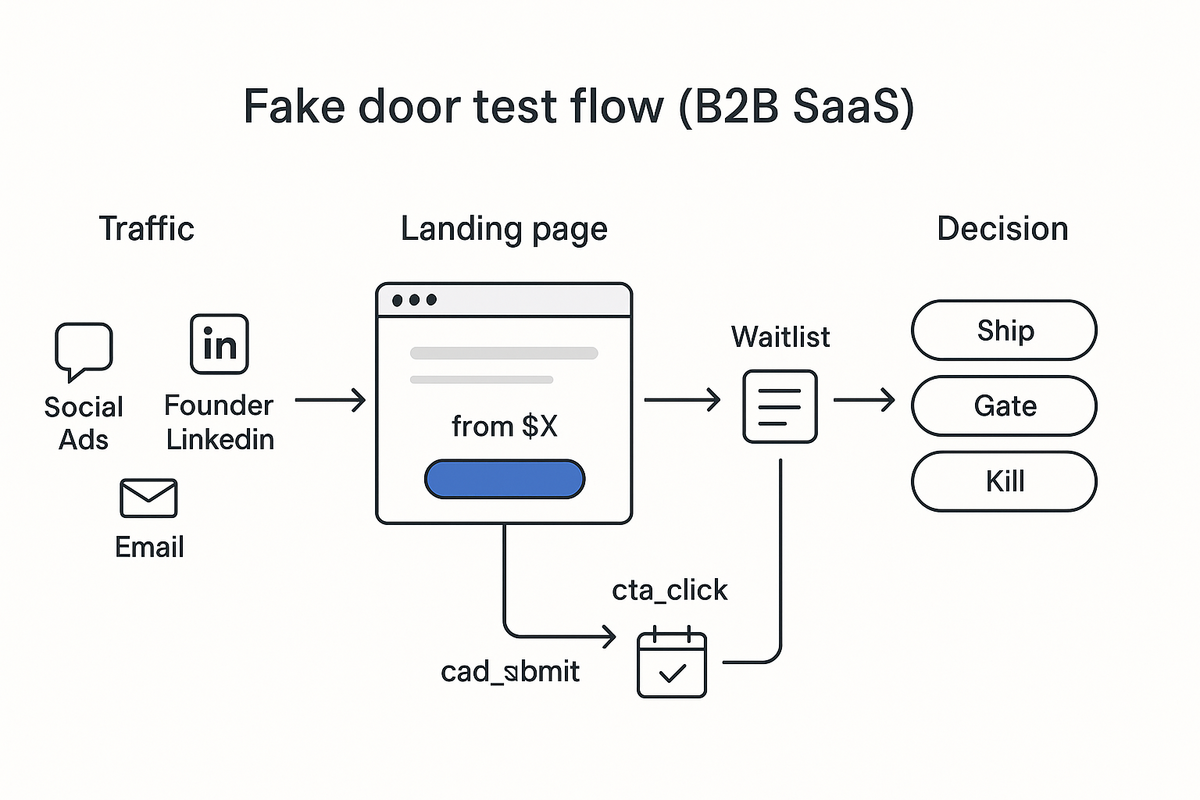
Do Instead: Run a fake door test to see if anyone will actually click "Buy" or "Sign Up" on a plain-text value proposition before the product exists.
Trap 2: The Stealth-Building Comfort Zone
Coding an application in a vacuum often happens because building is comfortable, whereas selling is hard.
Stop Doing: Writing production-ready code for a full feature set, building custom admin dashboards, or optimizing a database for scale you do not have.
Do Instead: Launch a rapid smoke test using a no-code landing page. Book targeted discovery interviews based on those signups. Resources like The Mom Test emphasize that conducting high-quality customer conversations is essential for grounding your idea in reality before writing any code.
Trap 3: Burning Sleep for Low-Leverage Motion
Toxic hustle-culture advice often implies you must sleep three hours a night to succeed. However, successful part-time founders thrive on structured time management, not reckless burnout.
Stop Doing: Staying up until 3 AM tweaking CSS colors, endlessly scrolling competitor social media, or attending generic networking events.
Do Instead: Allocate a strict 90-minute block each evening exclusively for 1:1 outreach to potential early adopters, then go to sleep.
Sample Schedule: Hypothetical 10-Hour Part-Time Validation Week
1 Hour: Reviewing analytics from active smoke tests.
4 Hours: Conducting four 30-minute customer interviews (plus prep/synthesis).
5 Hours: Direct 1:1 outbound messaging (email/LinkedIn) to secure next week's interviews.
0 Hours: LLC formation, logo design, or feature bloat.
Will building a startup while working full time actually get you to first customers?
Merely dedicating hours to a side project will not guarantee customers, especially if those hours are spent hiding behind code or administrative busywork. The reality of building while employed is that your bandwidth is deeply constrained. If you waste your few available hours on tasks that do not directly interface with the market, you risk burning out from exhaustion without ever securing a single paying user.
Transitioning from "playing startup" to executing a strict validation diet forces you out of the building. Your day job provides financial stability, which means you have the luxury of taking your time to validate properly rather than rushing a flawed product to market out of desperation. You do not need to build everything at once; you just need to prove that a specific group of people is desperate for a solution.
Ultimately, getting to your first customers while working full-time requires an obsessive focus on proof of demand. Every weekend spent avoiding customer conversations is a weekend wasted. By eliminating performative startup tasks, you clear the runway to do the one thing that actually matters: finding out if someone is willing to pay for your idea.
FAQ
Do I need to incorporate an LLC before I start collecting early payments?
No. In the earliest validation stages, founders testing demand can often collect initial pre-sales or pilot payments as a sole proprietor using standard payment links. You generally do not need an entity just to validate willingness-to-pay. Incorporation becomes necessary once you have actual revenue, distinct liabilities, and have proven the demand exists.
How do I market my startup publicly if I am still employed and want to keep a low profile?
Do not rely on mass public marketing or viral social media posts. Instead, focus entirely on targeted 1:1 outbound outreach. Cold email and direct messaging allow you to talk to your ideal customer profile privately. You can also use a pseudonymous landing page or a generic brand name for early smoke testing without broadcasting your side project to your current employer.
Is it illegal to work on a startup while employed full-time?
This guide does not provide legal advice regarding intellectual property assignment, non-competes, or moonlighting clauses. However, as a general rule of thumb for validation: do not use company time, do not use company equipment (laptops, phones), and do not build a product that directly competes with your employer.