Market validation mistakes rarely look like mistakes while you are making them. They look like encouraging calls, polite feedback, waitlist signups, and people saying the problem is real. The risk is that weak signals can make demand look stronger than it is, which pushes founders to keep building before they have evidence that buyers will spend money, change behavior, or take a real next step.
TL;DR: Validate behavior, not enthusiasm
The biggest market validation mistakes founders make come from treating interest as proof. Better validation looks for buyer behavior: specific pain, current workaround, urgency, budget context, authority, and a next action that costs the prospect something.
Polite praise is not demand; a stronger signal changes what the buyer does next.
A waitlist, survey, or interview can help, but only if you know what evidence it is supposed to prove.
Before pilots or channel spend, compare your evidence against real commitments, not against how good the idea sounds.
Use this as a diagnostic checklist before you decide the market is validated.
Key terms for reading the evidence
Proof of demand
Evidence that prospects are willing to take a concrete action, such as paying, booking a serious follow-up, inviting stakeholders, running a pilot, or switching from an existing workaround.
Fake door test
A test that measures whether people try to take an intended action before the full product exists, such as clicking a pricing page, requesting access, or starting a checkout flow.
Market validation mistake diagnostic
Use the diagnostic below to find the validation mistake, understand why it creates false confidence, and decide what stronger evidence to collect next.
1. Confusing compliments with buying intent
Why it creates false confidence: Founders often hear comments like "this is interesting," "I would use this," or "keep me posted" and count them as market validation. Those statements are cheap for the prospect. They do not require budget, priority, internal effort, or a behavior change.
Better evidence looks like:
The prospect describes a recent, specific instance of the problem.
They explain what they tried already and why it failed.
They agree to a concrete next step with a date, such as a pilot scoping call or stakeholder introduction.
They are willing to discuss pricing, procurement, implementation, or switching cost.
Correction checklist:
Replace "Would you use this?" with "When did this last happen?"
Ask what they do today, what it costs, and who owns the problem.
Treat compliments as weak evidence until paired with a next action.
Rob Fitzpatrick's The Mom Test is a useful reference for keeping customer conversations grounded in real behavior instead of compliments.
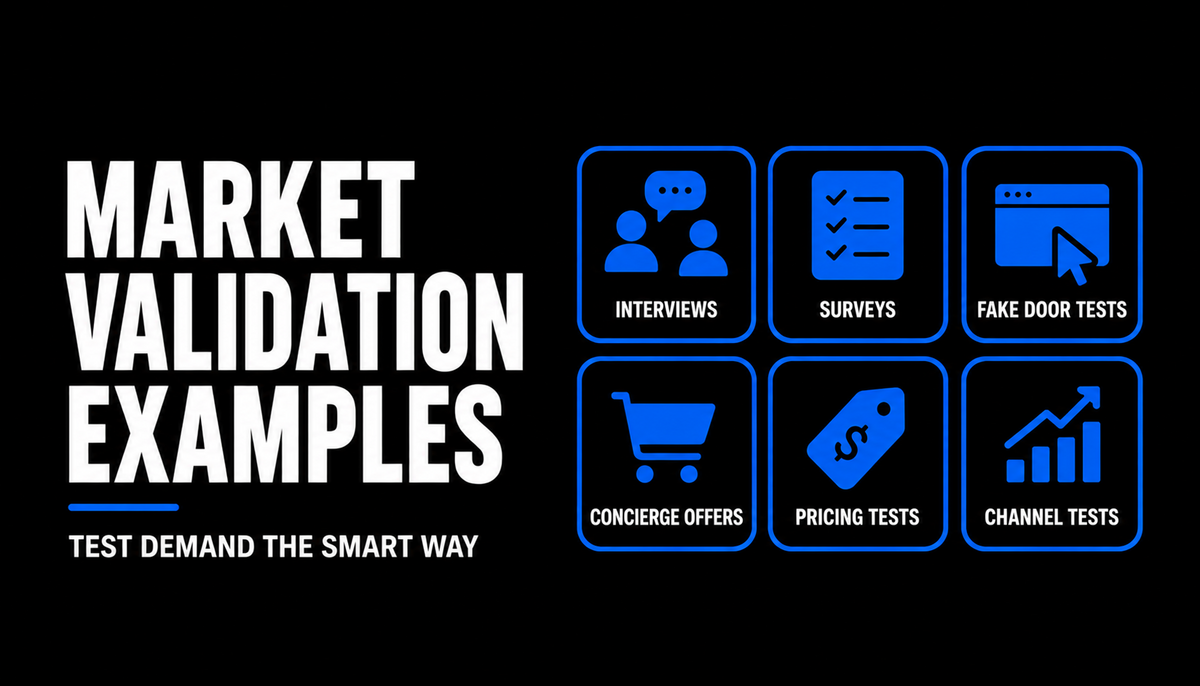
Review market validation examples to separate positive feedback from stronger demand signals.
2. Interviewing the wrong people
Why it creates false confidence: A person can understand the problem and still be the wrong validation source. If they are not the buyer, user, budget owner, recommender, or blocker, their feedback may be useful but not decisive.
Better evidence looks like:
You can name the buyer, user, influencer, and blocker separately.
The buyer connects the problem to a business outcome they already care about.
The user can describe workflow pain in detail.
The budget owner can explain how similar purchases are approved.
Correction checklist:
Tag every interview by role: buyer, user, evaluator, blocker, or observer.
Avoid averaging feedback across roles.
If users love the idea but buyers do not care, you may have a go-to-market problem, not validation.
If you are still defining the customer, step back to a broader business idea validation process before narrowing the product.
3. Treating surveys as proof of demand
Why it creates false confidence: Surveys are useful for spotting patterns, but they are weak at proving willingness to pay or switch. People can overstate future behavior, especially when answering hypothetical questions, so survey answers should be checked against what prospects actually do next.
Better evidence looks like:
Survey responses are used to segment the market, not declare victory.
High-intent respondents are invited into interviews or concrete follow-up steps.
Claims from surveys are checked against behavior: clicks, booked calls, deposits, pilots, or usage.
You separate "problem recognition" from "purchase urgency."
Correction checklist:
Keep surveys short and focused on recent behavior.
Avoid questions like "Would you pay for this?" without a follow-up action.
Use surveys to find who to interview, not to replace interviews.
Pair survey learning with a practical test from how to validate a product idea.
4. Counting waitlist signups as validated demand
Why it creates false confidence: A waitlist signup usually proves curiosity, not purchase intent. The signal gets more useful when the person matches your target segment and takes a higher-friction action.
Better evidence looks like:
Signups come from the intended buyer segment, not a broad audience.
A meaningful share of signups respond to follow-up.
Some prospects ask about price, timing, implementation, or access.
The waitlist is tied to a specific promise, not vague positioning.
Correction checklist:
Add one qualifying question that identifies segment, urgency, or current workaround.
Follow up quickly with high-fit signups.
Measure replies and booked calls, not just form submissions.
For a stronger demand signal, design a fake door test that captures attempted action before you build the full product.
5. Validating the solution before validating the problem
Why it creates false confidence: Founders often pitch the product too early. Once the conversation becomes a demo or concept review, prospects react to your proposed solution instead of revealing how painful the underlying problem is.
Better evidence looks like:
The prospect explains the problem before seeing the solution.
They describe current workarounds, costs, delays, or risks.
They rank the problem against other priorities.
They can say what would need to be true for them to switch.
Correction checklist:
Spend the first half of the conversation on the problem, not the idea.
Ask for stories, not opinions.
Keep notes on exact language, triggers, current tools, and decision criteria.
Group notes by segment, role, trigger, current workaround, and next action so patterns do not depend on memory.
6. Ignoring the cost of switching
Why it creates false confidence: A prospect may agree your product is better and still avoid switching. Switching costs can include training, migration, procurement, compliance, stakeholder approval, workflow disruption, and reputation risk.
Better evidence looks like:
The buyer names the current alternative and why it is inadequate.
The buyer describes what would trigger a switch.
The prospect is willing to involve others affected by the change.
The value appears large enough to justify effort, not merely attractive in theory.
Correction checklist:
Ask, "What would stop you from adopting this even if it worked?"
Ask who else would need to approve or use it.
Identify the incumbent, workaround, or "do nothing" alternative.
Do not count interest as demand until you understand why switching is worth it.
7. Over-reading a small number of strong conversations
Why it creates false confidence: A few excellent calls can be real, but they may represent a niche, an outlier segment, or founder-network bias. Qualitative research can reveal patterns, but it does not automatically estimate market size or conversion. Nielsen Norman Group notes that small qualitative samples can uncover many usability issues, but that research context is not the same as proving market demand or revenue scale; see their explanation of why five users often find many usability problems.
Better evidence looks like:
The same pain appears across similar buyers, not random contacts.
The segment is narrow enough to target and plausibly large enough to matter.
Prospects outside your warm network show similar urgency.
Evidence improves as tests become higher friction.
Correction checklist:
Separate warm intros from cold or semi-cold prospects.
Group notes by segment before drawing conclusions.
Look for repeated language, repeated triggers, and repeated buying constraints.
Treat early conversations as pattern discovery, then seek proof of demand through action.
8. Using weak tests for high-stakes decisions
Why it creates false confidence: Not every validation method can answer every question. A landing page can test message resonance. Interviews can test problem depth. A paid pilot can test willingness to pay and operational fit. Trouble starts when a low-friction signal is used to justify a high-friction decision.
Better evidence looks like:
Each test has a clear decision attached to it.
The evidence bar rises as the cost of the next decision rises.
You do not move from "people clicked" directly to "we should hire sales."
You know which assumption remains unproven.
Correction checklist:
Write the decision before running the test.
Match the test to the risk: problem, segment, pricing, channel, implementation, or retention.
Use low-friction tests early and high-friction tests before expensive commitments.
If the next move spends meaningful runway, require evidence that prospects will take a meaningful next step.
Compact evidence ladder
Signal | What it can support | What it cannot prove |
|---|---|---|
Compliment | The idea is understandable | Buying intent |
Survey response | Possible patterns or segments | Willingness to pay |
Waitlist signup | Curiosity or message resonance | Revenue demand |
Discovery interview | Problem depth and workflow context | Scalable acquisition |
Fake door action | Attempted behavior | Long-term retention |
Paid pilot | Serious demand from a segment | Full market size |
Short correction checklist before you call the market validated
Can you name the specific segment, not just the broad market?
Have prospects described recent behavior rather than future hypotheticals?
Do you know the current workaround and why it is not good enough?
Has anyone taken a higher-friction next step?
Have you separated buyer feedback from user feedback?
Do you know what evidence would disprove your current belief?
Illustrative math: If 200 people join a waitlist, 40 match your target segment, 12 respond to follow-up, 5 book a serious call, and 1 agrees to a paid pilot discussion, the validation signal is not "200 interested people." A more useful reading is "1 high-intent commercial conversation from 200 low-friction signups," which tells you to inspect targeting, urgency, and offer clarity before scaling spend.
Will market validation mistakes actually get you to first customers?
Market validation mistakes do not usually kill a startup in one obvious moment. They create a slow drift: the founder keeps building because the evidence feels positive, but the evidence is not strong enough to justify the next expensive decision.
The practical goal is not to become skeptical of every signal. It is to rank signals correctly. Praise, clicks, signups, interviews, stakeholder introductions, pilots, and payments all mean different things, and they should not be treated as equal proof.
Before you move into pilots, hiring, paid acquisition, or channel partnerships, make the evidence earn the decision. Weak validation can still teach you where to look next, but it should not be used as permission to spend runway as if demand has already been proven.
FAQ
What is a common market validation mistake founders make?
A common mistake is treating positive feedback as demand. A prospect saying the idea is interesting is useful, but it is not the same as taking a commercial next step, discussing budget, introducing stakeholders, or agreeing to a pilot.
Are customer interviews enough to validate a startup idea?
Customer interviews can help you understand the problem, language, workflow, and urgency. They are usually not enough by themselves to prove willingness to pay, adoption, or repeatable acquisition. Use interviews early, then add higher-friction tests.
Is a waitlist good market validation?
A waitlist can be weak or more useful depending on who joins and what they do next. It becomes more useful when signups match the target buyer, answer qualifying questions, respond to outreach, and take a stronger action.
How do I know if my validation evidence is misleading?
Your evidence may be misleading if it is mostly based on hypotheticals, warm-network praise, broad survey answers, unqualified signups, or conversations with people who cannot buy. Stronger evidence includes recent pain, current workaround, urgency, budget context, and a concrete next step.
Should I stop building until validation is perfect?
No. Validation is never perfect. The point is to match the evidence bar to the cost of the next decision. A prototype may need light evidence; a sales hire, major build, or paid channel push should require stronger proof.