TL;DR: Running paid ads to an unvalidated B2B website burns budget without revealing why visitors left. A flat conversion rate rarely shows whether your channel failed, your targeting was off, or your copy was confusing. Before spending money on ads, run three checks: test buyer comprehension directly, match external ad promises to your page headlines, and track high-intent visitor actions.
Website validation for business tests whether target buyers understand what you sell, who it serves, and why they should care. It confirms customer comprehension and message match before you buy distribution. It cannot prove long-term product viability, customer retention, or pricing power on its own.
The Trap: Buying Traffic for Founder Assumptions
When a new B2B website fails to generate demo requests, founders often turn to paid ads for quick answers. They put money into search or social campaigns. When bounce rates climb and conversions stay near zero, they assume the market rejected the product.
That assumption is usually wrong. The campaign did not test market demand. It tested what happens when you send cold traffic to a page built around internal beliefs. Research by CB Insights on top startup failure reasons shows that building something with no market need is a leading driver of company death. Spending money on ads before confirming that buyers care about your offer simply accelerates that failure.
Founders often write copy from their own view of the product. That copy leans on vision statements, abstract categories, and technical architecture. Target buyers look for fixes to immediate operational headaches. When they land on a page that ignores their daily reality, they leave.
Paid traffic scales existing clarity. It rarely fixes ambiguity. Practical website validation for business requires proving that your offer makes sense to an actual buyer before you spend cash to scale it. Ads should follow proven demand and working fulfillment, not substitute for validation.
The Three Hypotheses Behind Every B2B Page
A B2B website is not a digital brochure. It is a live test of three commercial assumptions:
The ICP hypothesis: You know the exact job title and company profile of the person who feels this problem most acutely.
The pain-solution hypothesis: You identified an urgent workflow bottleneck and paired it with a believable commercial outcome.
The distribution hypothesis: You know how to reach that buyer through a channel you understand.
When conversion stays flat, founders often rewrite random headlines or change button colors. That rarely helps. If your visitors do not fit your target profile, clear copy will not save the page. If you pick a channel you do not know how to run, poor results reflect channel execution rather than a flawed offer.
Before changing copy or spending ad budget, run a structured idea validation landing page sprint to isolate which assumption is actually broken.
Step 1: The Five-Second Buyer Comprehension Test
To validate B2B website messaging, first verify that qualified buyers understand your offer without coaching.
Founders often seek feedback by showing their homepage to friends, advisors, or polite industry peers. The question is usually: “What do you think of this?” The answer is almost always polite praise: “It looks very clean and professional.”
Polite praise is not market validation. In reality, buyers rarely volunteer direct criticism. As Rob Fitzpatrick outlines in The Mom Test, asking people for opinions on an idea invites polite encouragement rather than honest truth. You have to pull objections out of them deliberately by focusing on concrete past behaviors and immediate reactions.
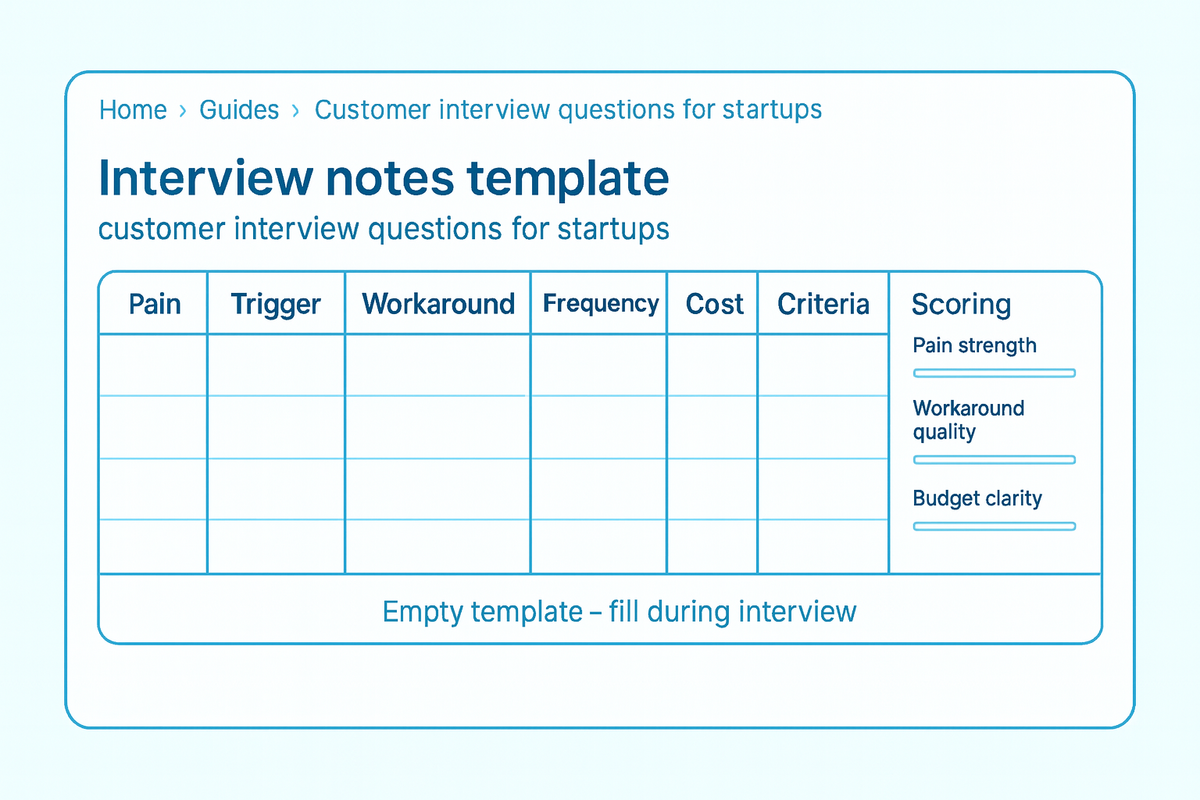
Applying established user interview protocols helps you gather unbiased qualitative feedback without leading the participant.
How to Run the Test
As a practical rule of thumb, recruit five to eight people who match your target buyer profile. This qualitative sample is not a formal statistical cohort; it is a rapid screening tool to spot obvious confusion. Choose professionals who currently manage the budget or workflow your product touches.
Show them your hero section for five seconds, then hide the screen. Standard qualitative testing shows that this initial exposure captures immediate cognitive orientation.
Ask three extraction questions:
What does this product do in plain words?
Who inside a company uses this daily?
What existing tool, spreadsheet, or process does this replace?
Bring the page back up, let them read the full section, and ask two friction questions:
What would stop your team from trying this today?
When did this problem last cost your company time or money?
How to Interpret the Feedback
Consider a composite scenario based on an early developer tool startup called QueryPulse. The founder wrote a hero headline based on technical pride: “Unified Telemetry and Autonomous Query Intelligence for High-Scale Stacks.”
During five-second tests, senior engineers asked whether the tool was an open-source database exporter, an APM suite, or an AI wrapper. Nobody could identify what budget line it replaced. The founder thought the text sounded advanced. To buyers, it sounded vague.
If qualified reviewers cannot state your category, user, and outcome within seconds, the headline needs work. Use a structured B2B value proposition template to test website value proposition clarity before testing again:
[Target Buyer] + [Specific Trigger Event] + [Measurable Operational Outcome] + [Primary Alternative Replaced]Takeaway: Clear positioning names the specific buyer, the trigger event, the measurable outcome, and the tool it replaces.
Step 2: The Traffic-Source Message-Match Audit
Once individual buyers understand your offer, inspect how visitors arrive at your page.
Visitors rarely arrive with a blank slate. They click because a search ad, social post, or email made a specific promise. The continuity between that external promise and your page headline is called information scent. When that scent breaks, visitors leave immediately.
Consider an illustrative case involving a construction software startup called SubAudit. The tool helped general contractors audit subcontractor invoices and lien waivers. The founder ran search ads targeting the phrase subcontractor invoice approval software.
The ads pointed to a homepage with an expansive headline: “The Complete Collaborative Operating System for Commercial Builders.”
Visitors bounced within seconds. The searcher wanted an invoice approval tool, but landed on an abstract operating system pitch. Google’s guidance on landing page experience and ad relevance reinforces that aligning landing page copy directly with user search intent improves campaign efficiency and lowers bounce rates.
Search Query or Ad Hook:
"Subcontractor invoice approval tool"
                  │
                  ▼
          [Information Scent]
                  │
                  ▼
Hero Headline:
"Approve Subcontractor Invoices in Minutes Without Chasing Lien Waivers"
Takeaway: Your landing page headline should repeat the exact promise, noun, and verb used in the ad that drove the click.
To complete a B2B website messaging audit:
Document external promises: Record the exact hook and call to action used in each ad, email, or post.
Match above-the-fold copy: Ensure your primary headline uses the same terms as the referring source.
Build dedicated entry points: Avoid sending multi-channel ad traffic to a generic root homepage. Set up a focused smoke test landing page built around a single promise for each audience segment.
Review channel baselines: Compare your initial engagement against typical B2B SaaS acquisition channel benchmarks so you do not mistake normal channel attrition for page failure.
Step 3: Low-Volume Intent-Signal Tracking
Early B2B websites rarely generate the traffic needed for traditional statistical significance. If you wait for fifty completed enterprise demos to evaluate your copy, you will run out of runway.
Instead of tracking only macro demo bookings, measure intent signals. These proxy actions reveal whether visitors are evaluating your product or leaving out of confusion.
Track four primary intent signals:
Scroll depth past the hero: Visitors scroll down to inspect workflow diagrams, integrations, or security details.
High-intent navigation clicks: Visitors click into technical documentation, API specifications, or pricing tiers.
Interactive asset engagement: Visitors test an ROI calculator, toggle feature tabs, or watch a product walkthrough video.
Form drop-offs: Visitors click the demo button, start typing, and stop at a specific field such as phone number or company size.
Google’s documentation on the GA4 traffic acquisition report outlines how to evaluate session engagement and conversion behavior segmented by traffic channel. Segmenting these mid-funnel interactions by campaign source reveals which messaging channels bring qualified interest.
If a technical buyer spends four minutes reading your API docs and leaves without booking a call, they did not reject the concept. They wanted technical proof your main page omitted. Adding an interactive preview or technical spec sheet often captures that interest.
Before running paid traffic, use a structured startup smoke testing methodology to set specific pass-fail thresholds for these intent signals.
B2B Website Messaging Diagnostic Rubric
When analyzing visitor behavior during landing page demand validation B2B tests, use this rubric to map drop-off patterns to concrete narrative adjustments:
Observed Visitor Behavior | Likely Diagnosis | Narrative Adjustment | Next Action |
|---|---|---|---|
High bounce rate under 5 seconds across all traffic sources | Category ambiguity. Visitors cannot tell what the product does or who it is for. | Replace vague slogans with a direct category anchor, clear target role, and concrete primary outcome. | Run unguided five-second tests with three qualified target buyers. |
Deep page scroll past 75% with zero clicks on any call to action | Missing commercial urgency. Visitors understand the topic but see no urgent reason to act now. | Add a cost-of-inaction section that quantifies the operational risks of manual workarounds. | Interview recent prospects about what operational crisis triggered their search. |
High traffic to documentation or security pages but zero demo requests | Architectural proof gap. Technical buyers grasp the pitch but doubt security or system integration. | Move data privacy standards, integration lists, and technical diagrams onto the main landing page. | Track whether demo requests increase after adding technical proof above the fold. |
Immediate exit upon scrolling down to the pricing section | Packaging mismatch. The pricing model contradicts buyer purchasing habits or budget authority. | Clarify licensing metrics and explicitly state what company size fits each tier. | Review pricing models of adjacent tools that your buyers already expense. |
High engagement with secondary resources but zero demo bookings | High commitment friction. Asking for a live meeting demands too much effort too early. | Introduce a lower-friction step, such as an interactive product tour, recorded demo, or sandbox tier. | Compare demo form submissions against an ungated or lightweight preview step. |
The Pre-Ads Validation Checklist
Before allocating ad budget to your landing page, verify that your campaign satisfies these four operational requirements:
Buyer comprehension confirmed: At least five qualified buyers accurately explained what you do, who uses it, and what it replaces after viewing the page for five seconds.
Strict message match: Your ad creative and your landing page hero use identical phrasing, nouns, and value promises.
Proxy intent events instrumented: Analytics tracks scroll depth, pricing views, and documentation visits segmented by UTM source.
Advance invalidation criteria set: You agreed in advance on what metrics will invalidate the test (for example, 100 qualified clicks from target buyers with zero intent events).
Channel Execution vs. Messaging Failure
A frequent mistake founders make during website validation for business is evaluating copy through an acquisition channel they do not understand.
Every marketing channel requires specialized tactical execution. If you run LinkedIn ads with loose targeting, ad spend goes to non-buyers. When that campaign yields zero demo requests, it shows poor channel targeting, not necessarily a failed value proposition.
When validating website copy:
Use familiar distribution first: Test your copy through founder outreach, direct community interactions, or personal networks before testing paid channels.
Keep the channel constant: If you test on paid platforms, avoid changing your channel setup and your copy at the same time.
Avoid double unknowns: Do not run an unvalidated headline through an untuned ad account to an unverified audience. When conversion fails, it becomes impossible to determine which factor failed.
FAQ
Does a low website conversion rate prove that my messaging is broken?
No. A low conversion rate can come from poor targeting, channel execution errors, or an uncompelling offer. Do not rewrite your website blindly. First, run five-second comprehension tests with target buyers to verify clarity. Second, audit message match between your traffic sources and your hero headline. Third, check intent signals to see where visitors lose momentum.
How many visitors do I need to validate B2B website messaging?
You do not need thousands of visitors to evaluate whether your messaging makes sense. In qualitative testing, five to eight structured buyer interviews serve as a practical heuristic to catch obvious positioning confusion faster than thousands of ad clicks. When testing paid traffic, evaluating 100 to 200 qualified visits from a single defined audience gives a directional benchmark, tracking secondary intent signals rather than waiting for statistically significant demo volumes.
What should I do if buyers understand the website but still refuse to book a demo?
If buyers understand your product but take no action, your offer lacks commercial urgency. The pain may exist, but solving it is not a priority for their current budget cycle. Ask them what project currently consumes most of their quarterly budget. If their answer is unrelated to your product category, your copy is clear, but your value proposition lacks commercial priority.
Can paid ads validate an early-stage B2B business from scratch?
Ads can confirm whether a specific headline attracts clicks from a known audience. However, ads cannot prove customer willingness to pay, onboarding success, or long-term retention. Relying on paid ads before validating customer pain usually leads to high acquisition costs and swift churn. Validate buyer demand through direct customer conversations and working delivery before scaling paid campaigns.