TL;DR: Founders often treat an idea validation landing page as a branding exercise. They spend weeks debating copy or trying to A/B test a page that gets zero traffic. But a validation page has one job: to find out if strangers will take a measurable action. Proof of demand beats vision. The best way to test this is a simple 3-section page that captures an email and immediately asks for a hard commitment, like a payment or a demo booking.
What is an Idea Validation Landing Page?
An idea validation landing page is a single-page website used to measure actual market demand for a new product concept before writing code. Its primary job is to test if visitors will take a measurable action, such as leaving an email address or making a deposit. This differs from a standard marketing page because it tests intent and willingness to pay, rather than just explaining features.
The Polish Trap
A founder often spends time making a landing page look perfect. They tweak the headline, debate the brand colors, and prepare the exact language an investor might want to read. They might even set up A/B tests to see which button color converts better, ignoring the fact that they have no real traffic.
They do this because asking for money feels exposed. They say the market wants the product, but they avoid asking for a real commitment because the concept is not proven. They capture low-intent "notify me" emails and call that validation.
Validation starts when someone crosses a paywall, not when they politely praise your idea. You should validate a business idea before building, but you need to test actual willingness to pay, not opinions.
Proof of Demand Beats Vision
A simple concept validation landing page is typically the cheapest way to prove commercial intent before writing code. If you are doing website validation for business, you do not need to build the software to see if someone will pay for it.
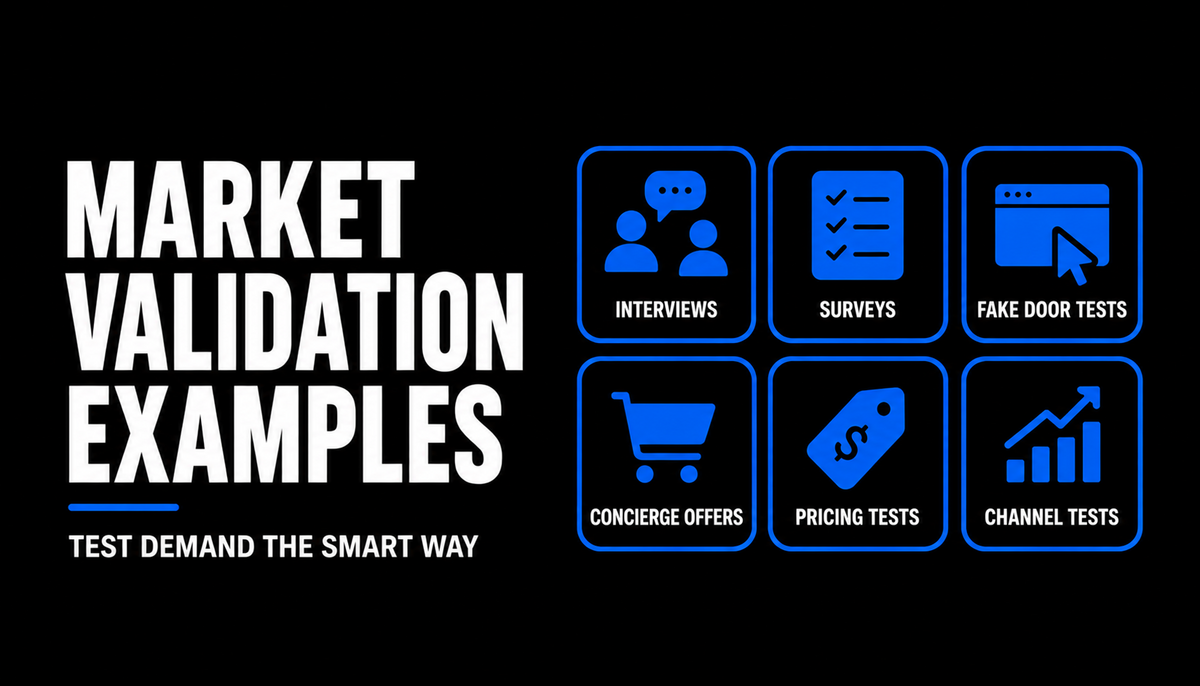
The landing page captures attention, but the next step tests intent. As experts at Y Combinator point out, talking to users is critical, but getting them to commit is the real test. Methods like fake door testing are commonly used to measure this exact behavior without building the underlying product.
An email signup is a lead for follow-up. It is not proof that someone will pay.
The 3-Section Validation Template
Do not turn this into a copywriting exercise. You need a simple page that forces a decision.
Use this 3-section structure optimized for email capture and intent measurement:
Audience, Pain, and Promise: Name who the page is for and the exact painful problem you solve. Make a clear promise about the outcome. (Measure: Bounce rate — do they stay to read more?)
How the Offer Works: Show a concrete use case or a before-and-after. Address obvious objections directly. (Measure: Scroll depth or click-through to the CTA)
Email Capture and Hard Commitment: Ask for the email, then immediately ask for a harder commitment step (like a payment or demo booking). (Measure: Conversion rate to email, then conversion rate to hard commitment)
The goal is to move the visitor from passive interest to active intent.
The Hard Commitment Funnel
A practical example is a landing page that leads to a Stripe checkout, which then leads to a private Slack group. The landing page captures interest, but the Stripe checkout is the real paywall. It acts as the commitment step. Validation is measured by who actually pulls out their credit card.
For a B2B product, the funnel looks different. The CTA captures an email and requires the user to book a qualification call or sign a Letter of Intent (LOI).
If you just collect emails on a vision page, you have a weak signal. If you collect emails and a measurable portion click through to checkout to preorder, you have a strong signal.
The Signal Strength Ladder
Not all signups are equal. Use this ladder to stop treating passive interest as validation:
Page visit (Weak): They saw the hook.
Email signup (Weak): They want to know what happens next.
Qualified reply (Moderate): They answered an email with a specific pain point.
Demo booking (Strong): They gave you their time.
Signed LOI (Very Strong): They agreed to terms in principle.
Deposit, preorder, or payment (Real Validation): They proved demand.
Do not build on your own beliefs. Build on real evidence.
FAQ
Can I validate an idea just by collecting emails?
No. An email signup shows interest, but it does not prove someone will pay for a solution. It is a starting point for follow-up, not a final validation signal.
Should I A/B test my validation landing page?
A/B testing is rarely useful without a large volume of traffic. Pick a credible first version of your copy and ship it. Focus on getting enough people to the page to measure intent.
What if my traffic or acquisition channel is weak?
Testing a hypothesis in a channel you do not understand mostly teaches you about the channel, not the idea. If your traffic quality is poor, your landing page test may be inconclusive.
What if I do not have a product to sell yet?
You can still ask for a deposit, a preorder, or a signed LOI. Handle it transparently by telling them the product is in development before their card is charged.