TL;DR
Competitor analysis isn’t about matching features — it’s about understanding who is already winning or delaying your ideal customer. Stop building massive feature-comparison spreadsheets. Instead, filter competitors by Ideal Customer Profile (ICP) overlap, plot them on a market-specific 2-axis matrix, and use the insights to validate your positioning, identify painful feature gaps, and test your unit economics.
A competitor analysis framework is a structured method for evaluating market players to uncover uncontested space and sharpen your unique value proposition. Rather than just tracking feature overlaps, it helps founders map competitors against customer pain points, positioning, and pricing to find out why buyers choose one solution over another.
There is a moment in many founder pitches that investors know well. The founder smiles, leans forward, and says: "We don't really have competitors."
To the founder, this sounds bold. It sounds like originality. To the investor, it sounds like a red flag. If you don't know your competitors, you haven't fully mapped the market. If you haven't mapped the market, you haven't found the customer's alternatives yet.
The usual reaction to this feedback is equally dangerous. The founder goes home, opens a spreadsheet, and lists every SaaS product that shares a few features. They create a "Price vs. Quality" matrix, check off which features their product has, and build a roadmap to close the gaps.
But feature similarity does not make a company your competitor. Fighting for the same ICP does.
The rule of competition: it’s about the ICP, not the features
Founders overcomplicate competitor analysis by treating it as a feature checklist. The problem with the "we have no competitors" mindset isn't that you missed a lookalike tool — it's that you haven't defined who you are fighting for.
Your most dangerous competitor may not look like your product at all. The biggest competitor to Instagram isn't just another photo app; it’s Netflix, because both compete for user attention. In B2B, your competitor might be a spreadsheet, an external agency, an intern, or simply the decision to do nothing. These are substitutes, and they absorb the same attention, budget, and urgency as your software.
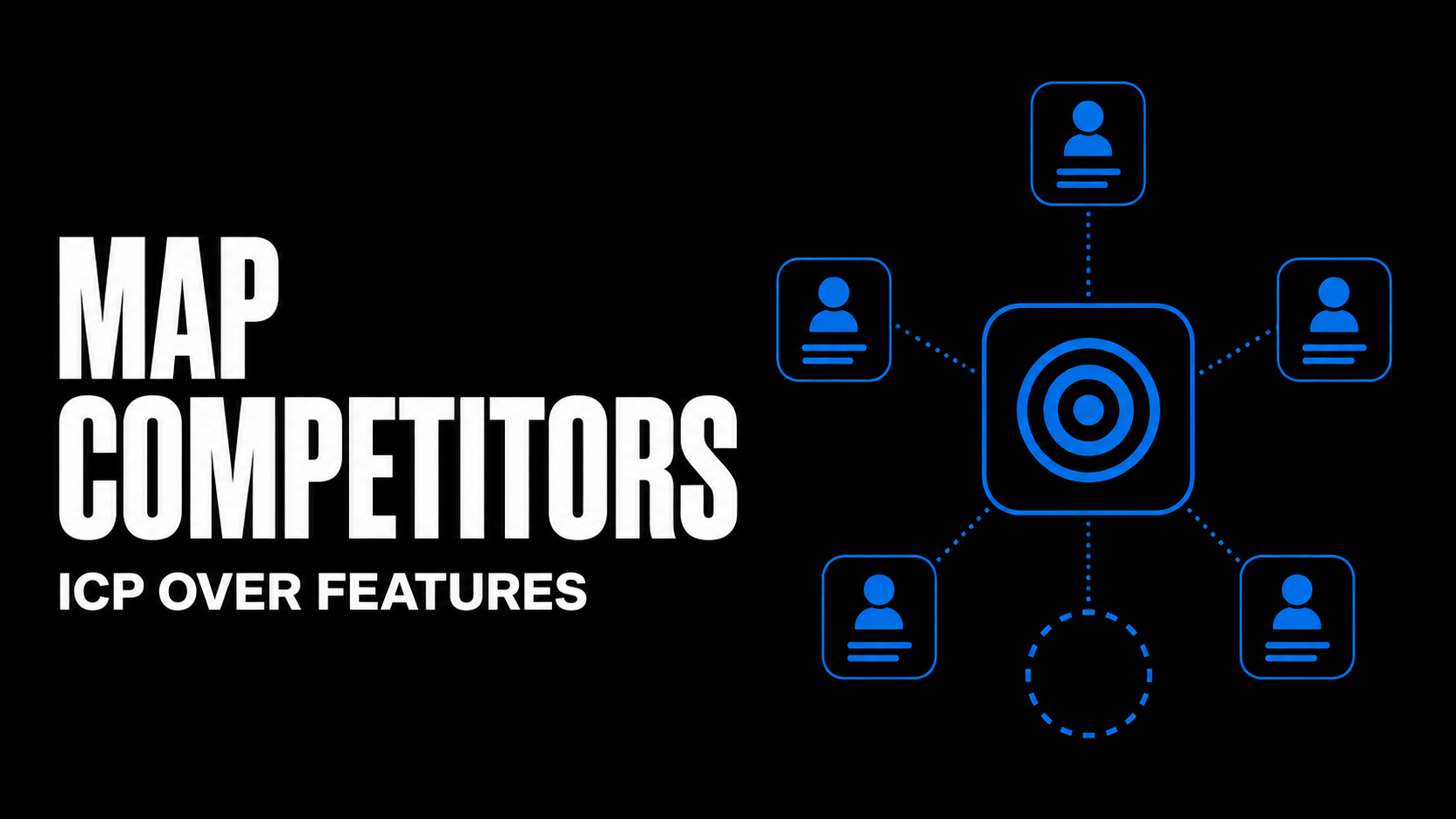
Before you map any competitor, pass them through a strict ICP filter.
The pre-analysis ICP filter
Do not compare companies unless they share the following:
Same buyer? Are you selling to the exact same role and seniority level?
Same budget? Will the cost of your product pull from the exact same department budget?
Same urgency? Are they solving a problem that the buyer needs fixed on the same timeline?
Same workflow? Does adopting the tool require the same operational changes from the user?
Same problem language? Do they describe their pain using the exact same terms you target?
Same buying trigger? Does the same specific event cause them to search for a solution?
If the answer is no, they are not a direct competitor. They might be an adjacent tool, but they aren't who you should base your go-to-market strategy around.
The practical competitor analysis framework
Once you know who is actually competing for your buyer, you need a way to visualize the market. Do not use universal templates like "Ease of Use vs. Power." The best matrix axes are market-specific. They must come from what actually separates buying choices in your specific space.
(Note: Competitor analysis tools help collect inputs, but they do not make the strategy. The insights come from how you evaluate those inputs against your own buyer.)
The 2-axis competitor map
Find the two core parameters that separate competitors from each other in the eyes of the buyer.
For example, if you are analyzing SaaS tools for social media management, you might choose these two axes:
One-platform vs. many-platform
Growth-first vs. full-management
                     Growth-First
                          |
        (Uncontested)     |     Competitor X
                          |
One-Platform --------------------------- Many-Platform
                          |
        Competitor Y      |     (Saturated)
                          |
                   Full-Management
Mapping your filtered competitors against these custom axes reveals uncontested space. It shows you exactly where the market is saturated and where a focused product can win.
The competitor evaluation list
After mapping, evaluate the players on the details that matter. Create a structured evaluation focusing on positioning, feature gaps, and pricing models:
Status Quo (Spreadsheets)
ICP served: Early-stage founders
Primary promise & positioning: "Free and infinitely flexible"
ICP-relevant feature gaps: Lacks automation, high error rate
Pricing model & unit economics: Free (Time cost is high)
Sales motion: Self-serve / Internal
Threat level: High
Enterprise Suite archetype
ICP served: Enterprise
Primary promise & positioning: "All-in-one compliance"
ICP-relevant feature gaps: Bloated interface, slow onboarding
Pricing model & unit economics: Seat-based (High ACV)
Sales motion: Top-down sales
Threat level: Low (Different buyer)
Point Solution archetype
ICP served: Mid-market
Primary promise & positioning: "Fastest setup"
ICP-relevant feature gaps: Missing custom reporting
Pricing model & unit economics: Usage-based
Sales motion: Product-led
Threat level: High
How to evaluate the data (without over-indexing on features)
Competitor analysis should act as a forcing function to validate your own value proposition. When you perform competitor analysis in marketing, it directly informs your positioning, GTM approach, messaging, and the channels you select to reach buyers. Here is how to read the data you collect:
1. Positioning and proof
Avoid the trap of leading with precise, generic ROI promises (like "increase revenue by 30%"). Sophisticated prospects have highly tuned bullshit detectors. Instead, look at how competitors prove their value. Competitor-like case studies and concrete customer outcomes raise perceived value much more effectively than abstract claims, naturally serving as helpful content for your buyers.
2. Feature gaps that actually hurt
A missing feature only matters if buyers feel the pain it solves. When looking at competitor feature sets, separate the "ICP-relevant gaps" from the "copycat gaps." Don't build an AI integration just because a competitor did if your buyer's most painful pain is actually data accuracy. Validate these assumptions through rigorous voice of the customer interviews.
3. Pricing as evidence, not a target
Do not copy the richer competitor's visible pricing just to undercut them. Pricing analysis is about validating unit economics. It asks: What kind of buyer and sales motion does this model imply?
If a competitor's pricing reveals low willingness to pay or requires a massive sales team to justify, be ready to change your market assumptions rather than blindly defending your initial belief.
If you need help building out lists of potential competitors for your initial research, platforms like Crunchbase and PitchBook can help identify funding signals and market categories — but remember that the real analysis happens when you filter those lists down to your specific ICP. For broader industry data, resources like Forrester can provide context on category maturity.
FAQ
What should a competitor analysis framework include?
A practical competitor analysis framework includes a strict ICP filter to identify true competitors, a customized 2-axis market map based on buying criteria, and a structured evaluation of positioning, feature gaps, and pricing models.How do you identify indirect competitors?
Look for substitutes that absorb the same attention, budget, or urgency. Ask yourself what tools or internal workarounds your ideal buyer currently uses to solve the pain — even if it's just a spreadsheet or an external agency.How often should a B2B startup update competitor analysis?
Update your competitor analysis whenever there is a major shift in the market, a change in your ICP, or a significant pivot in your product strategy. It shouldn't be a weekly chore, but rather a strategic check before major GTM moves.If competitors already have richer features and visible pricing, should we copy their roadmap and undercut them?
No. Competitor analysis is not for copying competitors; it is for learning the market and the customer. Use the framework as a forcing function: positioning asks what customer pain and market segment each competitor proves exists; feature gaps ask which missing capabilities map to the most painful pain, not nice-to-have themes or cheap AI add-ons; pricing asks whether the model exposes workable unit economics and willingness to pay. If it does not, be ready to change market assumptions rather than defend your first belief.