A founder spends an afternoon filling out a feature matrix: AI summaries, Slack integration, SOC 2, free trial, admin controls, integrations, pricing tiers.
Then they look at the table and still cannot answer the useful question:
What should our landing page say that buyers will believe?
The issue is usually not lack of research. It is the wrong filter. A competitor is whoever takes the same customer's budget, attention, or workflow, not just whoever has the same feature list.
TL;DR
Use this competitor analysis template as a working cue sheet, not a board-ready market report.
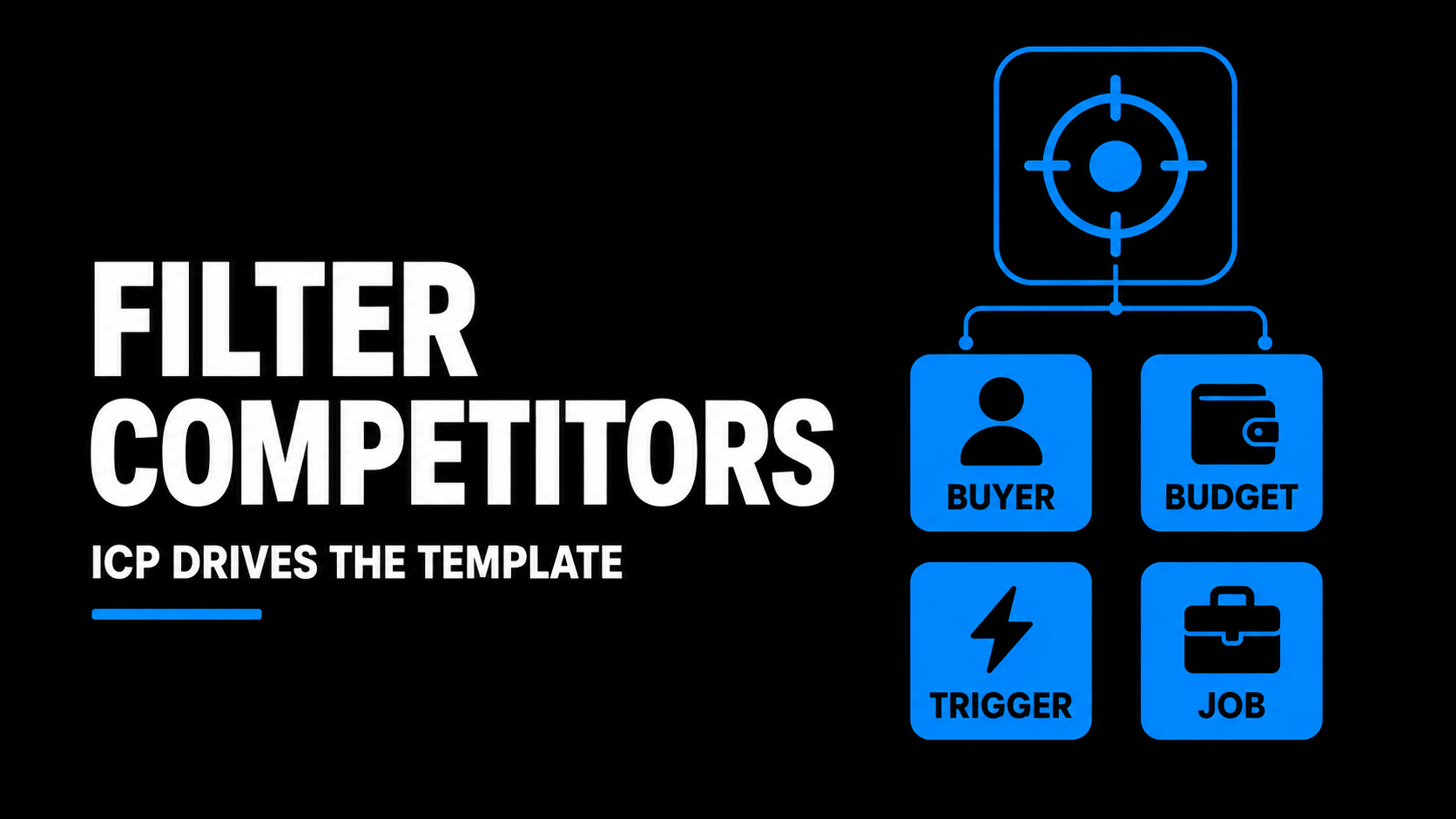
Start with ICP overlap:
Same buyer?
Same budget?
Same trigger?
Same job-to-be-done?
Shows up in sales calls, customer interviews, reviews, or buyer research?
Then log pricing, packaging, messaging, proof, risky claims, and the gap your landing page can own. This page is narrow on purpose: it gives you the template.
What is a competitor analysis template?
A competitor analysis template is a reusable structure for comparing companies, substitutes, pricing, positioning, proof, and messaging gaps. For B2B founders, the useful version starts with ICP overlap, not feature overlap, so the research leads to clearer landing page copy, sharper sales arguments, and better acquisition tests.
The ICP gate: should this company be in the table?
Before you compare features, ask whether the company is fighting for the same customer.
Check | Question | Keep in main table if... |
|---|---|---|
Same buyer | Is the buyer the same role or buying committee? | They sell to the person you need to persuade. |
Same budget | Does the money come from the same budget line? | Buying them makes buying you less likely. |
Same trigger | Does the buyer look for them during the same moment of pain? | They appear when the same problem becomes urgent. |
Same job | Are they hired to solve the same business job? | The buyer could choose them instead of you. |
Sales-call proof | Have prospects mentioned them, their category, or the workflow they replace? | They show up in real buyer conversations. |
If the answer is no across most of these, do not force the company into the main competitor table. Put it in a side note.
For example, if your buyer is a VP Sales at a small SaaS company, a sales platform may be a competitor, a meeting recorder may be a substitute, and a generic recorder may be noise.
Competitor types to include
Do not limit the table to companies that look like you.
Type | What it means | Example |
|---|---|---|
Direct competitor | Same ICP, same problem, similar category | Another sales coaching platform for SaaS sales teams |
Indirect competitor | Same buyer and budget, different category | A revenue intelligence platform that absorbs the coaching budget |
Substitute | What the buyer uses instead | Spreadsheets, Airtable, offshore ops team, consultant, agency |
Status quo | The current non-decision | "We'll keep doing this manually for now" |
Substitutes matter because buyers do not compare categories as neatly as founders do. A vertical AI company may think it competes with other AI tools, while the buyer is comparing it against an offshore team, a spreadsheet, and doing nothing.
Copy-paste competitor analysis template
Paste these records into Notion, Google Docs, Linear, Coda, or your team wiki. Use one record per company, substitute, or status quo option.
Qualification record
Field | What to enter |
|---|---|
Company / substitute | [Name] |
Competitor type | Direct / indirect / substitute / status quo |
Same ICP? | Yes / No / partial |
Proof/source | URL, call note, review, customer quote, sales mention |
Buyer alternative | What the buyer would use instead |
Pricing/package notes | Public pricing, custom quote, free tier, services cost, unknown |
Messaging record
Field | What to enter |
|---|---|
Core message | Their homepage-level promise |
Main proof | Case study, logo, review, benchmark, demo, none visible |
Risky or vague claim | Claim that feels broad, unsupported, or hard to believe |
Gap we can own | Specific weakness, missing proof, unclear ICP, slow setup, vague outcome |
Landing page angle | Page section or headline angle we can credibly own |
That is the whole asset. You can add fields later, but do not start with a 40-column feature grid. The point is not to produce a market map. It is to decide what your landing page should say next.
How to fill each field
Company/substitute
Name the vendor, workflow, agency, internal tool, spreadsheet, or status quo option.
If a prospect says, "We do this in Airtable," Airtable belongs in the template as a substitute. You are not analyzing Airtable as a company. You are analyzing the buyer's current workaround.
Competitor type
Use direct, indirect, substitute, or status quo. This keeps the template honest.
A direct competitor may matter less than a substitute if your buyer already has the substitute deeply wired into their workflow.
Same ICP?
Answer bluntly: yes, no, or partial.
Feature overlap does not count. A devtool selling to enterprise SRE teams may not compete with your product if you sell to seed-stage CTOs.
Proof/source
Add where the signal came from:
Competitor website
Pricing page
Sales call note
Customer interview
G2 or Capterra review
Case study
Job posting
Investor or company database
For company research, tools such as Crunchbase or a vetted company-data source can be useful inputs. Verify the specific fields you rely on before using them in positioning decisions. If you are deciding which source fits your workflow, compare the tradeoffs in this guide to Crunchbase vs PitchBook for B2B research.
You can also sanity-check market and competitive research basics with the U.S. Small Business Administration's guide to market research and competitive analysis.
Buyer alternative
Write what the buyer would do if your product disappeared.
This is often more useful than the competitor name. "Offshore audit team" tells you more about the sale than "FreightOps AI."
Pricing/package notes
Do not invent pricing if it is not public. Write "custom quote," "unknown," "starts at $X," "per seat," "usage-based," or "agency retainer."
Pricing is not just a number. It tells you how the competitor frames value.
Core message
Copy the plain meaning of their homepage promise.
Do not overanalyze. If they say "AI-powered sales insights," write that.
Main proof
What do they use to make the claim believable?
Screenshots
Customer logos
Case studies
Named quotes
Benchmarks
Security badges
Workflow demos
Public reviews
If there is no proof, write "none visible."
Risky or vague claim
Flag claims that a skeptical buyer may not believe without strong support.
If a competitor claims "increase revenue by 30%," do not copy the shape of the claim. Ask what proof a skeptical buyer would need before believing it.
Numbers are not bad. Unsupported numbers are weak.
Gap we can own
This is the useful field.
Vague ICP
Weak proof
Unclear setup path
No role-specific workflow
No pricing clarity
Overpromised outcome
Missing integration with the buyer's real system
Too enterprise for your smaller buyer
Too lightweight for your regulated buyer
Landing page angle
Turn the gap into a page section, headline, comparison block, proof module, or next action.
This field stops the research from becoming trivia.
Example: vertical AI for logistics
Imagine you are building invoice review AI for logistics brokers.
Qualification notes
FreightOps AI: Direct competitor; same ICP; buyer alternative is an offshore audit team; pricing is a custom quote.
Offshore ops team: Substitute; same ICP; buyer alternative is manual invoice review by contractors; cost varies by service model.
Spreadsheet workflow: Status quo; same ICP; buyer alternative is an ops manager checking invoices manually; no software cost, but meaningful labor cost.
Messaging notes
FreightOps AI: Core message is "Automate freight audit with AI." Main proof is one broker case study. A risky claim might be "Cut costs 40%" if the supporting detail is thin. A stronger landing page angle could be "Review invoice exceptions before they delay payment," backed by screenshots.
Offshore ops team: Core message is flexible human review. Main proof is the existing relationship. The gap to own is faster turnaround with a visible audit trail.
Spreadsheet workflow: Core message is familiarity and control. Main proof is internal habit. The gap to own is reducing repeat manual checks without changing the whole process.
Notice what is missing: a huge feature score. Feature depth matters only after you know the buyer, budget, trigger, and job.
From competitor gap to landing page
A competitor analysis structure is only useful if it changes what you ship.
Use this mapping after you fill the template:
Gap | Page section | Proof needed | Next action |
|---|---|---|---|
Competitor uses vague AI language | Hero | Product screenshot or short workflow demo | Show the workflow |
Competitor has a broad revenue claim | Proof section | Customer quote, before/after workflow, benchmark details | Show the example |
Competitor hides pricing | Pricing section | Pricing table, package criteria, plan comparison | Clarify plans or pricing criteria |
Competitor targets enterprise | ICP section | Setup checklist, time-to-value proof | Show setup steps |
Substitute is a spreadsheet | Comparison section | Manual workflow example, error log, handoff pain | Show where the spreadsheet breaks |
Status quo is "do nothing" | Objection section | Missed tasks, delayed payments, wasted review time | Estimate the cost of staying put |
Example:
Competitor says: "AI-powered sales insights."
A sample page headline could say: "Find the coaching moments your reps missed this week."
That is sharper because it names the buyer's job, the time window, and the output. But it only works if you can back it up with screenshots, a rep-level workflow, and one concrete use case.
This template is the working layer that turns competitor research into positioning and landing page decisions.
A lightweight research workflow
Use this in one working session.
Pick one ICP segment.
List a small set of direct competitors, substitutes, and status quo options.
Remove anything that fails the ICP gate.
Fill only the fields you can support with a source.
Highlight repeated gaps.
Pick one gap your product can credibly own.
Rewrite one landing page section around that gap.
Test the page with one acquisition channel before expanding the research.
If you need a competitor analysis PPT, use the same structure as slide sections:
Slide 1: ICP gate
Slide 2: direct competitors
Slide 3: substitutes and status quo
Slide 4: pricing and packaging gaps
Slide 5: messaging gaps
Slide 6: landing page actions
But do this after the template has produced a decision. Starting in slides can make weak research look finished too early.
Common mistakes
Mistake 1: starting with features
A row that says "Slack integration: yes/no" is not useless, but it is rarely the first question. Start with who the buyer is and what they are trying to replace.
Mistake 2: listing famous companies that never sell to your ICP
A category leader can be useful context without being a real competitor. If they sell to enterprise and you sell to 20-person teams, separate the lesson from the comparison.
Mistake 3: ignoring substitutes
Agencies, spreadsheets, internal tools, offshore teams, and manual workflows can win because they are already trusted.
Mistake 4: copying competitor claims
If a competitor makes a bold claim, do not automatically make a louder one. Ask what proof your buyer would need.
Mistake 5: treating the template like a report
The template should help you make decisions. If it does not change your landing page, sales script, offer, or acquisition test, it is probably too abstract.
FAQ
What should a competitor analysis template include?
It should include ICP overlap, competitor type, proof/source, buyer alternative, pricing, core message, main proof, risky claims, gaps you can own, and landing page angles.
Should I list every company with similar features?
No. Include them only if they fight for the same ICP, budget, trigger, or job. Otherwise, treat them as noise or keep them in a side note.
Should substitutes go in the template?
Yes. Substitutes can be the real competition: spreadsheets, agencies, internal tools, offshore teams, consultants, or doing nothing.
How do I use this for landing page copy?
Look for gaps you can prove. If competitors are vague, be concrete. If they overclaim, show narrower proof. If buyers use spreadsheets, show the exact moment the spreadsheet breaks.