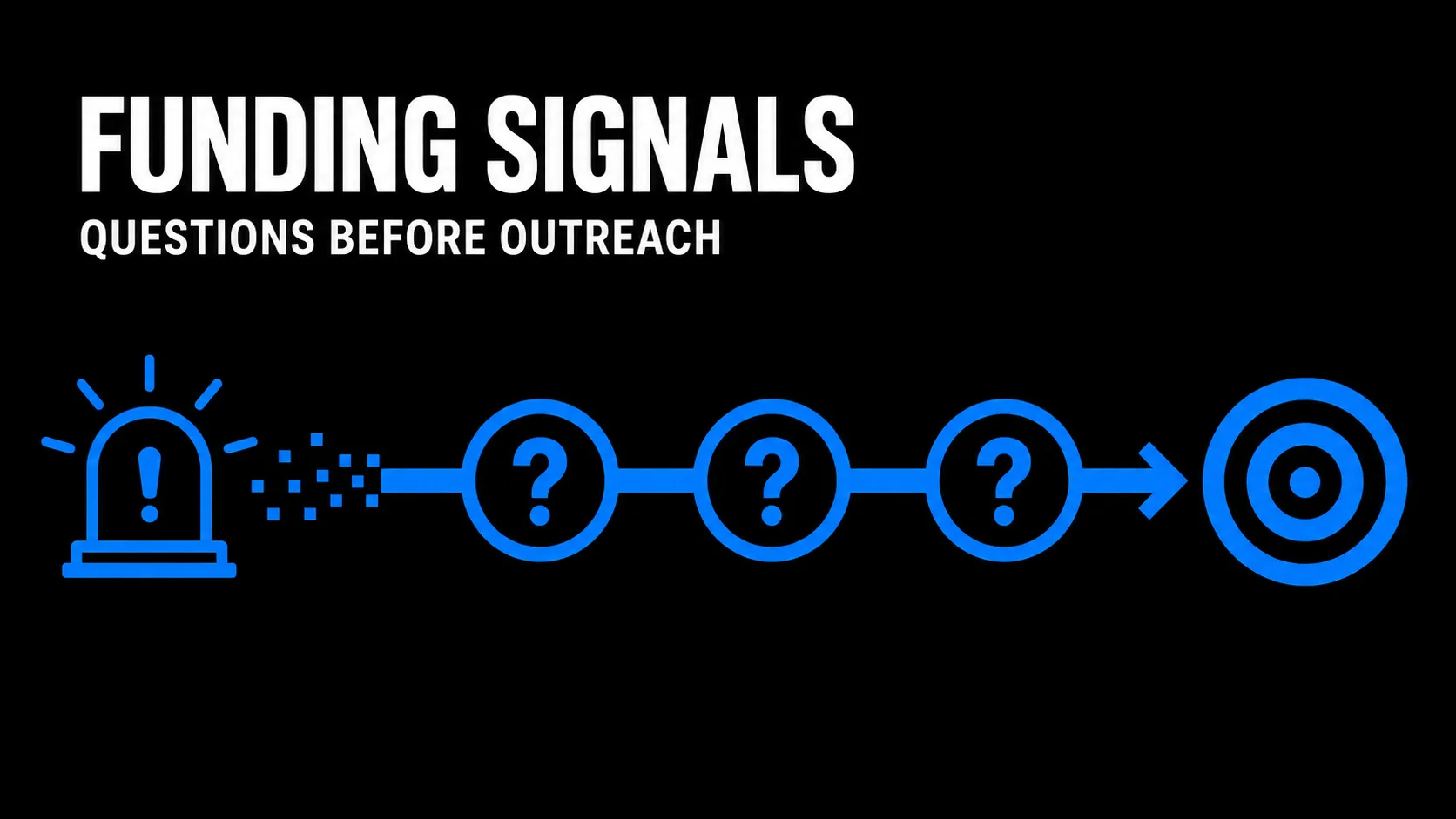
Crunchbase Funding Alert Questions for Founder-Led Prospecting
last updated: May 11, 2026
Crunchbase funding alerts are useful when they help you decide who to contact, why now, and what to say. A new round is not automatically a buying signal; it is a timing signal that needs qualification. Use this guide to turn recently funded company alerts into a founder-led prospecting workflow instead of another noisy export.
TL;DR: Treat funding as a trigger, not proof of demand
A funding alert deserves action when the company matches your ICP, the round suggests a likely operating change, and you can name a plausible business problem tied to the raise. The main mistake is assuming capital equals urgency.
Use this as a qualification workflow, not a lead scraping checklist.
- Start with ICP fit before you interpret the funding event.
- Prioritize alerts where the round may imply hiring, expansion, compliance, infrastructure, go-to-market pressure, or operational complexity.
- Disqualify companies when the only reason to reach out is "they raised money."
Use this as a qualification workflow, not a lead scraping checklist.
Core Definitions
- Funding alert. A notification that a company has announced or recorded a financing event, such as seed, Series A, Series B, debt financing, acquisition-related funding, or another capital event.
- Trigger timing. The reason a company may be more receptive now than last quarter, based on a recent change in its business.
- ICP fit. The degree to which the account matches the customer profile you can actually serve, including segment, company size, geography, business model, tech environment, and pain pattern.
- Buying committee clue. Evidence that the problem may involve multiple stakeholders, such as new executive hires, department growth, compliance exposure, budget ownership, or cross-functional process changes. For complex sales, founder-led outreach should identify likely stakeholders early instead of treating the funding announcement as the whole reason to contact the account.
- Disqualification rule. A clear reason to skip, delay, or deprioritize an alert so your prospecting list stays small enough to research well.
The funding alert qualification workflow
Use this question-led workflow to decide whether a Crunchbase funding alert deserves action.
1. Confirm the account fits before reading too much into the round
Ask:
If the answer is weak, do not rescue the lead just because the company raised money. Use your broader Crunchbase B2B search framework and Crunchbase advanced search filters to define fit before you export anything.
- Is this company in a segment where we already understand the pain?
- Does its business model match the kind of customer we can serve without heavy customization?
- Is the company large enough to feel the problem but small enough to buy from a founder-led startup?
- Does the geography, industry, customer type, or regulatory environment matter for our product?
If the answer is weak, do not rescue the lead just because the company raised money. Use your broader Crunchbase B2B search framework and Crunchbase advanced search filters to define fit before you export anything.
2. Interpret the funding stage as a likely operating shift
Funding stage does not tell you exactly what the company will buy. It gives you a hypothesis about what may be changing. Treat funding labels as classification fields to inspect in the source record, then qualify the business context before acting.
3. Look for the why now beyond the announcement
A useful funding alert often has at least one second signal:
Use the alert as the starting point, then complete account research before outreach. A lightweight Crunchbase account research template can keep this from turning into open-ended browsing.
- New executive or department leader hired.
- Open roles tied to the pain you solve.
- Expansion into a new market, customer segment, or geography.
- Product launch, partnership, acquisition, or regulatory exposure.
- Public messaging that names a priority your product supports.
Use the alert as the starting point, then complete account research before outreach. A lightweight Crunchbase account research template can keep this from turning into open-ended browsing.
4. Score the alert before you write the email
Use a simple 0 to 2 score for each question:
Priority rule:
These thresholds are illustrative, not market benchmarks. Adjust them after you compare outcomes against your own replies, meetings, and qualified opportunities. If this workflow becomes part of a search-led acquisition experiment, separate visibility from action by tracking impressions and clicks as distinct signals; Google Search Console defines those metrics in its impressions, position, and clicks guidance.
- 8 to 10 points: research and contact soon.
- 5 to 7 points: save, enrich, or test with a lighter touch.
- 0 to 4 points: skip unless another channel creates stronger evidence.
These thresholds are illustrative, not market benchmarks. Adjust them after you compare outcomes against your own replies, meetings, and qualified opportunities. If this workflow becomes part of a search-led acquisition experiment, separate visibility from action by tracking impressions and clicks as distinct signals; Google Search Console defines those metrics in its impressions, position, and clicks guidance.
5. Decide what action the alert deserves
6. Write the outreach premise before the outreach copy
Before drafting, complete this sentence:
Because [company] recently [funding trigger] and appears to be [operating change], they may now care about [pain], so I should contact [likely owner] with a point of view about [specific problem].
Illustrative example: Because AcmeCo recently raised a Series A and appears to be hiring its first sales operations lead, they may now care about pipeline visibility and handoff quality, so I should contact the revenue leader with a point of view about reducing manual forecasting work.
Replace the example with real account facts before you write outreach.
Because [company] recently [funding trigger] and appears to be [operating change], they may now care about [pain], so I should contact [likely owner] with a point of view about [specific problem].
Illustrative example: Because AcmeCo recently raised a Series A and appears to be hiring its first sales operations lead, they may now care about pipeline visibility and handoff quality, so I should contact the revenue leader with a point of view about reducing manual forecasting work.
Replace the example with real account facts before you write outreach.
7. Build the list only after the qualification logic is clear
If you are still defining your search universe, start with a Crunchbase search strategy. If you need examples of how recently funded lists can be structured, use recently funded company list examples. If you are ready to operationalize the workflow, use a focused Crunchbase export leads workflow, but pair it with lead export questions and lead list building questions so you do not create a broad list that nobody has time to research.
8. Apply disqualification rules aggressively
Skip the alert when:
- You cannot explain why this company fits your ICP.
- The company is too early, too late, too complex, or too far outside your current proof base.
- The round does not imply any pain you can credibly discuss.
- The likely buyer is unclear and there is no practical path to identify one.
- Your only opening line would be "congrats on the raise."
- You would need to invent a business problem to justify the outreach.
9. Track learning, not just volume
For every batch, record:
The point is not to prove that funded companies are better prospects. The point is to learn which funding-trigger patterns create better conversations for your market.
Hypothetical sample math: if you receive 100 funding alerts in a week, 35 match your broad market, 15 match your current ICP, 8 show a specific operating trigger, and 4 have a clear likely buyer, then the useful prospecting list is 4 accounts, not 100. If 1 of those 4 turns into a qualified conversation, your learning is about the filter pattern, not the original alert volume.
If you later publish what you learned from those patterns, keep the material specific and useful. Google's helpful content guidance is a useful check: write for the person making the decision, not just for search visibility.
- Funding stage.
- Trigger hypothesis.
- ICP segment.
- Persona contacted.
- Outreach angle.
- Reply quality.
- Meeting quality.
- Disqualification reason.
The point is not to prove that funded companies are better prospects. The point is to learn which funding-trigger patterns create better conversations for your market.
Hypothetical sample math: if you receive 100 funding alerts in a week, 35 match your broad market, 15 match your current ICP, 8 show a specific operating trigger, and 4 have a clear likely buyer, then the useful prospecting list is 4 accounts, not 100. If 1 of those 4 turns into a qualified conversation, your learning is about the filter pattern, not the original alert volume.
If you later publish what you learned from those patterns, keep the material specific and useful. Google's helpful content guidance is a useful check: write for the person making the decision, not just for search visibility.
Will Crunchbase funding alerts actually get you to first customers?
Funding alerts can help you waste less founder time, but they do not create demand by themselves. The useful signal is not "this company has money." The useful signal is "this company is likely changing in a way that makes our problem more urgent."
For first customers, that distinction matters. Founder-led prospecting works best when the message is grounded in a visible customer reality: a team is hiring, a function is forming, a process is breaking, a market is expanding, or a buyer now has a reason to care. A funding event can point you toward that reality, but it cannot replace research.
The mistake to avoid is building a giant recently funded company list and calling it traction work. A smaller list with clear ICP fit, trigger timing, buyer logic, and disqualification rules will usually teach you more than a large export full of companies you cannot credibly help.
This is why I built Traction OS. Fix your foundation before you launch.
For first customers, that distinction matters. Founder-led prospecting works best when the message is grounded in a visible customer reality: a team is hiring, a function is forming, a process is breaking, a market is expanding, or a buyer now has a reason to care. A funding event can point you toward that reality, but it cannot replace research.
The mistake to avoid is building a giant recently funded company list and calling it traction work. A smaller list with clear ICP fit, trigger timing, buyer logic, and disqualification rules will usually teach you more than a large export full of companies you cannot credibly help.
This is why I built Traction OS. Fix your foundation before you launch.
FAQ
- You:Should I contact every company that appears in a Crunchbase new funding alert?Guide:No. Contact only the companies where the funding event connects to ICP fit, a likely operating change, and a credible buyer problem. Most alerts should be skipped, watched, or enriched before outreach.
- You:What is the best funding stage for founder-led prospecting?Guide:There is no universal best stage. Seed can work if your product helps early teams set up a core motion. Series A can work if you solve repeatability problems. Later stages can work if you solve scale, reporting, compliance, or cross-functional complexity. The right stage is the one where your pain is most likely to become urgent.
- You:How fast should I reach out after a funding announcement?Guide:Reach out when you have a specific reason, not merely because the announcement is fresh. Same-week outreach can work if the trigger is clear, but a better-timed message after you identify a new hire, open role, or expansion signal may be stronger than a generic immediate note.
- You:What should I say in the first line of a funding-triggered email?Guide:Avoid using "congrats on the funding" as the whole opener. Use the funding event as context, then connect it to a business change: hiring, expansion, infrastructure, reporting, customer growth, or a workflow likely to break.
- You:How do I know if this channel is working?Guide:Track qualified replies and useful conversations, not just exports or sent emails. Segment results by funding stage, ICP, trigger type, and buyer persona so you can see which alert patterns are actually producing traction.
Find where your first 100 customers are in 2 mins. — or browse all the free founder guides.
No-BS guides