Customer feedback collection is the process of gathering, categorizing, and acting on input from early users and design partners. For early B2B startups, it means manually extracting exact workflow friction from specific people, rather than relying on aggregate survey scores.
TL;DR: Early feedback collection fails when founders strip out the context that makes the feedback useful. Do not rely on sanitized dashboards or aggregate summaries as a substitute for specific sources during early pilots. Instead, manually capture specific source-level context: who said it, what workflow failed, and which hypothesis it affects. Treat missing-feature complaints as positive signals of interest, not automatic roadmap commands.
You look at your early dashboard and feel good. The feedback summary says, “Users want better reporting,” and “Pricing seems fair.” You think you have a reliable system.
Then a pilot user emails you: “We can’t use this unless it exports to Salesforce.”
The common reaction is panic. The founder assumes the product is failing or immediately starts drafting a ticket to build the integration. But a complaint about a missing feature is not an automatic roadmap command. It is one of the few hard signals that someone actually cares enough to imagine using your product in their daily work.
Early feedback does not fail because founders collect too little. It fails because they strip out the context that made the feedback useful. They treat feedback collection as a pile of aggregate scores instead of treating it as specific customer evidence that validates or invalidates their strategy.
In pilots and early access, the goal is not to run a scalable survey process. The goal is to collect manual, source-level evidence that tells you exactly why a user acted the way they did.
The Trap of Premature Scaling
Founders watch successful onboarding flows of large software companies and assume their own onboarding must be scalable from day one. They set up passive surveys and polished, automated funnels.
At the pilot stage, this is a mistake. The goal is not to impress anyone with a perfect flow. The goal is to get a deep understanding of who your customer is, work with them, and understand their needs in context.
In a pilot, manual feedback collection is not inefficiency. It is the product doing its job as a learning system. Go to where your first alpha customers are, invite them, and run the new B2B pilot onboarding yourself. Watch to see if they get actual value. If they do not volunteer objections, you have to actively extract them.
When to Collect Feedback During a Pilot
Founders often look for a strict cadence for gathering feedback — like a weekly check-in or a bi-weekly survey. But early on, cadence should be driven by behavior, not the calendar.
Do not force a rigid schedule that causes survey fatigue. Instead, collect feedback when the user hits a critical moment in their workflow: right after they complete their first major task, or when they stop logging in. Keep the feedback loop tight by observing them during onboarding and following up directly when their usage drops or spikes.
Past Behavior vs. Polite Lies
If you ask a user, “What do you think about it?” or “How do you like it?”, you will get polite lies. People do not want to be mean to your face.
Do not study their perception of you. Study their past performance and behavior. Instead of asking hypothetical questions, ask: “Show me exactly how you completed this task last Tuesday.” If they bypassed your software and used a spreadsheet instead, you have extracted a real objection.
This behavioral approach is central to asking effective market research questions. You are looking for the exact friction in their workflow, not a general opinion.
Customer Feedback Collection Requires Source-Level Context
Do not use aggregate themes as a substitute for exact sources. A bad note is: “Users want better reporting.” A good note is: “Sarah, VP of Sales, could not export Monday forecast data before her 3 p.m. pipeline meeting.”
When you strip away the specific source, you lose the ability to understand why the product failed them. Feedback must serve as hard evidence against your core hypotheses — your ideal customer profile (ICP), your pain-solution fit, and your distribution model.
Before you start any discovery call, write down the hypotheses you are testing. When you finish the call, sort the raw behavioral notes strictly as evidence for or against those hypotheses. If the evidence conflicts, you can then ask the strategic question: were we wrong about the market, or did we just fail to reach the right people?
Practical Framework: Feedback Capture Fields for Early B2B Pilots
Use this framework to capture feedback at the source level. User inputs about failed attempts should help you personalize how you talk to them and make them feel heard. Do not let those notes change your core strategic recommendation just because one user complained. Use them to structure your understanding of customer needs.
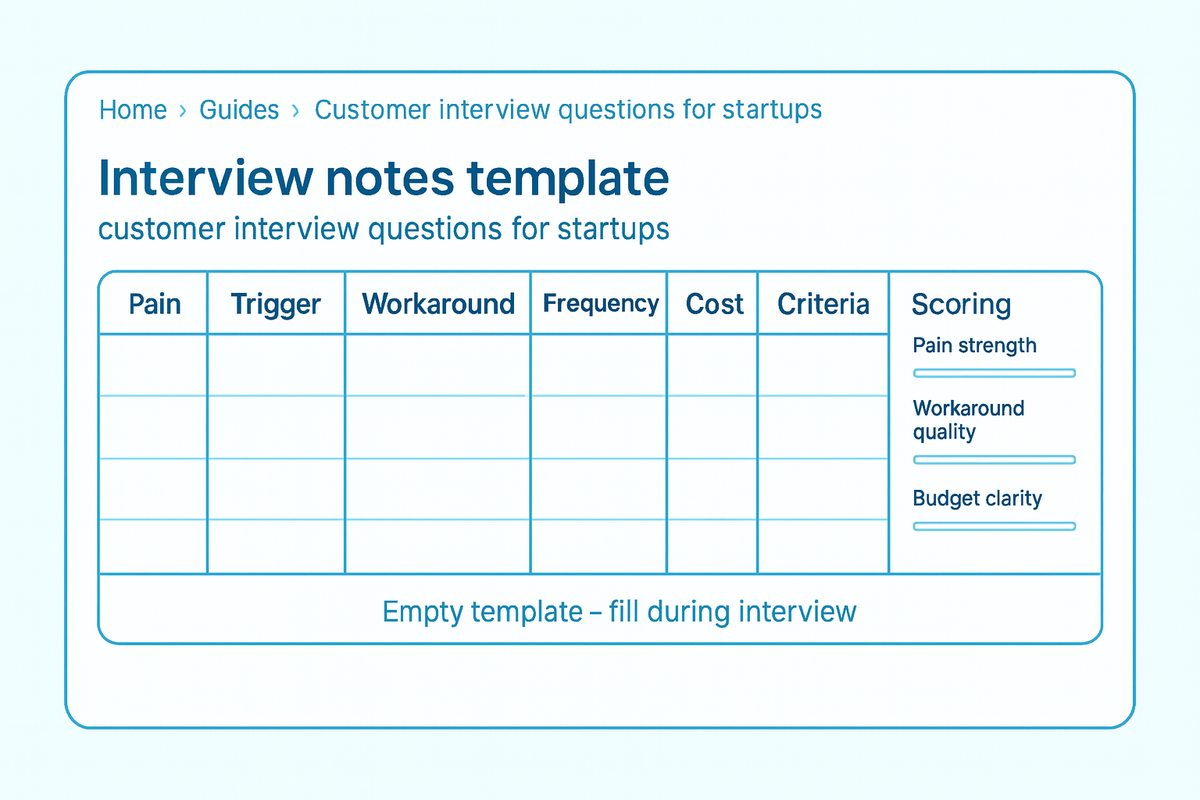
To keep this actionable and easy to read, log these specific fields for every piece of feedback:
Source: Who exactly said it? (e.g., Sarah, VP Sales, Design Partner)
Workflow Moment: What were they doing? (e.g., Exporting forecast data)
Raw Signal: What exactly happened or was said? (e.g., "We can’t use this unless it exports to Salesforce.")
Hypothesis Affected: Which core assumption does this test? (e.g., Pain-solution fit)
Severity: High, Medium, or Low?
Next Action: What do we do now? (e.g., Research alternative export methods)
Owner: Who is responsible? (e.g., Founder)
This manual logging ensures that when you see a pattern, you have exact context to make an informed decision, rather than guessing based on a dashboard. It is the kind of unscalable work that builds highly defensible products, similar to how Superhuman used manual onboarding as their biggest feature.
The Pilot Feedback Loop
Collecting the feedback is only the first half. You must close the loop visibly.
Capture: Manually observe onboarding and log source-level notes.
Classify: Map the raw signal against your pre-written hypotheses.
Decide: Treat missing features as signals to investigate, not commands to build.
Ship, Ignore, or Research: Make a decision based on the evidence.
Close the Loop: Update the customer.
By keeping the feedback tied to the source, you can return to the exact user with an update that makes them feel heard.
FAQ
How do we collect feedback that is not just customers being polite?
Stop asking "what do you think?" or "how do you like it?" because that produces polite lies. In pilots and early access, collect qualitative feedback by manually staying close to the first alpha customers, onboarding them yourself, and watching whether they get real value. Interview them around past behavior: what they did, why they did it, their workflow, context, and team.Should we use surveys to collect early feedback?
Surveys are useful for lightweight pulse checks, but they should not replace calls, direct onboarding observation, and source-level notes during the early pilot phase. Relying too heavily on passive surveys strips away the necessary context you need to build the right product, and risks causing survey fatigue.What do we do when a customer complains about a missing feature?
Celebrate it. Customer complaints about a missing feature indicate real customer interest. It proves they are picturing your product inside their actual workflow. It does not mean you automatically have to build the feature, but it is a strong signal that you need to investigate the underlying workflow friction.How often should early startups collect customer feedback?
Do not force a rigid calendar schedule. Early on, cadence should be driven by behavior. Collect feedback when the user hits a critical moment in their workflow, such as right after they complete their first major task, or when they stop logging in. Keep the feedback loop tight by observing them during onboarding and following up directly when their usage drops or spikes.