TL;DR: When a founder says they have no competitors, they usually just don't know the market. True customer understanding means ignoring polite feedback and feature requests to study past behavior. Finding the real need requires identifying the current workaround, the root pain, and the cost of the problem today.
Understanding customer needs means moving past what people say they want, and instead uncovering the root problems they are actively trying to solve.
When a founder pitches an idea and says, "We have no competitors," it sounds like confidence. Usually, it is a red flag. It means the founder does not know the market, which means they do not know the customer. They have not found the current workaround, the substitute, the budget owner, or the reason the customer tolerates the pain today.
If you are building from your own belief instead of real evidence, every new feature feels reasonable. You end up building a product for yourself. To build something people actually buy, you have to move past hypothetical ideas and find out what is already hurting the customer enough to make them act.
The Trap of Polite Lies
Founders often overcomplicate customer discovery by treating interviews as a way to collect opinions. They ask, "What do you think of this?" or "Would you use this feature?"
These questions force polite lies. People do not want to tell you your idea is bad, so they say they like it. That positive feedback feels great, but it is useless for building a business. If you want to validate an idea with interviews, you have to stop asking for opinions.
Instead, anchor your questions entirely in past behavior. Ask what they did, why they did it, and what pain forced the action. If a customer says they need a specific feature, do not just put it on the roadmap. Use it as a clue.
For example, a request for a PDF export button might not be about PDFs at all. The real story might be a manager spending Friday mornings copying numbers into a deck because they are afraid of looking unprepared in a meeting. The feature request is the symptom; the workplace anxiety is the root cause. When you understand the underlying job the customer is trying to do, you can build a better solution than a simple export button. This aligns with the Jobs-to-be-Done framework, which focuses on the progress a customer is trying to make in a given circumstance.
Practical Framework: A Worksheet for Root Cause Analysis
A feature request is a clue, not an instruction. When you hear one, you need to translate it into a testable hypothesis about customer pain.
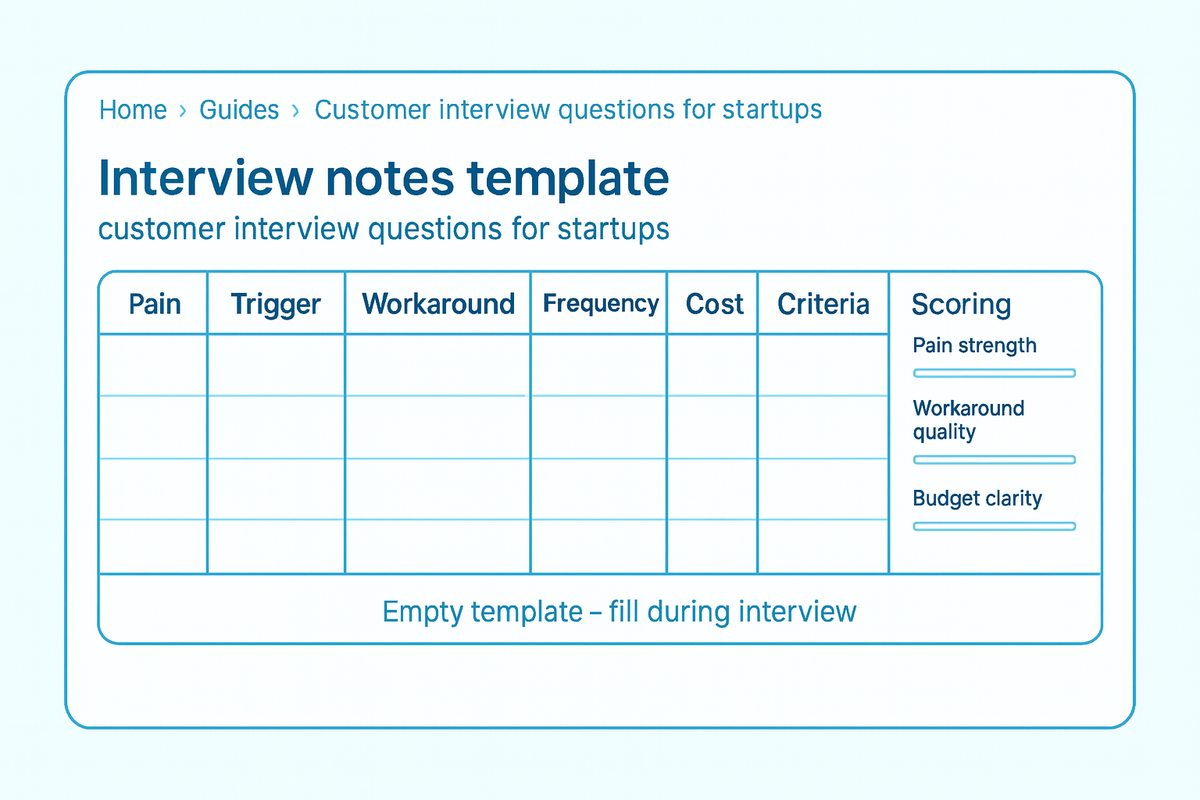
Use this worksheet structure during your B2B product discovery to move from a surface-level request to real evidence. Notice the "Commitment Signal" column — this is proof that the pain is real, showing what the customer is actually willing to sacrifice (time, money, or data) to solve it.
Example 1: Translating a "PDF Export" Request
Feature Request: "We need PDF exports."
Last Real Moment: "I spent two hours Friday copying data into a slide deck."
Root Pain: Fear of looking unprepared in the weekly review.
Current Workaround: Manual data entry and screenshots.
Cost/Risk: Wasted time and high stress.
Commitment Signal: Willing to pay for automated weekly digests.
Example 2: Translating an "AI Forecasting" Request
Feature Request: "We want an AI forecasting tool."
Last Real Moment: "We ran out of inventory last month and lost sales."
Root Pain: The emotional weight and financial cost of ordering mistakes.
Current Workaround: Checking bank balances and guessing.
Cost/Risk: Lost revenue and feeling like a failure.
Commitment Signal: Will provide past sales data to run a test model.
The Pattern Check
One loud customer asking for a feature does not equal a market need. Before you write code, pause product work and do direct qualitative discovery.
Talk to several potential customers or industry experts. Do not lead them to your solution. Let them explain their workflow. You are looking for a pattern check: trust the pain only when several people independently describe the exact same problem and workaround.
This approach works especially well during structural market shifts. In one case, a European B2B sustainability startup assumed large corporations were their primary target because of incoming ESG regulations. But by pausing to run market research, they found a much better, low-competition segment: consultants and green SMBs. These smaller companies did not have to report, but they wanted to for branding and mission reasons. The startup found this by understanding the market deeply, rather than just building what seemed obvious. You have to get out of the building and test your assumptions with real people.
Extract Objections, Don't Wait for Them
Do not assume customers will voluntarily offer objections or lay out their B2B value proposition for you. You have to extract the truth from them.
If they do not show any objections, it does not mean they do not have them. You have to dig into why they behaved a certain way in the past. Use frameworks like the Five Whys as a lightweight interview lens: start with the last real incident, then ask why the current workaround exists, and keep asking why until you hit the real cost or emotion driving the behavior. Remember that past behavior is the only reliable indicator of future actions, a core principle of The Mom Test.
FAQ
How do I understand what customers actually need instead of just collecting feature requests or polite feedback?
Stop asking whether they like the product. Instead, interview around past behavior: what they did, why they did it, and what pain forced the action. Treat a complaint about a missing feature as an unusually valuable signal, but dig into the root cause rather than just building the requested feature.
What is the difference between a customer need and a feature request?
A feature request is a specific solution the customer thinks will help (like a "PDF export button"). A customer need is the underlying problem they are trying to solve (like "avoiding embarrassment in weekly meetings"). Build for the need, not the request.
How do you identify customer pain points in B2B interviews?
Look for the messy workarounds. If a company is paying for multiple disjointed tools, spending hours on manual data entry, or risking compliance violations, you have found a real pain point.
How many customer interviews are enough to trust a pattern?
You have enough when you stop hearing new answers. Usually, if you interview several people in a specific segment and they all independently describe the exact same problem and workaround, you have found a pattern you can trust.