TL;DR: Founders often delay asking for money because the product is not finished, collecting cheap interest signals instead. True demand validation requires friction: asking buyers to give up money, time, or political capital. You can measure this through pre-product payments, analyzing past behavior, and manual alpha onboarding.
Demand validation proves that a target market will pay for a solution, rather than just showing passive interest in the idea. It separates polite encouragement from true purchasing intent by requiring the customer to commit money, time, or reputation before the product is built.
Founders often make a mistake early on: they delay the money conversation. They feel afraid to ask for payment because they have not proven the concept yet. So they build waitlists, run surveys, and book friendly calls instead.
People will give you polite encouragement for free. They will sign up for a waitlist and say they love your idea. But words do not matter. Willingness to pay money does. Until you ask someone to hand over their credit card, budget, or calendar, you have interest, not intent.
My team once ran a fake-door test where we charged money for a product that did not exist yet. The moment the card cleared, we immediately reversed the charge at the bank. We told buyers that capacity just ended, refunded them, and put them on a waitlist. It kept trust intact, and it proved with real money that people needed the solution. (Note: this is an extreme tactic. If you test like this, you must refund immediately and handle the communication carefully so you do not break trust or payment rules.) Everything before the card charge was interest. The charge itself was intent.
We saw the same lesson when a paywall went live on a beta product. Signups were steady when it was free, but acquisition flatlined the day the paywall appeared. We learned there are only two reads for early numbers: either the payment funnel is technically broken, or the apparent demand evaporates the moment the paywall becomes real.
Vision is good, but vision without traction is naive storytelling. Investors rarely take it seriously unless you are well connected. Across successful pitches I have reviewed, the winners usually carry proof of demand. That means signed letters of intent, lined-up demos, or actual revenue. Before you invest months into a build, compare your signals against established proof of demand benchmarks. You can also review Y Combinator's advice on product-market fit for a wider perspective on early traction.
Three Demand Validation Signals That Show Purchasing Intent
You do not need a finished product to test whether someone will buy it. You only need to introduce friction and see if the prospect is willing to cross it.
1. Ask for money before the product exists
It is not just okay to ask for payment when you have nothing yet; it is often the best way to prove real demand. In a B2B setting, you can pitch yourself as an outsourced engineering team. You offer to build a custom development solution for a fraction of the standard cost. If the prospect feels genuine pain and lacks internal resources, they will pay you. That validates the intent before you write any scalable code. This approach aligns with the principles in Steve Blank's customer development framework.
2. Study past behavior, not hypotheticals
Founders love asking customers, "What do you think of this?" or "Would you buy it?" That forces polite lies instead of actionable insights. Do not ask people to predict their future behavior. Study their past performance. Ask what they already bought, what they hacked together in spreadsheets, what they complained about, and what they budgeted for this year.
3. Run a manual alpha onboarding
You cannot validate demand with a scalable, hands-off process early on. Go to where your target customers already are, invite them manually, and onboard them yourself. A founder recently hoped manuals and videos would be enough for a new team to figure out a product. But early friction easily kills conversion for an unproven tool. You need to be highly available to watch them get actual value out of the thing. If they refuse to spend time on an onboarding call with you, the pain is likely not severe enough. As emphasized in The Mom Test, direct observation beats passive reporting.
Practical Framework: The Signal Scorecard
Use this table to separate soft signals from hard commitments.
Interest signal | Intent signal | What it proves | What it does not prove |
|---|---|---|---|
"Loved the idea" | Introduced you to procurement | They understand the concept | They have budget |
Joined a waitlist | Paid a deposit | They are willing to share contact info | They will actually buy |
Said a budget exists | Shared current workaround and cost | They recognize the problem | Your solution is the winner |
Booked a demo | Brought the real buyer to the next call | They want to learn more | They have authority to buy |
Where Founders Misread the Signal
Even when you look for the right signals, it is easy to misinterpret the results. Founders often treat every weak signal as a verdict on market demand, when it is usually a verdict on their own execution.
Silence is not agreement. Founders often assume objections will flow toward them naturally. They do not. You have to do the hard work of extracting objections from people. If a prospect does not show any pushback, it does not mean they agree with you. A call with no pushback is not intent; it is an unfinished interview.
A bad channel test is not proof of zero demand. A founder's strategic bottleneck is often channel expertise, not the product hypothesis. If you test your B2B idea through LinkedIn cold outreach and get zero replies, you might conclude the market is dead. But testing in a channel you do not know mostly teaches you that you do not know the channel. You have to learn the distribution method before you can trust the demand read.
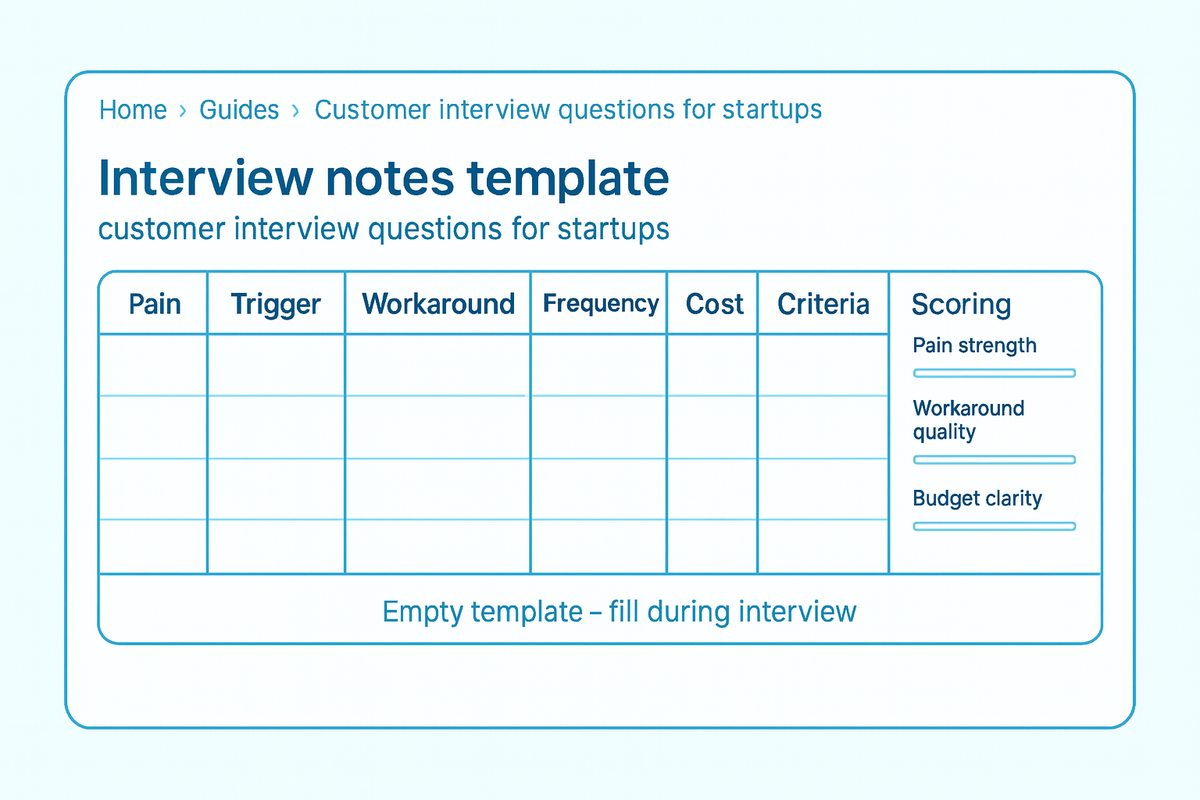
Existence of an edge case is not a market. You might confirm that a specific problem exists, like users struggling with obscure document formats. But you still have to validate whether that capability is broad enough by checking how often users hit those nonstandard cases, and how costly those failures are. Confirming the pain exists is only half the job; you must size the frequency and the cost.
Zero response is still data. Sometimes you launch a free webinar around your proposed value proposition and nobody signs up. Founders blame the marketing funnel. But if nobody even registers for a free event about the topic, the problem may be a complete lack of interest in the problem itself. That is a different issue, but it is a highly useful signal.
FAQ
What is the difference between demand validation and market validation?
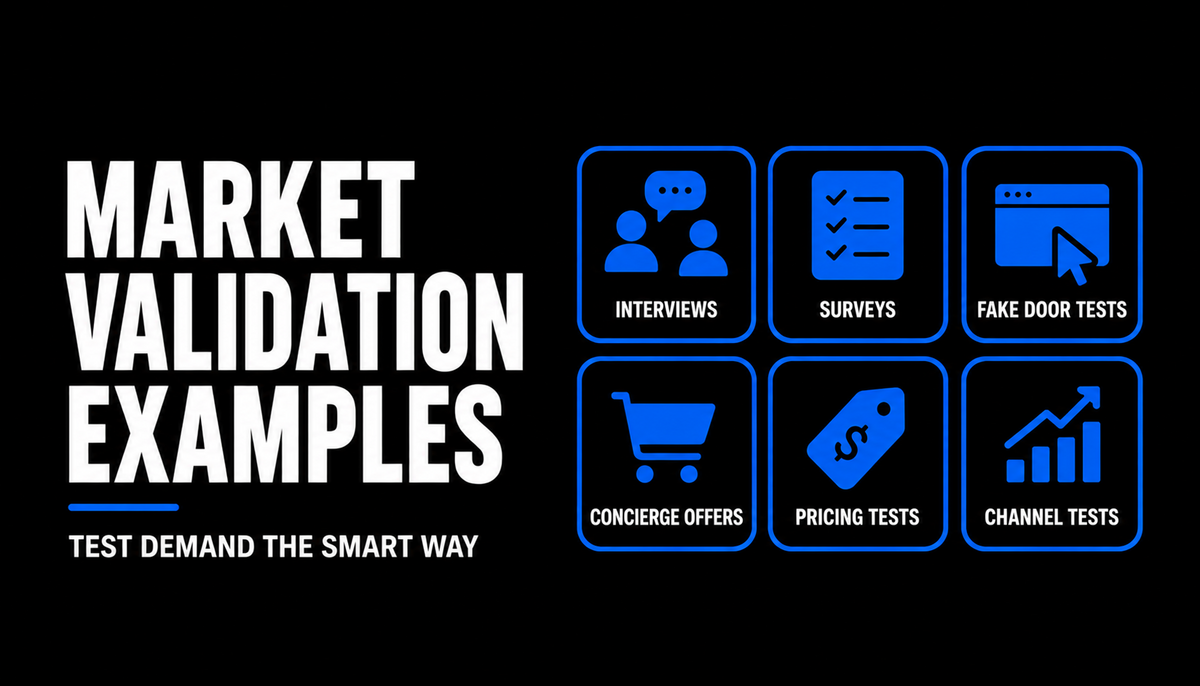
Market validation proves that a problem exists and a group of people care about it. Demand validation proves those people will actually pay for your specific solution. A market validation survey might show a large audience has the problem, but only a payment or a time commitment validates the demand.
What are weak demand validation signals?
Weak signals cost the user nothing. These include joining a waitlist, saying they love the idea on a call, booking a casual demo without the decision maker, or answering a hypothetical question about future purchases.
Can I ask for money before I have a product?
Yes. For B2B products, frame the early offer as custom development or an outsourced engineering project. You solve their problem manually for a fraction of the cost they would spend building it internally. If they refuse to pay for a manual fix, they probably will not pay for software.
How many customers do I need to talk to for validation?
There is no fixed number. The goal is to reach a point where you stop hearing new objections and start seeing consistent past behavior patterns. Focus on the quality of the friction they are willing to cross, rather than the raw number of polite conversations.
What should I do if a prospect complains about a missing feature?
Celebrate it. In most cases, customers simply do not care about the features you think they do. If they take the time to complain that a specific feature is missing, it shows they actually care about the workflow. It is a strong positive signal.