TL;DR: Early enterprise sales calls rarely fail on price alone; more often, they stall on career risk. A corporate buyer worries about looking foolish if your startup folds, leaks company data, or burns internal goodwill. Instead of defending roadmaps or reciting pitch decks, uncover private doubts before the call ends. Resolve those doubts with structural terms: phased rollouts, data export guarantees, and bounded pilot agreements that limit buyer downside.
To handle early stage sales objections, founders must uncover the unvoiced risk behind polite stalls, identify whether pushback stems from company viability, security, product gaps, or timing, and offer a bounded de-risking step. Rather than arguing features, protect the buyer's standing with phased pilots, clear rollback terms, and explicit data protections.
The Minute-28 Stall: Why Polite Calls Fail
It is minute 28 of a 30-minute product demonstration.
The prospect nodded through your slides, asked no difficult questions, and smiled at your workflow diagrams. Then they deliver the familiar closing line: “This looks promising. Send over the deck and pricing sheet. We need to think about this internally.”
Founders often leave these calls feeling encouraged. They log the deal as an active opportunity and mark the demo as a win. In reality, the deal is drifting.
When a corporate buyer says they need to think about it, they are usually finding a polite exit. Prospects rarely volunteer their real objections on a live call. They keep hesitations private, thank you for your time, and let those doubts kill momentum the minute you hang up.
If an objection stays private, it decides the deal after the call ends. A stall at this point rarely means the buyer needs more time to read your deck. It means an unvoiced risk remains unaddressed, which explains why B2B sales stall after a demo even when the product appears to solve their problem.
Why Early Stage Sales Objections Stem from Career Risk
To resolve early pushback, you need to understand what corporate buyers actually protect.
An enterprise buyer rarely buys software to help an early-stage startup succeed. They buy software to solve a problem without endangering their own standing inside the company. The old purchasing adage still holds true: nobody gets fired for buying established incumbents. A department lead can face severe internal blame if an unproven vendor loses customer records, fails an audit, or runs out of cash mid-deployment.
Enterprise procurement teams run formal evaluations known as vendor risk management because working with unproven vendors exposes the firm to operational disruption. When data shows that running out of cash is a primary driver in why startups fail, buyers evaluate their personal exposure. When a buyer asks about your team size, balance sheet, or hosting setup, they are evaluating that exposure.
This dynamic changes objection handling. Standard sales tactics teach founders to counter objections with persuasion, feature comparisons, and urgency plays. In early-stage enterprise sales, defensive rebuttals backfire. If a buyer worries about stability, arguing with them will not make them feel safer. You must distinguish retail rebuttals from startup risk mitigation, as outlined in our guide to sales objection scripts and de-risking.
You do not ask an enterprise champion to trust your distant future. You give them commercial terms and technical structures that limit their downside today.
In the earliest stages, objection handling belongs directly with founders. You cannot delegate this work to an early sales hire. Before hiring an account executive, you must hear how cautious buyers describe their hesitation in their own words. Delegating before you understand these patterns creates pipeline noise, a core reason to review the timing of your first sales hire versus founder-led sales. Learning the customer's real hesitation firsthand is the backbone of any working founder-led sales process.
The Four Root Categories of Pushback
Most pushback in early founder-led sales falls into four distinct categories. While the exact wording changes across industries, the underlying risk profiles stay consistent.
Category | Core Buyer Question | Root Risk |
|---|---|---|
Startup Viability | “Will you exist in 12 months?” | Operational continuity and orphaned data |
Security & Compliance | “Will you pass our audit?” | Data exposure and regulatory liability |
Missing Features | “Will this break current workflows?” | Shelfware and internal adoption failure |
Budget Priority | “Why do this right now?” | Resource distraction during existing projects |
1. Startup Viability (“Will you be around in twelve months?”)
What the buyer says: “We generally work with vendors that have at least three years of operating history and twenty enterprise accounts.”
What they fear: If your company shuts down in nine months, they must explain an abandoned rollout to executive leadership, clean up fragmented data, and restart procurement from scratch.
The wrong response: Boasting about venture backing, naming angel investors, or promising a Series A round is coming soon. Outside capital does not protect a buyer from an orphaned workflow.
The founder response principle: Provide operational transparency and an easy exit path. Show them exactly how their data remains safe, how they can export it independently, and how they can roll back without penalty if priorities change.
2. Security and Compliance (“You don't have SOC 2 Type II”)
What the buyer says: “Our security team blocks any vendor handling company data without completed SOC 2 and ISO certifications.”
What they fear: A data breach or a failed internal compliance audit that points straight back to their vendor selection.
The wrong response: Claiming an audit is “almost done” when you have barely scheduled it, or pretending your cloud host's compliance automatically covers your application layer.
The founder response principle: Offer isolation and architectural boundaries. While formal frameworks like the AICPA SOC suite and supply chain standards from NIST SP 800-161 establish long-term trust, you can protect early pilots through zero-data-retention modes, client-side encryption, and dedicated sandbox environments.
3. Product and Integration Gaps (“You lack a native integration”)
What the buyer says: “We cannot evaluate this tool until you have a native, bi-directional sync with our legacy ERP.”
What they fear: The tool will create another manual data silo. Their team will ignore the product, leaving the buyer holding an unused subscription.
The wrong response: Promising you can build the integration over the weekend. Rushed engineering promises signal instability rather than competence.
The founder response principle: Separate essential requirements from generic checklist requests. Examine their historical behavior: “When was the last time an integration gap caused a rollout to stall on your team?” If the requirement is genuine, tie the build to a committed purchase milestone.
4. Budget Priority and Timing (“Not a priority this quarter”)
What the buyer says: “We like the concept, but tooling purchases are frozen until our cloud migration finishes in Q4.”
What they fear: Taking on change management that distracts their team from existing commitments. Enterprise buyers often choose the status quo simply to reduce internal coordination friction.
The wrong response: Offering an unprompted 30% discount to force a signature before month-end. Slashing price does not reduce the internal effort required to deploy software.
The founder response principle: Anchor the problem to an existing priority. If their engineering hours are currently tied up in a cloud migration, determine whether your tool speeds up that exact project or prevents costly rework. If it does not, agree on a concrete event trigger to reopen the conversation rather than sending weekly check-in emails.
Early Stage Objection Triage Matrix
Use this matrix to identify what the prospect is protecting, how to structure your reply, and which artifact removes the fear.
Objection Category | Buyer Fear | Founder Response Principle | De-Risking Asset |
|---|---|---|---|
Startup Viability | Career fallout if the vendor shuts down, leaving orphaned data and wasted team effort. | Offer structural transparency and bounded commercial commitments instead of venture credentials. | 60-day pilot exit terms, raw data export guarantees, and source code escrow provisions. |
Security & Compliance | Audit failure or data exposure caused by unvetted third-party software. | Isolate the technical footprint; document architecture and data boundaries honestly. | Architecture whitepaper, third-party pen-test summary, and zero-retention data flow diagrams. |
Missing Features | Internal shelfware; team frustration caused by incomplete workflows or missing connectors. | Interrogate past deployment history to verify blockers; bind missing builds to commercial milestones. | Scoped product roadmap with delivery criteria tied to a conditional purchase contract. |
Budget Priority | Internal blame for taking on distracting change management during active projects. | Connect the cost of inaction directly to the project they are already trying to complete. | Cost-of-delay calculation sheet and milestone-triggered pilot schedule. |
The Call-End Checkpoint: Stop Leaving Deals in Limbo
The most critical moment in founder-led sales occurs in the final five minutes of a call.
Most founders let prospects leave the conversation with vague pleasantries. They hear “we need to discuss this internally” and accept it as a normal step. This is a mistake. A vague deferral usually means the prospect is holding an unspoken objection that will kill the deal once the call ends.
You must actively surface hidden doubts while you still have the buyer on the line.
Step 1: Surface the Hidden Concern
When a prospect says they need to think about it, acknowledge the statement without accepting the brush-off. Ask a direct question that gives them permission to be candid:
“Usually, when someone says they need to think about a tool like this, it means there is an integration hurdle, a security requirement, or an internal priority conflict we haven't touched on yet. What is the biggest hesitation you would have to defend if you brought this to your team today?”
This question shifts the conversation from polite evaluation to operational reality. If the buyer has a real concern about data retention or team bandwidth, they will usually share it once you show you can handle the answer.
Step 2: Name the Decision Owner
If an objection surfaces, establish who owns the requirement inside their company:
“If we solve that data isolation question, who on the security team needs to verify the architecture before you can test this in a sandbox?”
Avoid accepting an amorphous “we.” Enterprise decisions are made by individuals who carry specific responsibilities. You need the name and role of the person whose sign-off determines the next step.
Step 3: Agree on a Concrete Operational Step
Do not end the call on an open-ended promise to review materials. A call should produce one of two outcomes: a calendar-scheduled next meeting with a clear agenda, or a signed commercial agreement.
Acceptable next step: A 30-minute security review scheduled for next Thursday with their lead infrastructure engineer.
Acceptable next step: A signed pilot agreement covering a defined 30-day evaluation.
Unacceptable next step: “I'll review the deck and reach back out if it makes sense.”
Step 4: Triage the Pipeline
If a prospect refuses to schedule a specific next step and insists on thinking it over privately, do not record that deal as an active lead.
Treat the objection as unresolved and the opportunity as unsold. You can still send a concise recap note outlining the terms discussed, but you should not count on the deal closing. Remove the optimistic revenue from your forecast and turn your attention to buyers willing to engage in honest evaluation.
Neutralizing Viability with a Bounded Agreement
When facing vendor viability pushback, your strongest commercial tool is a bounded pilot structure, rather than a price discount.
Rather than asking an enterprise company to sign a master services contract immediately, offer a structured framework that answers one specific question by a defined date. This approach changes an intimidating corporate procurement process into a controlled experiment.
Pilot Dimension | Traditional Contract Approach | Bounded Pilot Structure |
|---|---|---|
Deployment Boundary | Broad company-wide deployment | Single team, 5 seats, or staging sandbox |
Success Metric | Open-ended feature evaluation | One measurable outcome (e.g., cut report generation time by 75%) |
Timeline | Indefinite annual commitment | 30 to 60 days total with set review milestones |
Exit Path | Complex cancellation clauses | Guaranteed raw data export and zero renewal penalties |
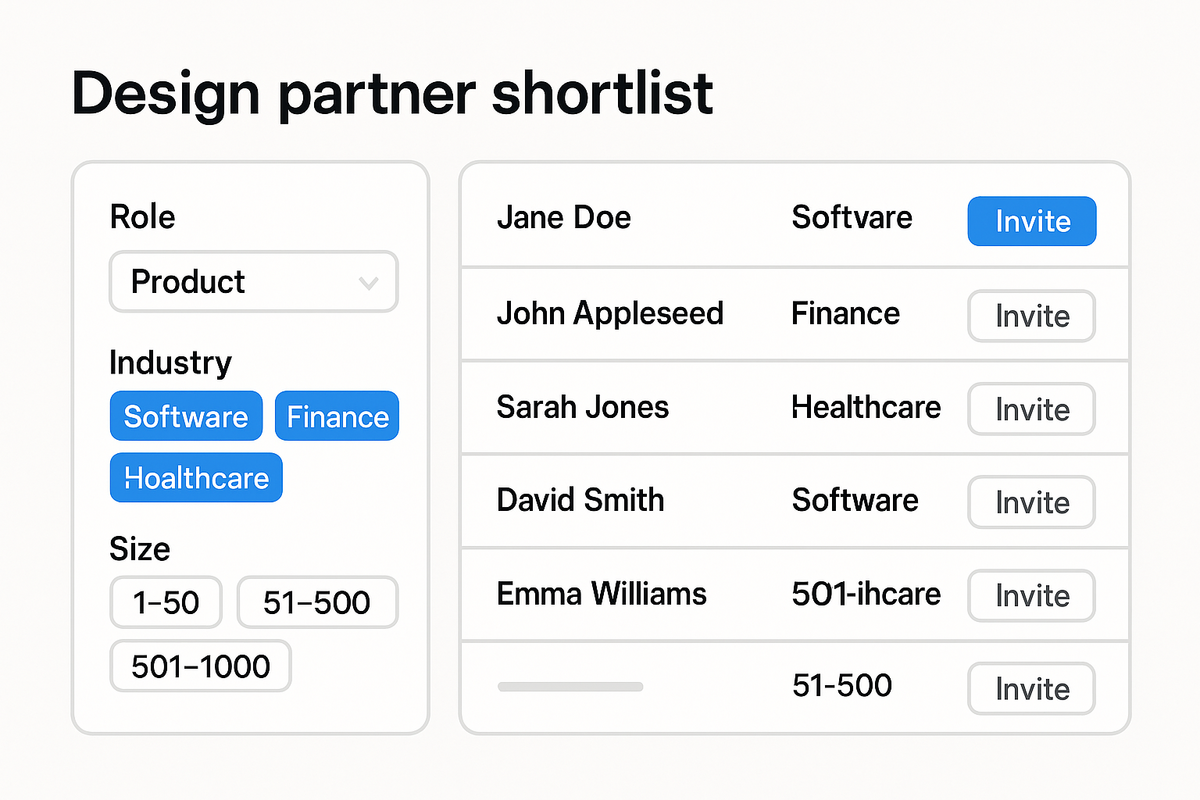
You capture these terms using a structured legal document rather than a handshake. By structuring a design partner MOU, you give enterprise champions a formal asset they can present to legal and procurement teams. The document proves that downside risk is strictly contained, making it safe for the champion to sponsor your rollout.
FAQ
If a prospect raises no objections during a demo, is that a good sign?
No. In early founder-led sales, silence during a demonstration is usually a warning sign. When an enterprise buyer is seriously evaluating software for production, they test its boundaries. They ask how it handles edge cases, where audit logs live, how permissions work, and how it interacts with legacy systems. A buyer who smiles, asks zero difficult questions, and praises the interface is often showing polite disinterest. Instead of asking speculative questions like “How do you like this?”, ask about their past behavior: “When was the last time you bought a tool in this category, and what caused the rollout to succeed or stall?” Past behavior reveals true evaluation criteria far better than opinions about your demo.
Should founders offer a price discount to overcome vendor viability objections?
No. Cutting your price when a prospect questions your viability reinforces their concern. A price cut does not make an unstable startup more reliable. If a buyer worries that you might shut down in six months, saving $4.000 on an annual subscription does not reduce their career risk. If anything, steep unprompted discounts suggest cash flow distress, which heightens concerns about company longevity. Keep your pricing intact. Resolve viability concerns using commercial terms: short initial pilot commitments, clear rollback procedures, and guaranteed data export agreements.
How do you handle missing feature requests without overcommitting engineering time?
Separate nice-to-have requests from genuine rollout blockers by looking at existing workflows. Ask the buyer how their team handles the task today without your software. If they currently manage the problem using a basic spreadsheet or manual script, the feature is rarely an immediate blocker. If the missing integration or feature is an absolute requirement for deployment, do not promise to build it over the weekend. Instead, offer a mutual commitment: draft an agreement stating that if you deliver that specific capability according to written specifications by an agreed date, they commit to initiating an evaluation or commercial pilot on day 60. If they refuse that trade, the feature request was merely an excuse to avoid saying no.