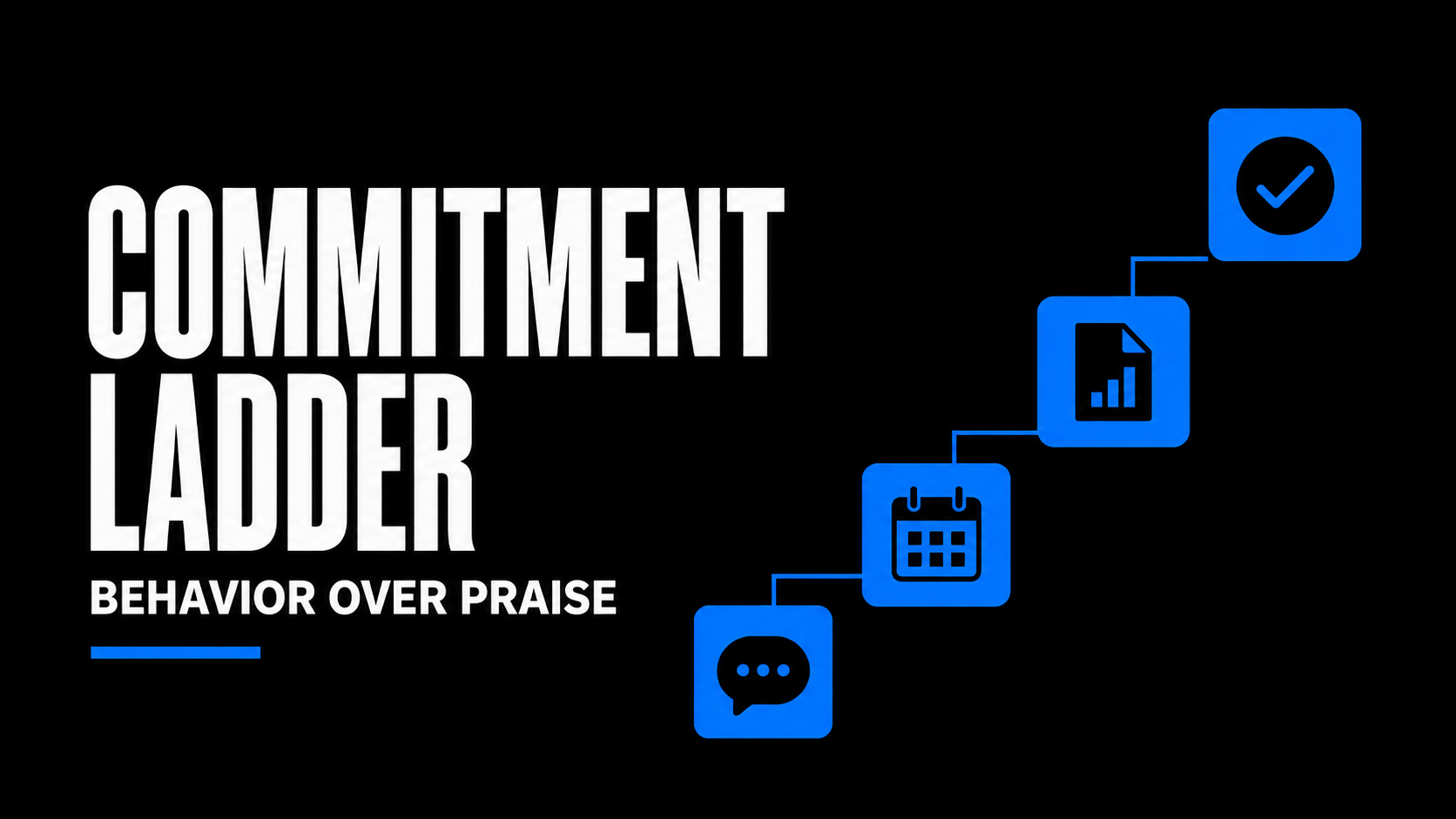
Early customer commitment is not the same as enthusiasm. A prospect can love the demo, praise the idea, and still never buy, pilot, or introduce you to anyone with authority. The useful question is: did this conversation create evidence, urgency, and next-step accountability, or did it only create compliments?
TL;DR: Treat commitment as behavior, not sentiment
The strongest first customer commitment signals are actions that cost the prospect time, access, reputation, budget, or internal effort. Use this guide to decide which prospects deserve more build time, sales effort, pilot design, or design partner follow-up.
Weak interest sounds positive but requires little from the prospect: praise, curiosity, feature ideas, and vague future intent.
Strong commitment creates friction for the buyer: stakeholder access, data sharing, budget discussion, timeline pressure, security review, procurement steps, or executive sponsorship.
The mistake to avoid is treating discovery validation as commercial proof before the prospect has taken a concrete next step.
Read this as a signal ladder. Move prospects up only when they do something observable.
Commitment signal ladder
Use this ladder after every discovery call, demo, pilot discussion, or design partner conversation. The goal is not to force every prospect into a sales process. The goal is to stop confusing polite interest with evidence that deserves scarce founder time.
1. Start with proof of pain before proof of purchase
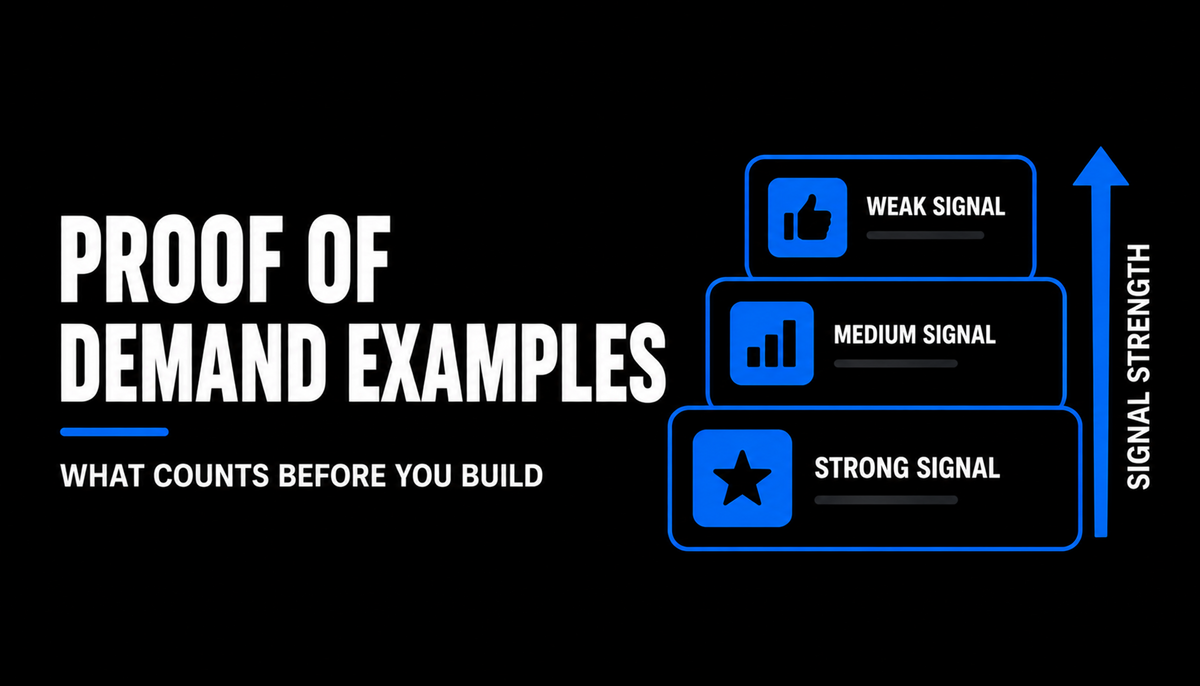
Before you judge commitment, make sure the problem itself is real. A useful first-customer conversation should show that the prospect has a costly, frequent, urgent, or strategically important problem. The U.S. Small Business Administration frames market research as a way to understand customers and validate opportunity before committing resources (SBA market research guide). If you have not separated problem evidence from buying behavior yet, start with proof of demand and compare your notes against concrete proof of demand examples.
A prospect is not commercially qualified just because they describe a painful workflow. They become more interesting when they also act like solving that workflow matters now.
2. Score the conversation on the signal ladder
Level | Signal type | What it looks like | Founder read |
|---|---|---|---|
1 | Polite interest | "This is interesting" or "Keep me posted." | Weak. No next step, cost, or urgency. |
2 | Problem confirmation | They describe a painful current workflow or workaround. | Useful discovery evidence, but not yet buying behavior. |
3 | Time commitment | They book a follow-up, bring a teammate, or agree to a working session. | Moderate. They are spending time to keep evaluating. |
4 | Access commitment | They introduce a decision-maker, user group, technical owner, or budget holder. | Stronger. They are risking some internal credibility. |
5 | Operational commitment | They share data, workflows, requirements, security constraints, or success criteria. | Strong. They are helping define a real implementation path. |
6 | Commercial commitment | They discuss budget, timeline, procurement, legal, pilot scope, or executive sponsorship. | Strongest. They are behaving like a buyer, not just a listener. |
Do not skip levels in your interpretation. A founder can use a founder demo script to create a cleaner conversation, but the demo itself is not the signal. The prospect's behavior after the demo is the signal.
3. Look for the six buying behaviors that matter most
Stakeholder access: A serious prospect helps you meet the people who will use, approve, block, integrate, or fund the product. If they refuse all internal access, treat the opportunity as early or politically weak until new evidence appears.
Budget discussion: You do not need a perfect price on the first call, but you do need to learn whether the buyer has a budget owner, budget category, or replacement cost. Budget silence is not fatal; budget avoidance after multiple useful conversations is a warning.
Timeline pressure: Strong prospects can explain why now matters. The trigger may be a renewal, launch, audit, hiring plan, customer commitment, board priority, compliance deadline, or operational bottleneck.
Data sharing: A prospect who shares sample data, workflow screenshots, process docs, success metrics, or anonymized examples is giving you implementation evidence. That is usually more meaningful than generic praise.
Procurement movement: Security questionnaires, vendor setup, legal review, finance routing, compliance checks, and purchase-order steps are tedious, but they can be real signs that the opportunity has entered the buyer's operating system. Treat procurement as a signal only when it follows a clear business owner and use case.
Executive sponsorship: Executive support matters when the buyer needs budget, cross-functional cooperation, or process change. It does not have to mean the CEO is on every call. It means someone with authority is willing to attach their name to the project.
This behavior-first approach fits the customer development idea that founders learn by testing assumptions with customers, not by relying only on internal conviction or polite feedback (Steve Blank customer development).
4. Use a small false-signal filter
False signal | Why founders overvalue it | Better test |
|---|---|---|
"This is cool" | It feels like validation after a hard build cycle. | Ask what would need to happen before they could use it. |
Feature requests | They sound like product direction. | Ask whether solving that feature would trigger a pilot or purchase step. |
Long friendly calls | Time feels like commitment. | Ask for a concrete follow-up with another stakeholder or real workflow artifact. |
Logo excitement | A known company creates emotional pull. | Score the person, use case, urgency, and buying path, not the logo. |
Verbal pilot interest | "Pilot" sounds commercial. | Define scope, dates, success criteria, owner, and paid or unpaid status. |
5. Ask questions that convert interest into evidence
Use these prompts when a prospect sounds interested but has not yet created a real next step:
"Who else would need to care about this before it could move forward?"
"What happens internally if this problem is still unsolved three months from now?"
"Is there an existing budget, tool, contractor, or manual process this would replace?"
"What would make a pilot worth the team's time?"
"What data, workflow, or sample case could we use to test whether this works?"
"If the pilot worked, what would the next buying step be?"
For design partner conversations, keep the bar higher than curiosity. A real design partner should have a painful problem, relevant access, a willingness to give feedback, and some plausible path to commercial value.
6. Decide what to do next
Use this decision rule after the call:
If the prospect only gave praise, put them in nurture and avoid building for them yet.
If they confirmed a painful problem but avoided next steps, run more discovery before pitching a pilot.
If they gave stakeholder access or shared operational context, invest in a tailored follow-up.
If they discussed timeline, budget, procurement, or executive ownership, move toward a pilot or commercial proposal.
If they want to try the product but cannot define success, scope the pilot before you build more.
This is where first customer work connects to beta and pilot strategy. Beta customers can help you learn, but not every beta user is a buyer. Pilot customers should create a clearer commercial path: problem, owner, scope, timeline, success criteria, and next step.
7. Keep one simple commitment note per prospect
After each meaningful conversation, write four lines:
Strongest signal observed:
Missing signal:
Next action owned by prospect:
Decision: nurture, discover, demo, pilot, design partner, or disqualify:
This reduces the chance that founder optimism rewrites the call afterward. It also gives you a clean way to compare prospects without pretending early sales is more precise than it is.
Illustrative prioritization example: if you have 12 active prospects and only 3 have introduced another stakeholder, shared workflow details, and agreed to a dated follow-up, prioritize those 3 for custom pilot work. Put the other 9 into lighter follow-up until they create a concrete commitment signal. This is prioritization math, not a conversion benchmark.
Will first customer commitment signals actually get you to first customers?
Commitment signals will not manufacture demand. They help you see which conversations are creating commercial evidence and which ones are only making the founder feel encouraged. The real value is prioritization: spend your limited build and sales energy on prospects who create urgency, access, and accountability.
The tactic breaks when founders turn it into a rigid scoring game. Early markets are messy, and some buyers move slowly for valid reasons. Use the ladder as a judgment tool, not as an excuse to ignore context, relationship quality, or strategic learning.
The founder mistake to avoid is building for the loudest interested person instead of the most committed buyer. A serious first customer does not just admire the product. They help you understand the buying path, expose the constraints, involve the right people, and make the next step real.
FAQ
Is a verbal yes a real customer commitment signal?
Not by itself. A verbal yes becomes more meaningful when it is paired with a dated next step, stakeholder access, budget discussion, pilot scope, procurement movement, or shared success criteria.
What is a strong early customer commitment signal before payment?
A strong pre-payment pattern is internal access plus operational effort plus a commercial next step. For example, a prospect introduces the budget owner, shares workflow data, agrees on pilot success criteria, and starts vendor or security review.
Should I ignore prospects who are interested but not ready to buy?
No. Keep them in a lighter follow-up path, especially if they teach you something useful about the market. Just do not let low-commitment interest consume the same founder time as a prospect who is actively creating buying evidence.
How do I tell whether a design partner is serious?
A serious design partner has a painful use case, gives you access to real users or stakeholders, commits to feedback, helps define success, and has a plausible path to adoption. Curiosity alone is not enough.
![Founder demo script: 30‑minute agenda that converts [Guides]](/tild3937-3366-4131-b635-333834326161__30-min-founder-demo.png)