What is competitor analysis for startups? It is the process of evaluating what competes for your target customer's budget, attention, and current habits. For founders, the useful version is not a giant feature list. It is a focused read on competitor positioning, target audience, assumptions, and weaknesses so you can find a sharper offer.
TL;DR
Skip the overbuilt feature matrix unless it answers a real strategic question.
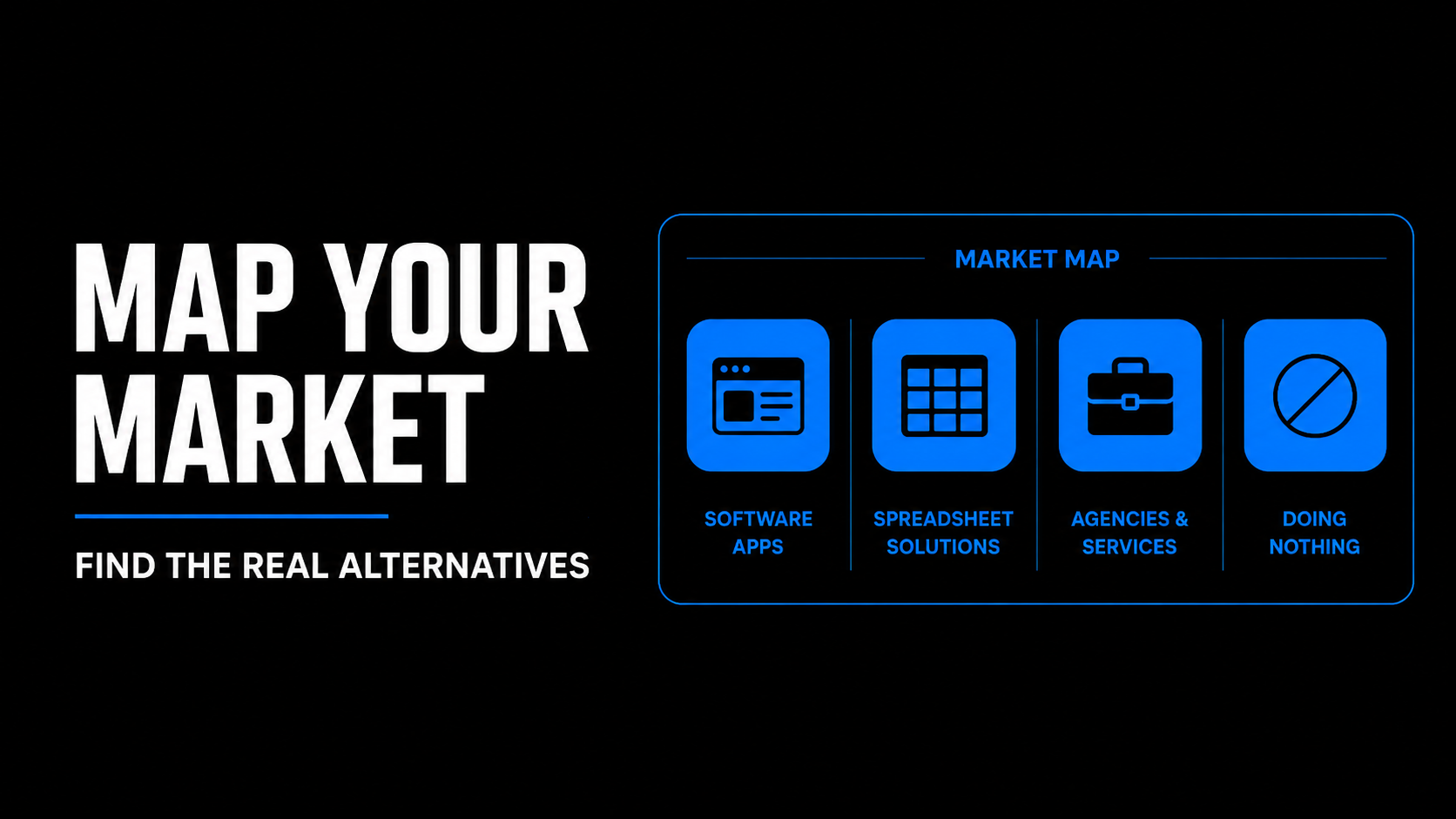
Your real competition may be a spreadsheet, an assistant, an agency, or doing nothing.
Start with hypotheses about what you need to learn before you open competitor sites.
Compare competitors by positioning, audience, and weaknesses, not just features.
Use the gap you find to sharpen your offer, landing page, proof points, and traction channel choices.
If you want to know how to analyze competitors without getting buried in noise, start with where founders usually lose time. A founder spends weeks building a color-coded spreadsheet of pricing tiers, integrations, mobile apps, export formats, and new add-ons.
Then discovery calls reveal the real issue: the buyer is not choosing between those polished software tools. They are using a messy spreadsheet, texting an assistant, outsourcing the task, or ignoring the problem.
That is why competitor analysis for startups needs to include substitutes. A social app may compete for attention with entertainment options outside its direct category. A meal planning product may lose to delivery apps, grocery routines, or the user's existing habit of deciding at the last minute. The question is not only "Who has the same feature set?" It is "What already owns this behavior?"
Stop the feature parity trap
When competitor analysis becomes a feature audit, the conclusion is usually predictable: "We need to build features X, Y, and Z to catch up." Sometimes that is true. More often, it pushes a young company toward a generic roadmap.
Features matter, but they are secondary to the customer truth behind them. You need to identify who competitors serve, what pain they assume the buyer has, what they avoid, and where their model breaks down.
The Jobs to Be Done framework is useful here because it treats products as things customers hire for progress. That lens can make non-obvious substitutes easier to see. If your analysis does not help you change your positioning, offer, or landing page, it is probably just a spreadsheet.
Start with hypotheses
Before you open a competitor's website, write down what you need to learn. Competitor analysis does not replace customer discovery; it gives your discovery sharper questions.
Ask:
Who is underserved by the current options?
What pain do competitors seem to assume the user has?
Where does the incumbent's offer break down?
What alternative does the buyer use when they avoid buying software?
Y Combinator's startup advice emphasizes talking to users and learning quickly. Use competitor research the same way: as a way to generate better questions, not as a reason to stay in desk research.
Once you have hypotheses, use voice of the customer interview questions to test what the market actually values in the buyer's words.
How to analyze competitors: a 4-step framework
Instead of a feature grid, build a positioning grid. The core question is simple: what would customers do if your product disappeared tomorrow?
1. Form your hypotheses
Define what you believe competitors misunderstand about the customer. Write down your assumptions about their target audience, the pain they emphasize, and the pain they avoid.
2. Map the alternatives
List what competes for the buyer's budget, time, and behavior. Include more than direct software tools.
Direct competitors: Who solves the same problem for the same buyer?
Indirect competitors: Who solves a related problem that could absorb the same budget?
Substitutes: What manual workaround, spreadsheet, agency, or internal process does the customer use instead?
Status quo: What happens if the buyer does nothing?
3. Analyze positioning and weaknesses
Read competitor pages for assumptions, not just claims. If a competitor emphasizes dozens of integrations, they may believe the main pain is connectivity. Your hypothesis might be that the deeper pain is setup complexity. If an incumbent keeps moving downmarket, your opportunity may be a narrower premium segment that cares more about reliability, support, or risk reduction.
4. Adjust your landing page and offer
Translate the gap into a positioning angle, then use it to establish proof of demand. The output should change what you say, who you say it to, and what proof you show.
Competitor signal | Possible positioning angle | Offer or proof change |
|---|---|---|
Competitors promote more templates. | Buyers may want one confident final result. | Test proof around faster completion or fewer decisions. |
Incumbents focus on enterprise features. | A smaller segment may feel ignored. | Show use cases for lean teams and simpler rollout. |
Competitors promise aggressive revenue lifts. | Skeptical buyers may distrust big claims. | Use process proof, time saved, or customer quotes instead. |
When to walk away
Competitor analysis should not be used to rationalize a weak market. If research points to low demand, high acquisition costs, or broken economics, positioning alone may not fix the business.
CB Insights has reported recurring startup failure patterns, including demand and business model problems. Treat that as a warning label: if the economics do not work in your initial segment, consider changing the segment or market instead of forcing the analysis to defend your original plan.
FAQ
Why is competitor analysis important for startups?
It helps you identify market gaps and refine your positioning. Without it, you can drift into building a copycat product and competing on feature count instead of customer insight.
What should a startup include in competitor analysis?
Include target audiences, positioning, pricing model, customer pain assumptions, messaging weaknesses, direct competitors, indirect competitors, substitutes, and the status quo.
Do we have a competitor insight, or are we just listing features they already ship?
You have an insight when it changes your hypothesis about the customer. A feature list says what competitors built. A real insight explains what they believe about the buyer and where that belief may be wrong.
Should we ignore competitor features?
No. Review features, but use them as clues. Ask what each feature says about the competitor's customer assumptions, then test whether those assumptions match what buyers tell you.
What if our biggest competitor is a spreadsheet?
That is useful information. Your positioning should probably focus on the cost of manual work, errors, delays, or coordination pain instead of comparing yourself only to other software tools.
The practical next step is to write one competitor hypothesis, test it in customer conversations, and update one part of your offer or landing page based on what you learn. Then choose the traction channel where underserved buyers already search, ask, or compare alternatives. If the research does not change your message, segment, proof, or channel priority, keep digging.